
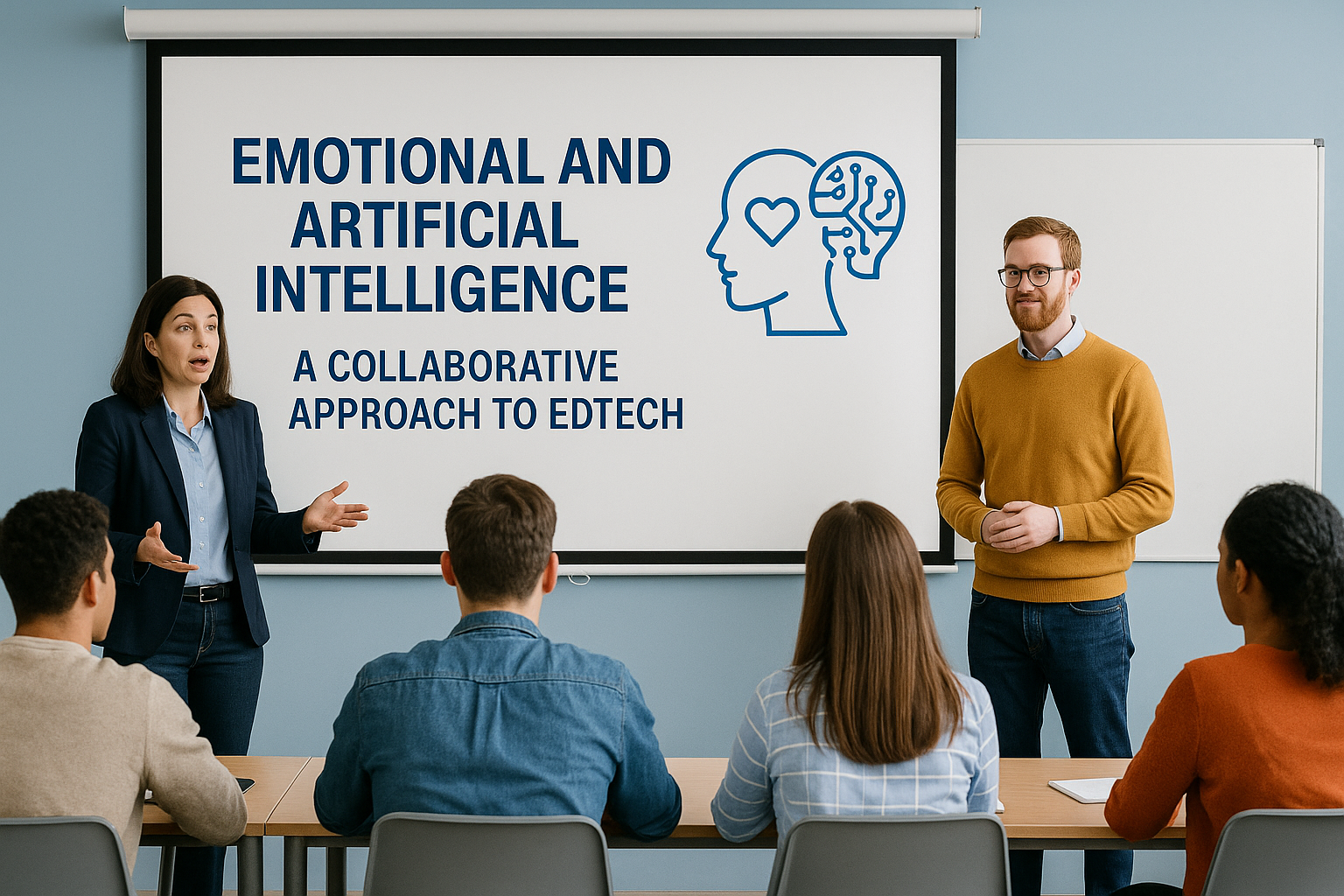
Emotional intelligence helps students notice emotions and manage reactions. It also helps them understand other people and make thoughtful choices. Those skills matter in a startup. A founder may need to hear hard feedback, work through doubt, and speak with care.
Artificial intelligence can support parts of that learning process. It can prompt reflection, help organize feedback, or offer another way to practice a conversation. It cannot know a student’s inner state, replace a trusted educator, or make a sound mental health judgment.
What “emotionally intelligent AI” should mean in education
The phrase can create the wrong impression. Software does not experience empathy. Some systems may infer patterns from language, voice, or behavior, but an inference is not a fact about how a person feels.
For educators, a safer definition is simple: AI is used to support human reflection and communication, while people remain responsible for interpretation and care.
Good uses may include:
- generating a role-play for a difficult customer conversation;
- asking a student to consider another stakeholder’s view;
- helping a learner rewrite a message in a respectful tone;
- offering reflection questions after a team decision; or
- helping an instructor draft, not finalize, feedback.
High-risk uses include diagnosing emotions, making disciplinary decisions, ranking students by inferred mood, or collecting sensitive data without a clear need.
Use a plain test for each tool. Does it help a student think, speak, or act with more care? Can the student opt for a fair path with no AI? Does a real person check the result? If any answer is no, pause the use and change the plan.
Why emotional intelligence belongs in entrepreneurship education
Business decisions are not only financial. A founder must listen to customers, work with partners, respond to failure, and explain a change to a team. Students need practice with both the decision and the human effect of that decision.
An entrepreneurship lesson can make these skills visible. Ask students to choose between two business options, then identify who benefits, who carries risk, and how they would communicate the choice. A team debrief can examine conflict, confidence, and uncertainty without pretending there was one perfect emotional response.
Five principles for responsible classroom use
Keep the educator in charge
AI output should be treated as a prompt or draft. The instructor decides whether it fits the learner, course, and situation. Students should know when AI is involved and where to seek human help.
Collect less data
Do not gather emotion-related data simply because a tool can. Identify the educational purpose first. Review what data is collected, how it is used, how long it is kept, and who can see it. Follow institutional privacy and security rules.
Avoid hidden inference
Students should not be surprised by an emotion score or behavioral label. If a system analyzes language or behavior, disclose that function in plain terms. Give students a meaningful way to ask questions and, where appropriate, use another path.
Test for bias and context
Tone, expression, and communication differ across cultures, disabilities, languages, and individuals. An automated inference can miss that context. Never treat it as an objective measure of character, motivation, or ability.
Design for reflection, not surveillance
The best activity helps students think. It does not monitor them more closely. Use questions such as “What might the customer be concerned about?” or “How could the team communicate this change?” These prompts support perspective-taking without claiming to read emotions.
A classroom activity for business students
Give teams a startup scenario: sales are below forecast, cash is limited, and a planned hire may need to wait. Ask each team to make a decision and prepare three short messages—one for an employee candidate, one for an investor, and one for current staff.
Students can use an approved AI tool to suggest questions or critique clarity, if the course policy allows it. They should verify the output and explain what they changed. The class can then compare how each message balances honesty, empathy, and business constraints.
Grade the reasoning, not whether the message sounds polished. A simple rubric can cover stakeholder awareness, clarity, evidence, respect, and reflection.
How business simulations add useful context
Startup Wars places students in an entrepreneurship setting where choices have connected business effects. Educators can pair those decisions with human-centered questions: Who is affected? What uncertainty remains? How should the team explain the choice? What would responsible leadership look like next?
This approach keeps emotional intelligence grounded in real decisions. It also makes AI optional rather than central. The learning goal is judgment.
Before adopting any AI feature, review your institution’s policy, privacy requirements, accessibility needs, and assessment rules. The educator FAQ explains Startup Wars at a high level, while the evidence center separates documented information from claims that still need validation. For a course-specific discussion, contact Startup Wars.
About the author
Startup Wars Editorial Team
Entrepreneurship education contributors
The Startup Wars editorial team shares practical guidance on experiential learning, business education, and helping learners build real-world skills.