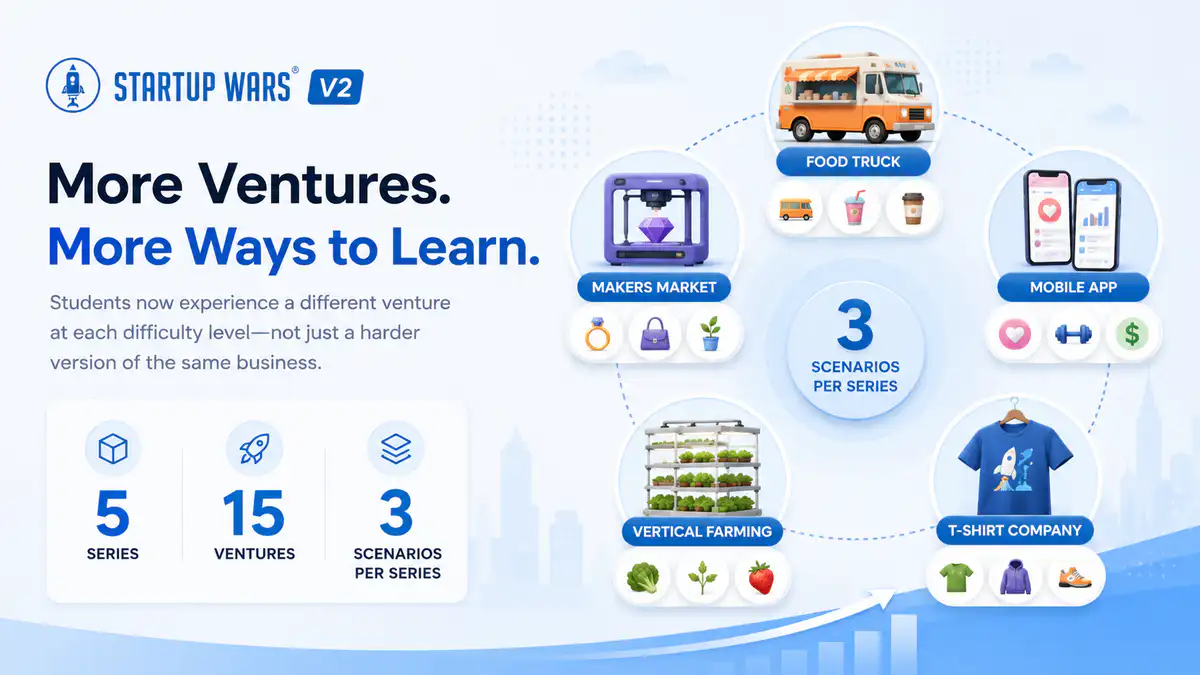
Your students can now experience three distinct ventures within each of our five core business simulation series, giving them more opportunities to see how business decisions change when the company, market, costs, and operating conditions change around them.
Entrepreneurship is full of concepts students will see again and again: pricing, inventory, staffing, marketing, financing, production, and profitability.
What changes is the business around those decisions.
Managing inventory for a coffee truck is very different from managing product development for a mobile app. A vertical farm has to think about crop cycles and perishability, while an apparel company has to balance materials, fulfillment, margins, and returns.
With our latest Startup Wars update, students will get to experience more of those differences themselves.
We're introducing scenarios across all five of our core simulation series.
What Are Startup Wars Scenarios?
A scenario is a distinct business venture within a Startup Wars simulation series.
Previously, students could progress through difficulty levels while continuing to operate the same type of business. With scenarios, advancing through a series can now introduce a different venture with its own products, costs, operating conditions, and financial considerations.
The core entrepreneurship concepts are still there. What changes is the context students have to apply them in.
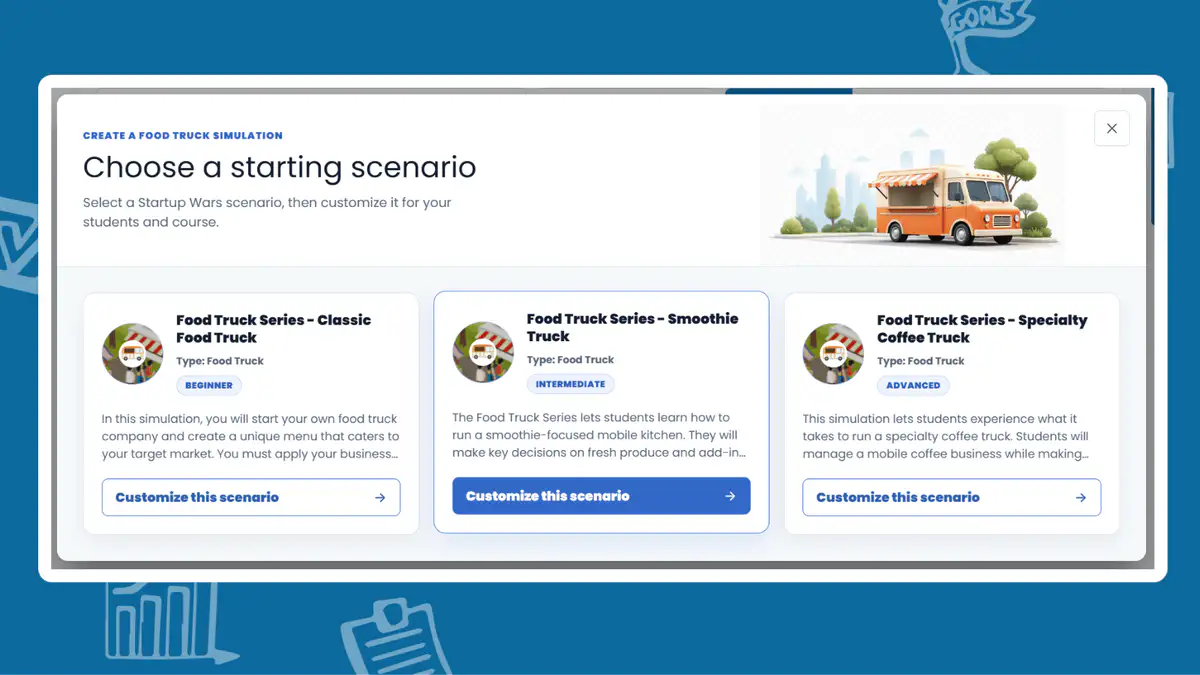
For example, the Food Truck Series now progresses through:
Classic Food Truck → Smoothie Truck → Specialty Coffee Truck
Instead of simply asking students to run a more difficult version of the same food truck, each scenario changes important parts of the business they are managing.
That same approach now extends across all five core Startup Wars simulation series.
What's New in Startup Wars?
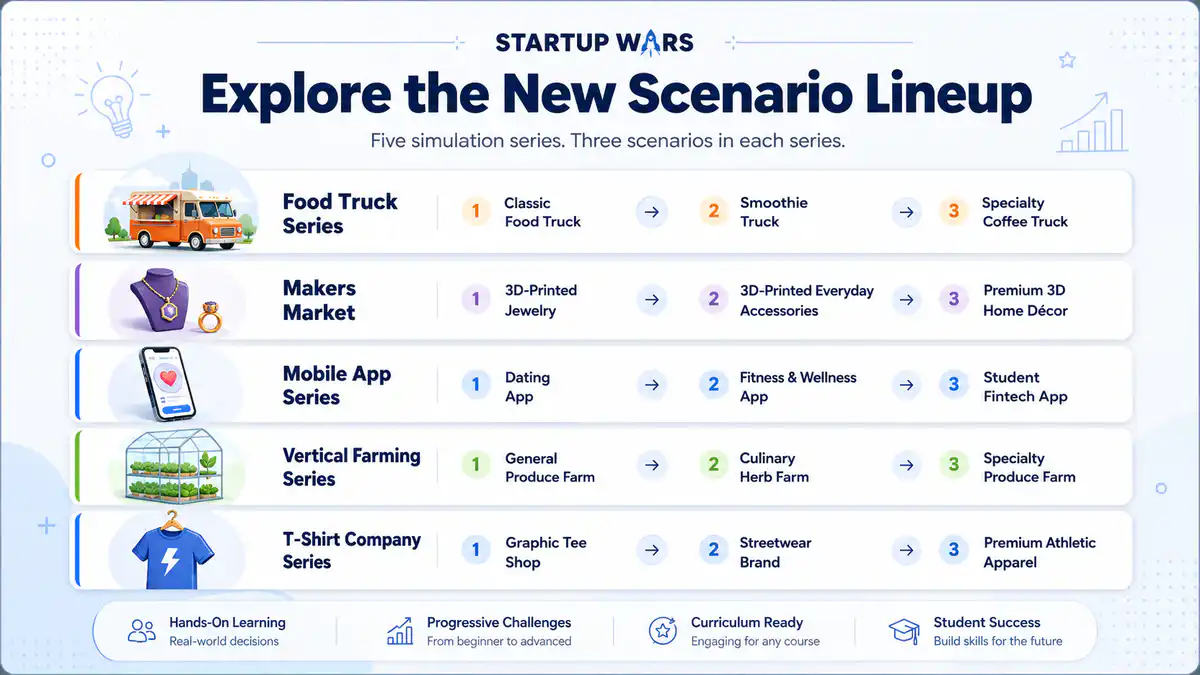
Each core series now includes three distinct scenarios, creating a lineup of 15 ventures across Startup Wars.
Here's the full lineup:
Food Truck Series
Classic Food Truck → Smoothie Truck → Specialty Coffee Truck
Makers Market
3D-Printed Jewelry → 3D-Printed Everyday Accessories → Premium 3D Home Décor
Mobile App Series
Dating App → Fitness & Wellness App → Student Fintech App
Vertical Farming Series
General Produce Farm → Culinary Herb Farm → Specialty Produce Farm
T-Shirt Company Series
Graphic Tee Shop → Streetwear Brand → Premium Athletic Apparel
The goal isn't simply to give each difficulty level a different name. Each scenario changes some of the financial and operational conditions students have to work through.
How Scenarios Change the Student Experience
The Food Truck Series is probably the easiest place to see the difference.
A student operating the Specialty Coffee Truck works with café lattes, iced drinks, seasonal products, and ingredients that carry different costs and shelf lives.
That changes what an inventory decision means.
Students have to think about questions such as:
- How much of each ingredient should I purchase?
- How long can that inventory realistically be used?
- Do I have enough storage capacity?
- Which products should have a place on my menu?
- How should I price products with different ingredient costs?
- How much demand should I expect before buying additional inventory?
A purchasing decision can quickly become a pricing, storage, product-mix, and demand decision at the same time.
That is the kind of connection scenarios are designed to make easier for students to experience.
Different Industries Create Different Business Problems
The same entrepreneurship fundamentals show up throughout Startup Wars, but each series gives students a different environment in which to apply them.
Food Truck: Managing Products That Don't Last Forever
Across the Food Truck scenarios, students work through decisions involving menu pricing, product mix, perishable ingredients, shelf life, storage capacity, inventory purchasing, licenses, vehicle and website expenses, and daily customer demand.
This gives students a practical example of why purchasing more inventory is not automatically the safest decision. Having enough supply matters, but so does whether that supply can be stored, sold, and used before it loses value.
For instructors, that opens up useful conversations about forecasting, waste, pricing, margins, and how operational constraints affect financial decisions.
Makers Market: Balancing Production With What You Can Actually Sell
The Makers Market scenarios move through 3D-Printed Jewelry, 3D-Printed Everyday Accessories, and Premium 3D Home Décor.
Students work with cost of goods sold, material choices, printer and manufacturing time, production capacity, shipping costs, product catalogs, local-market registration, and online sales.
That makes production itself part of the business problem.
Students may want to sell more products, but they also have to think about how long those products take to make, what materials cost, and how much production the business can realistically handle.
It's a useful way to show why demand and capacity have to grow together.
Mobile App: When Inventory Becomes Time, Talent, and Technology
The Mobile App Series looks very different from a physical-product business.
Students progress from a Dating App to a Fitness & Wellness App and then a Student Fintech App, with decisions involving MVP development, feature roadmaps, labor allocation, digital pricing and subscriptions, customer acquisition, churn, competitive marketing, loans, and other funding decisions.
The scenarios also introduce considerations around privacy, security, and responsible technology choices.
There may not be boxes of physical inventory sitting on a shelf, but students still have limited resources to manage. Development time, labor, capital, customers, and product priorities all compete for attention.
For students interested in technology or digital businesses, this provides a very different way to experience many of the same entrepreneurship fundamentals.
Vertical Farming: Matching Production to Demand
The Vertical Farming Series progresses from a General Produce Farm to a Culinary Herb Farm and then a Specialty Produce Farm.
Students encounter hydroponic equipment investments, seed and nutrient costs, crop cycles, yield, perishable inventory, production capacity, and different approaches to selling through market stalls or online channels.
Here, timing becomes particularly important.
Students have to think not only about what they can produce, but when it will be ready and whether demand will be there when the harvest is available.
That creates a useful environment for understanding the relationship between production planning, inventory, capacity, and sales.
T-Shirt Company: From Product Costs to Brand Positioning
The T-Shirt Company Series now moves through Graphic Tee Shop, Streetwear Brand, and Premium Athletic Apparel.
Students work with blank and ink costs, material quality, printing time, inventory, fulfillment, shipping, retail pricing and margins, returns, brand positioning, limited-edition products, and sustainable sourcing.
As the type of apparel business changes, students have more variables to consider when deciding what a product should cost and what customers may be willing to pay.
That gives instructors another way to connect pricing decisions with product quality, positioning, costs, and the type of customer a business is trying to reach.
Difficulty Now Changes More Than the Business
The venture itself isn't the only thing that changes as students progress.
The scenario progression also moves students from generally lower-cost cities into average- and higher-cost markets.
That matters because expenses begin to consume more of the capital students have available.
A strategy that worked comfortably in an earlier scenario may suddenly become much harder to sustain when operating costs increase. Students may need to reconsider how quickly they hire, how much inventory they purchase, where they spend on marketing, or how much financial room they leave for unexpected costs.
This gives students an opportunity to experience an important lesson in entrepreneurship:
A decision doesn't happen in isolation. The conditions surrounding the business matter too.
Students are still working with pricing, inventory, staffing, production, marketing, and financing, but scenarios give them more opportunities to see how those decisions influence one another.
Using Scenarios for Classroom Discussion
For instructors, one of the most useful parts of this update may happen after students finish playing.
Different scenarios create more opportunities to compare how students approached similar business concepts under changing circumstances.
You might ask your class why a pricing strategy worked in one venture but struggled in another. Students can compare how perishable inventory changed their purchasing decisions, or look at what happened to their strategy once operating costs began taking up more of their available capital.
Those conversations can also move beyond whether a student succeeded or failed.
Two students may reach different outcomes because they made different assumptions about demand, spent their capital differently, or reacted differently when conditions changed. Reviewing those choices gives students a chance to explain the reasoning behind their strategy and learn from the results.
That is where the business simulation can become more than an assignment. It becomes something students can refer back to when the same concepts come up later in your course.
The Same Concepts, Applied in More Ways
Scenarios don't replace the entrepreneurship fundamentals behind Startup Wars.
They give students more environments in which to practice them.
A student may encounter inventory in a food truck, production capacity in a Makers Market business, customer churn in a mobile app, crop yield in a vertical farm, and product margins in an apparel company.
The details are different, but students are repeatedly being asked to make decisions with limited resources, respond to changing conditions, and understand the consequences of the choices they make.
For instructors, that means the same business simulation series can now provide more variety as students progress through it, while giving you more examples to bring into classroom discussions and reflection activities.
Ready to Explore the New Scenarios?
If you're already using Startup Wars, the easiest way to get familiar with the update is to log into your instructor account and explore the new scenario lineup for yourself.
Try moving through one of the simulation series as a student and pay attention to what changes from one scenario to the next. The Food Truck Series is a great place to start because the differences in products, shelf life, inventory, and demand are easy to see.
If you're new to Startup Wars and want to see how our business simulations can fit into your entrepreneurship course, you can also explore our resources for educators or schedule a walkthrough with our team.
And as always, if you're using the new scenarios with your students, we'd love to hear what you notice. Which scenario created the best discussion? Which decisions surprised your students? Those are exactly the kinds of stories that help us continue improving Startup Wars.
Frequently Asked Questions
What is a scenario in Startup Wars?
A scenario is a distinct business venture within a Startup Wars business simulation series. Each scenario can introduce different products, costs, operating conditions, market conditions, and business decisions while continuing to reinforce core entrepreneurship concepts.
Are scenarios the same as completely new simulations?
Not exactly. The five core Startup Wars simulation series remain Food Truck, Makers Market, Mobile App, Vertical Farming, and T-Shirt Company. Each series now contains three distinct scenarios that give students different ventures to operate as they progress through the series.
How many scenarios are available in Startup Wars?
The current lineup includes 15 scenarios across five supported business simulation series, with three ventures in each series.
Do scenarios only make the business simulations harder?
No. Difficulty is part of the progression, but the venture and operating conditions change too. Students can encounter different products, costs, production requirements, market conditions, and financial pressures as they move through a series.
Do later scenarios use different market conditions?
Yes. The progression generally moves from lower-cost cities toward average- and higher-cost markets, which makes operating expenses and capital-management decisions increasingly important.
Is LTI included with this update?
Not yet. LTI support is planned separately for September and is not part of the scenario release. We'll share more information about that phase of the rollout separately.
About the author
Startup Wars Team
Entrepreneurship education contributors
The Startup Wars editorial team shares practical guidance on experiential learning, business education, and helping learners build real-world skills.
More from Startup Wars Team