
how to start a business with no money

If you search how to start a business with no money, you’ll probably find two types of advice:

  1. Unrealistic “get rich quick” business ideas


  2. Long theoretical explanations about business plans and funding


But the real answer is simpler.

Starting a business with no money in 2026 doesn’t mean building a company from day one.

It means selling something valuable before investing heavily in infrastructure.

In other words:

A business starts when someone pays you. Not when you design a logo.

This mindset is not only how many modern startups begin — it’s also the reality students must understand if they want to become entrepreneurs.

Yet many business classrooms still rely on lectures and case studies instead of real entrepreneurial experimentation.

Brace yourself: whiteboards alone won’t cut it anymore.

Table of Contents

The Mindset Shift: Entrepreneurship Starts Before Funding

One of the biggest myths in entrepreneurship education is that businesses begin with capital.

In reality, most startups begin with three things:

  • A problem

  • A potential customer

  • A simple solution

Funding usually comes later.

In fact, many successful entrepreneurs start by bootstrapping, which means growing a company using early revenue instead of outside investment.

This approach teaches an essential entrepreneurial principle:

Focus on solving a real problem before worrying about scale.

For students and aspiring founders alike, this is where entrepreneurship truly begins.

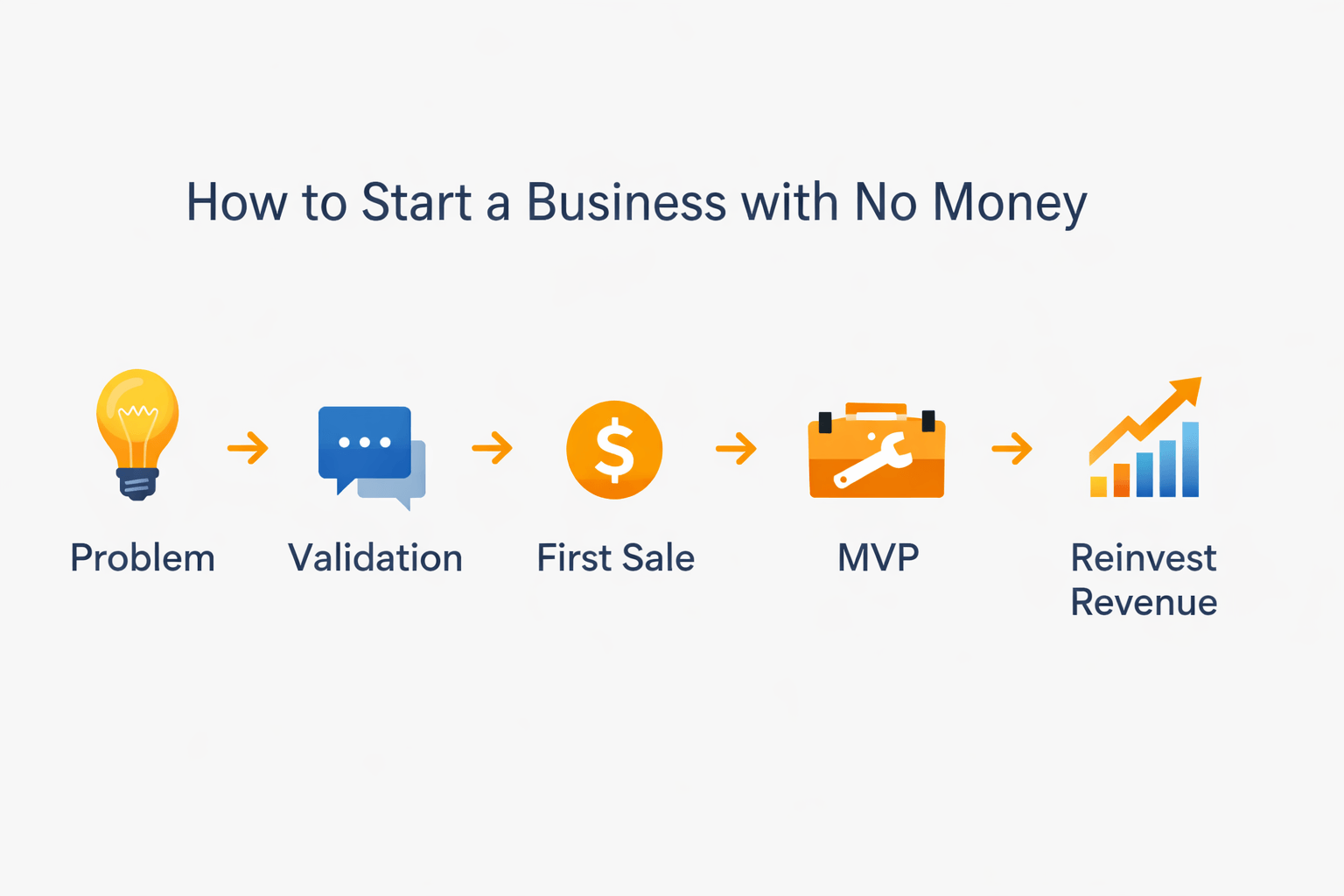
How to Start a Business With No Money (Step-by-Step)

start-business-no-money-framework

Let’s break the process into a practical framework anyone can follow.

This is the same structure many startup founders use when launching lean businesses.

Step 1 — Identify a Real Problem

Every successful business begins with a problem people are willing to pay to solve.

Start by asking questions like:

  • What frustrates people in your industry?


  • What tasks are businesses wasting time on?


  • What services are expensive but could be simplified?


If the problem is painful enough, customers will pay for a solution.

Students often struggle with this step because traditional education emphasizes ideas, not customer discovery.

Entrepreneurship is not about clever ideas, it’s about solving real problems.

Step 2 — Choose a Low-Capital Business Model

If you’re starting with zero budget, avoid models that require inventory, manufacturing, or expensive software development.

Instead, focus on skill-based or service-based models, such as:

  • Consulting


  • Freelance services


  • Digital products


  • Workshops or training


  • Online courses


  • Automation services


These models allow founders to start generating revenue quickly.

The goal is simple:

Turn knowledge or skills into value.

Step 3 — Validate Before Building

One of the most common startup mistakes is building a product before confirming anyone wants it.

Instead, validate the idea first.

Ways to validate with no money include:

  • Talking to potential customers


  • Posting a simple offer online


  • Testing interest on social media


  • Conducting quick surveys


  • Offering pre-orders


If people show real interest, or even better, commit to paying, you’ve confirmed demand.

This step dramatically reduces risk.

Step 4 — Sell Your First Version

Once validation happens, create the simplest possible version of the solution.

Entrepreneurs call this an MVP (Minimum Viable Product).

It doesn’t need to be perfect.

It just needs to work.

For example:

  • A consulting offer instead of a SaaS platform


  • A workshop instead of a full training program


  • A manual service instead of automation


The goal is learning and revenue, not perfection.

Step 5 — Reinvest Your First Revenue

Once you make your first sale, reinvest the money strategically.

Instead of spending on aesthetics like logos or branding, prioritize assets that grow the business:

  • marketing


  • better tools


  • improved processes


  • customer acquisition


Revenue should always fund the next stage of growth.

This is how many successful companies begin, slowly, but sustainably.

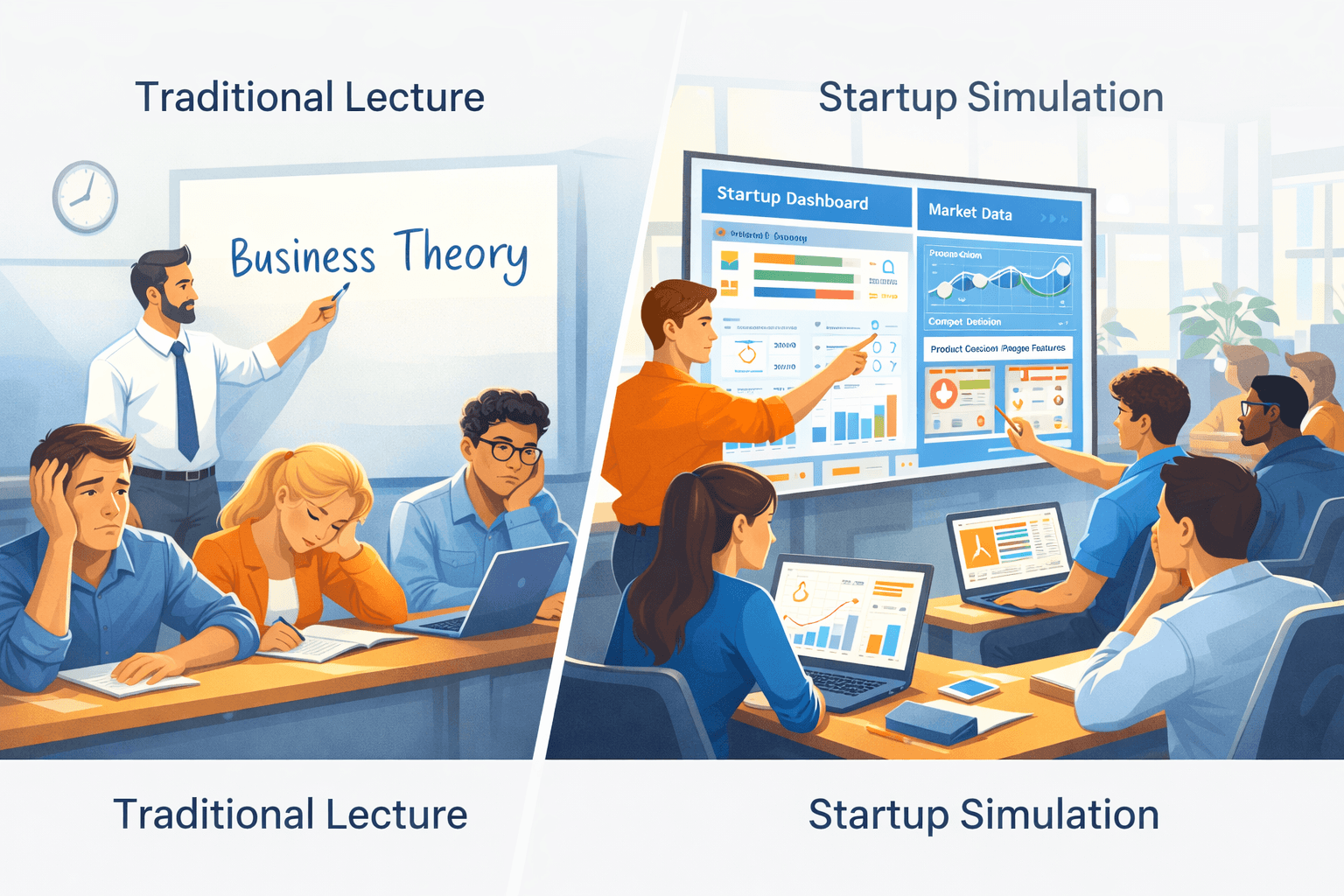
Why This Is Hard to Teach in Traditional Classrooms

Now here’s where things get interesting for educators.

Teaching entrepreneurship using lectures alone is like teaching swimming from a textbook.

Students may understand the concepts, but they never experience the real dynamics of building a business.

Common classroom challenges include:

  • Students memorize theories but never apply them

  • Business plans replace real experimentation

  • Risk-taking is simulated only on paper

But entrepreneurship is inherently experiential.

Students must make decisions, face uncertainty, and see consequences.

Without that experience, entrepreneurship education becomes abstract.

entrepreneurship-education-traditional-vs-simulation

Bringing Real Entrepreneurship Into the Classroom

This is where simulation-based learning becomes powerful.

startup-simulation-learning-experience

Modern entrepreneurship education is shifting toward experiential learning, where students practice entrepreneurship instead of just studying it.

One innovative tool that supports this approach is Startup Wars, a startup simulation platform designed specifically for entrepreneurship courses.

Instead of reading about startups, students:

  • build simulated businesses
  • make strategic decisions
  • compete in real-time market environments
  • experience the consequences of their choices

This approach transforms entrepreneurship education from passive learning into active experimentation.

For professors, this creates several benefits:

Higher Student Engagement

Students participate actively instead of passively listening to lectures.

Real-World Skill Development

They learn decision-making, strategy, and problem-solving.

Practical Understanding of Entrepreneurship

Students experience what it actually feels like to run a startup.

For business schools aiming to modernize their entrepreneurship programs, this kind of simulation-based learning bridges the gap between theory and practice.


The Future of Entrepreneurship Education

Starting a business with no money isn’t just a survival strategy.

It’s one of the best ways to understand how entrepreneurship really works.

You begin with:

  • a problem


  • a customer


  • a simple solution


And you grow from there.

But for students to truly grasp this process, they need more than lectures and case studies.

They need experience.

That’s why many forward-thinking universities are integrating startup simulations into their entrepreneurship programs.

Tools like Startup Wars allow students to experiment, fail safely, and learn how businesses actually grow.

And that’s where real entrepreneurial education begins.

Frequently Asked Questions

1. How do I start a business with no money in 2026?

Start by identifying a real problem, validating demand, offering a simple solution, making your first sale, and reinvesting the revenue. Focus on service-based or digital businesses that require little upfront capital.

2. What is the easiest business to start with no money?

Service-based businesses such as consulting, freelance services, and digital training programs are the easiest to launch because they require minimal startup costs.

3. Can students start a business without investment?

Yes. Many student businesses begin with skill-based services, small digital products, or freelance work that require little or no capital.

4. Why is entrepreneurship difficult to teach in classrooms?

Traditional teaching methods focus on theory rather than real-world experimentation. Students learn concepts but rarely experience real decision-making or market dynamics.

5. How can universities teach entrepreneurship more effectively?

Universities can adopt experiential learning methods such as startup simulations, where students run virtual businesses and practice strategic decision-making in realistic environments.

Let's Empower The Next Generation Of Founders

Schedule a call with our team to explore how Startup Wars can fit into your classroom.

How to Start a Business with No Money in 2026

Subscribe to the Startup Wars newsletter to receive free resources for starting your company, delivered right to your inbox.

Charlotte Kane
Charlotte Kane Undergraduate Student, The Ohio State University

Startup Wars allowed me to understand everything that goes into starting a business in 90 days.

Darshita Bajoria
Darshita Bajoria Undergraduate Student, The Ohio State University

Startup Wars is an interactive way to learn and hone entrepreneurial skills while being a no-risk outlet. Great tool for those pursuing entrepreneurship.