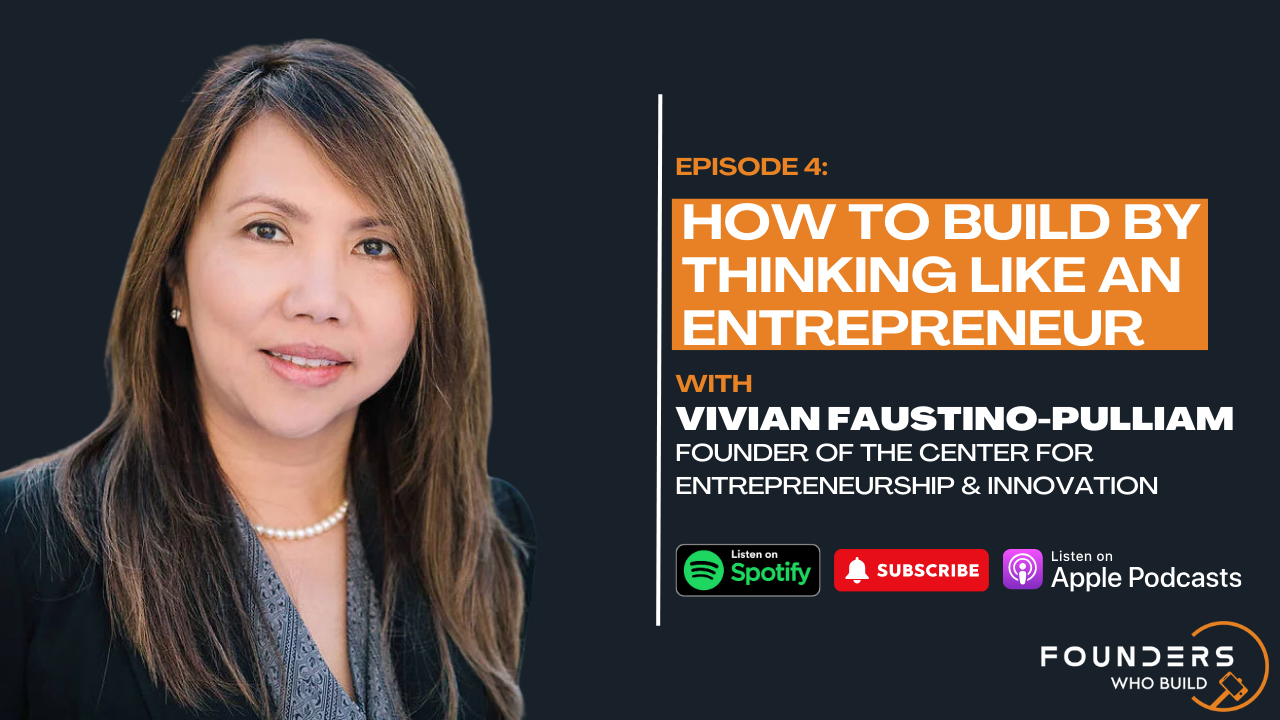
Entrepreneurship Lessons from Vivian Faustino-Pulliam
When most people think about entrepreneurship, they picture startups, funding rounds, and fast-growing companies.
But that definition leaves a lot out.
It ignores the founders who don’t raise venture capital.
Founders who work inside broken systems.
Founders creating programs, platforms, and ecosystems where none existed before.
This episode of Founders Who Build challenges the idea that entrepreneurship only lives inside startups and asks a bigger question: what does it really mean to be a founder?
TL;DR: Entrepreneurship Lessons from Vivian Faustino
- Higher education needs to reinvent itself by learning from platform-based companies like Uber, Airbnb, Amazon, and Apple.
- Vivian Fino-Pulliam founded the Center for Entrepreneurship at City College of San Francisco in 2018 and built it like a startup incubator inside a community college.
- She approached the center like a founder: leveraging what she had—location, relationships, students, industry contacts, and partnerships—instead of focusing on limited funding.
- The center grew through scrappy tactics like pitch events, university partnerships, free faculty training seats, in-kind company support, mentors, speakers, QuickBooks, Shopify, and startup pilots.
- Vivian argues that entrepreneurship is not limited to starting a for-profit business; it can mean launching a nonprofit, movement, book, community, academic program, or career reinvention.
- Traditional higher education is too linear and outdated for modern entrepreneurship education, especially with AI changing how students access knowledge.
- Her model positions colleges as platforms or ecosystems, connecting students with faculty, industry experts, tools, mentors, and real-world opportunities.
- Faculty should shift from being the sole expert to becoming facilitators, curators, and collaborators who work alongside industry professionals.
- Entrepreneurship education should be experiential and co-created, with industry experts helping students apply current tools, skills, and workplace realities.
- Colleges still need to act as the clearinghouse by vetting partners and content so students get value without being sold to.
- Vivian built support by proving traction with an MVP-style approach, recruiting internal collaborators, using students as advocates, and showing early results.
- The center’s impact goes beyond business launches; it helps students build confidence, self-efficacy, resilience, purpose, and belief that their ideas matter.
- Community colleges increasingly serve immigrants, older adults, career changers, and nontraditional students who may use entrepreneurship to create new opportunities.
- Vivian believes entrepreneurship should be taught across disciplines because the mindset supports problem-solving, adaptability, career growth, and personal transformation.
- Her key advice: learn to unlearn, stay focused, ask for help, build ecosystems, and say no to distractions that pull you away from what matters.
Watch the Full Founders Who Build Interview
Prefer to watch instead of read? Watch the full conversation with Vivian.
A Founder Who Built Outside the Startup Playbook
In this episode, I sat down with Vivian Faustino-Pulliam, an educator, former banker, and serial entrepreneur whose career doesn’t follow a linear or traditional path.
Vivian became a mother at 16, built multiple businesses across commercial services and food franchises, and worked her way up in banking from teller to vice president of marketing. Eventually, she brought her entrepreneurial mindset into higher education, not to teach theory, but to build something new from the ground up.
She founded the Center for Entrepreneurship inside a community college with no startup capital, no formal budget, and no existing model to copy. At the time, it was the first incubator-style entrepreneurship center in a community college setting.
And she ran it exactly like a startup.
The Origin: Treating Education Like a Startup
Vivian didn’t approach the Center for Entrepreneurship as an academic program.
She treated it as a venture.
She defined a value proposition. She looked at existing assets instead of limitations. She built partnerships instead of waiting for funding. She launched initiatives, tested what worked, and iterated quickly.
That mindset shift to thinking like a founder shaped everything that followed.
Insight #1: Entrepreneurship Is a Mindset, Not a Company
One of Vivian’s strongest points is that entrepreneurship is not synonymous with business ownership.
In her view, entrepreneurship is about creating value, regardless of whether the outcome is a company, a nonprofit, a program, or a platform. The tools are the same: problem-solving, resourcefulness, storytelling, and resilience.
This broader definition is especially important in environments like community colleges, where students are often older, career-switchers, immigrants, or people searching for purpose rather than exits.
Entrepreneurship, in this context, becomes a vehicle for confidence and agency, not just income.
Insight #2: Build Ecosystems, Not Programs
Rather than building isolated initiatives, Vivian focused on building an ecosystem.
She connected students with industry partners, mentors, guest speakers, and real-world tools. The Center for Entrepreneurship became a hub, rather than a classroom.
Her critique of higher education is direct: most institutions still operate with linear, outdated models, while entrepreneurship and the real world are non-linear and relational.
Ecosystems create momentum while programs create silos.
Insight #3: Impact Isn’t Always Measured in Revenue
Some of the most powerful moments in the conversation aren’t about metrics; they’re about people.
Vivian shares stories of students who found purpose, confidence, and direction through entrepreneurship education. A student who published a children’s book. Another who pitched an idea in front of their parents for the first time. One who struggled with substance abuse but showed up every day and completed a full semester.
These outcomes are not business-related, but human.
But they reveal something critical: entrepreneurship builds the belief that your ideas matter and that you can act on them.
What Founders Can Apply Right Now
Whether you’re building a company, a program, or something inside an existing institution, these questions matter:
- Are you focused on what you lack or what you can leverage?
- Are you building a standalone project or an ecosystem around it?
- Are you defining success only in financial terms?
- Where do you need to unlearn outdated assumptions?
Vivian’s story is a reminder that building something meaningful often requires redefining the game entirely.
Rethinking What It Means to Be a Founder
This episode of Founders Who Build expands the definition of entrepreneurship.
You don’t need venture capital.
You don’t need a tech startup.
You don’t even need a company.
What you need is the willingness to build, to see a problem, mobilize resources, and create something that didn’t exist before.
🎧 Listen to the full episode of Founders Who Build with Vivian Faustino-Pulliam.
Practice Entrepreneurship in a Risk-Free Digital Environment
Founder stories like Logan’s remind us that entrepreneurship is not only about the big launch moment. It is about the decisions that happen before launch: the research, the user conversations, the systems, the pivots, and the willingness to learn before everything feels perfect.
A strong product launch plan gives founders a way to move from idea to action. It helps them test earlier, listen better, and build with users instead of guessing from a distance.
For students, that kind of learning can be transformative.
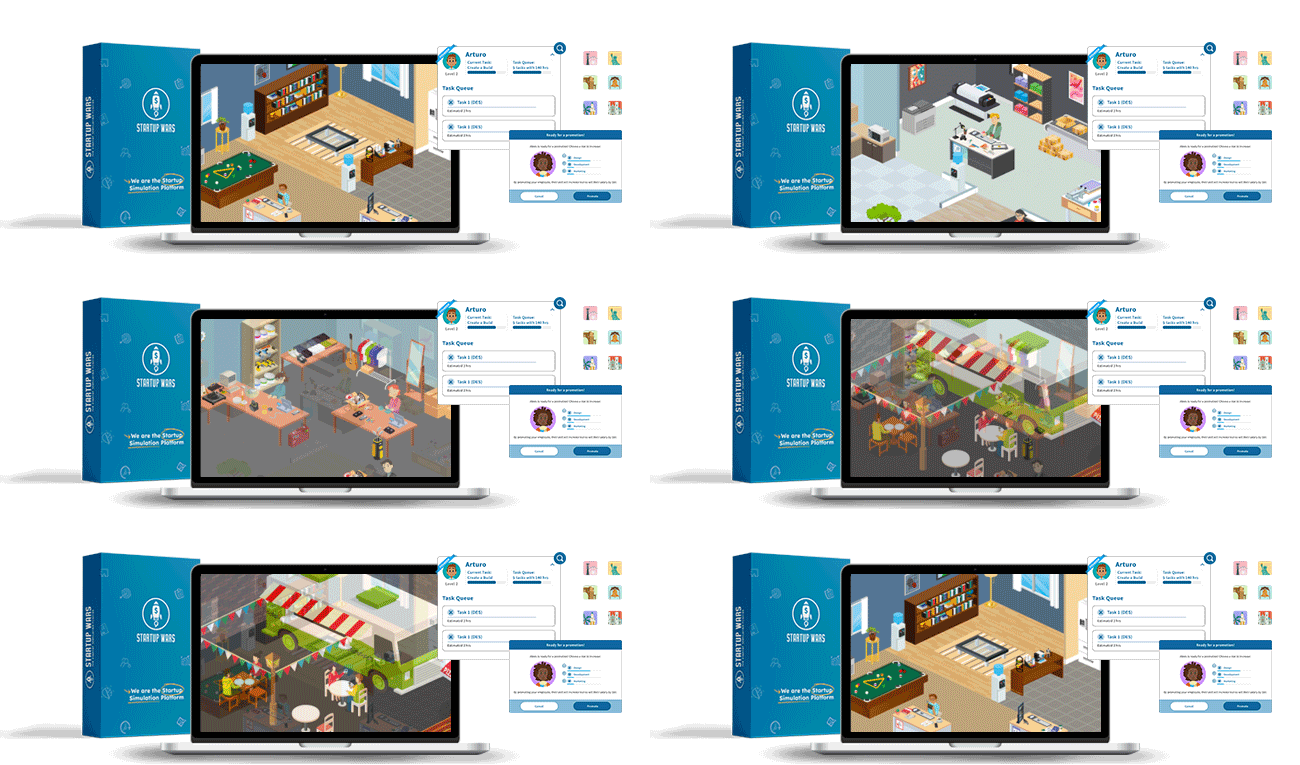
Startup Wars gives high school students and college-aged young adults a risk-free digital environment where they can build entrepreneurship skills through simulated ventures like supply management, marketing, business strategy, and more.
If you are an educator looking for a more engaging way to teach entrepreneurship, Startup Wars can help students move beyond theory and into real-world decision-making.