What Business Should I Start?
Choosing a business idea can feel exciting, confusing, and slightly dramatic all at once.
One minute, you are thinking, “I could totally start a business.” The next minute, you are asking much bigger questions: What would I sell? Who would buy it? Would people actually pay for it? Could I run it without losing my mind by week two?
That is where this what business should I start quiz comes in.
This quiz is designed to help you think through the early questions behind a business idea. It will not magically hand you a perfect company concept, because sadly, there is no “instant billionaire” button hiding in the internet. But it can help you understand how you think about customers, problems, pricing, creativity, and decision-making.
TL;DR: What Business Should I Start?
* This what business should I start quiz helps students explore business ideas in a simple, engaging way.
* It helps users think about customers, problems, pricing, creativity, and startup decision-making.
* A strong business idea usually starts with a real problem, not just a cool product.
* Students can use the quiz to reflect on what kind of founder they might become.
* Instructors can use the quiz as a warm-up, discussion starter, or pre-activity.
* Take the quiz below to discover which business path fits your natural decision-making style.
A Quiz to Find Your Path
What Business Should I Start? An Entrepreneurship Quiz
Use this quick entrepreneurship quiz to explore what type of business idea may fit your interests, skills, goals, and problem-solving style. Whether you are starting your first business, planning a class project, or exploring entrepreneurship as a career path, this quiz can help you find a direction and think through your next step.
Question
Your answer:
Correct answer:
Please wait..
↺Your Answers
The Business Question Most People Overlook
The question seems simple on the surface. But for most people, it comes bundled with a long list of follow-up questions that all hit at once.
Should you sell a product or a service? Go online or stay local? Build around your strengths, your interests, or a problem you keep running into? Start something you love or something that just makes sense financially?
The reason this question feels so hard is that there is no single right answer — there are only answers that are right for you, given your resources, your goals, and the kind of work you are actually willing to show up for every day.
That is why the most useful place to start is not with a product idea. It is with a problem.
Types of Businesses Worth Exploring
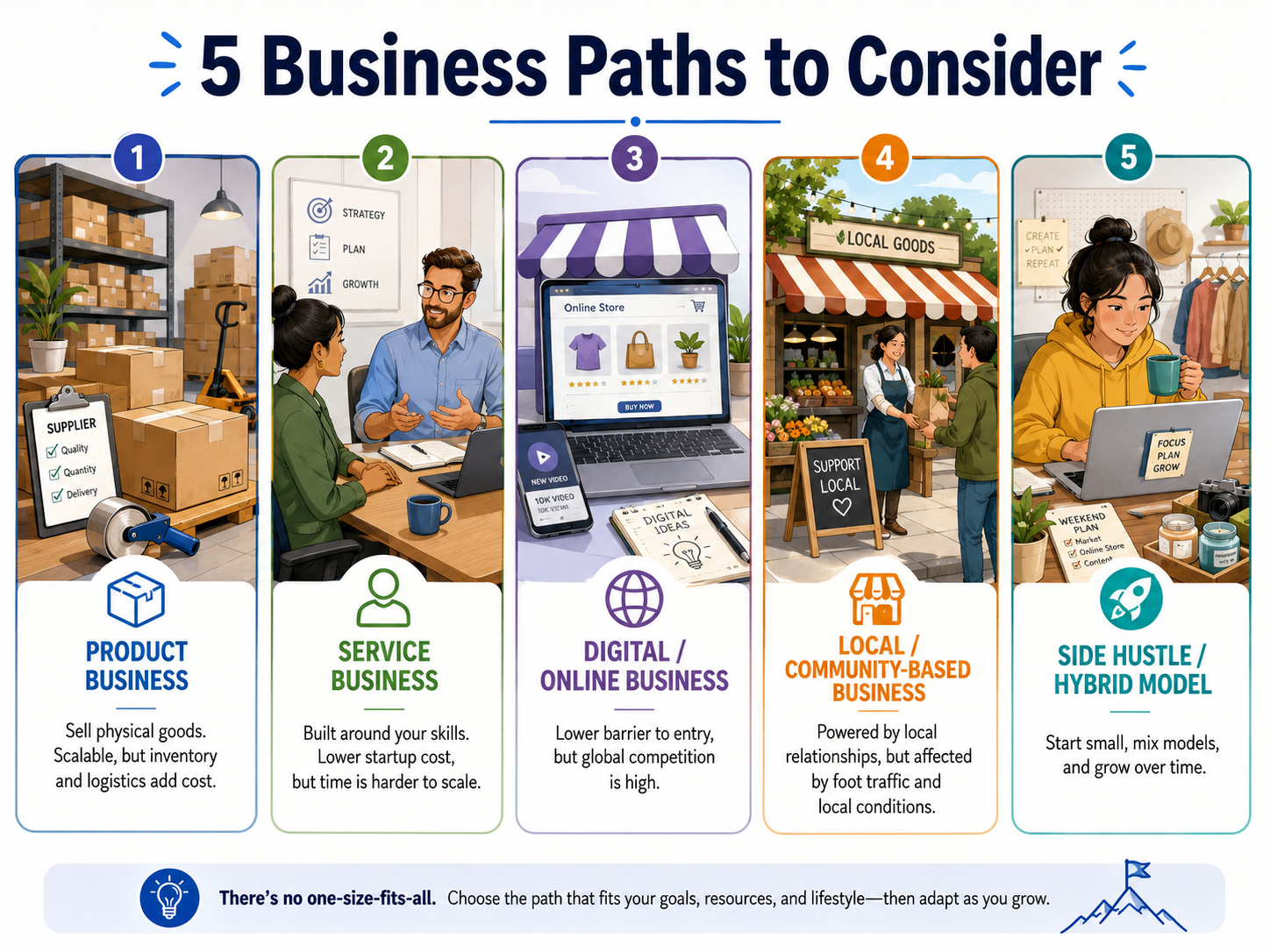
There is no master list of business types that works for everyone, but most small and first-time businesses tend to fall into a few broad categories. Understanding what each one actually demands can help you figure out which direction feels most natural.
Product businesses involve creating or sourcing physical goods and selling them to customers. Inventory, fulfillment, and supplier relationships are part of the job. The upside is that a strong product can scale; the challenge is that physical goods come with real costs and logistics.
Service businesses are built around what you know how to do. Consulting, coaching, creative work, trades, care services — these businesses have lower startup costs and faster feedback loops, but they are often harder to scale because your time is the main resource.
Digital and online businesses include everything from e-commerce and content creation to software products and digital services. The barrier to entry is often lower, but the competition is global and standing out takes real effort.
Local and community-based businesses are tied to a specific place — a neighborhood, a market, an event circuit. They benefit from proximity and personal relationships, but they are also more affected by local conditions and foot traffic.
Side hustles and hybrid models blend elements of the above, often starting small and growing into something more defined over time. Many successful businesses started as a side project before anyone treated them as a real company.
None of these is better than the others. The right one depends on you — how you work, who you want to serve, and what kind of problems you are genuinely interested in solving.
Start With the Problem, Not the Product
Most people approach the question of what business to start by leading with the idea itself. They want to open a café, launch a clothing brand, build an app, or offer a service. That is a perfectly natural place to start, but it skips a step that separates businesses that gain traction from ones that stall.
The stronger question is: what problem does this business actually solve?
A food truck does not just sell lunch. It solves a convenience problem for people who want a real meal without leaving a neighborhood that does not have many sit-down options. A tech product does not just add features. It saves someone time, or reduces a decision they hate making, or removes friction from something they do every day.
Before you land on what to build, ask yourself:
- Who would pay for this, and why?
- What is frustrating or missing in their life that this would fix?
- Is this a problem people are already spending money to solve — just in a way that is not quite working?
- Could I test a small version of this before committing fully?
That shift from “I have an idea” to “I understand the opportunity” is where real business thinking begins. If you are ready to take that next step, our guide on how to start a small business in 2026 walks you through exactly what that looks like in practice.
Final Thought: The Best Business Idea Is One You Can Explain
Here is a practical test worth applying to any business idea you are considering. Can you explain it clearly — in one or two sentences — to someone who has never heard of it?
If you can say who it is for, what problem it solves, and why someone would pay for it, you have something worth exploring. If you find yourself needing three minutes of context before the idea even makes sense, keep refining it.
The best businesses are usually not complicated. They are clear, specific, and connected to a real human need. Everything else follows from there.
Take the quiz above to find out which type of business fits the way you naturally think and make decisions — and use it as a starting point for figuring out what you want to build next.