Table of Contents
AI and Academic Integrity in the GenAI Era: Designing for Process, Not Prose
The shift to GenAI has changed classroom realities faster than most educators ever expected. One moment, students were drafting essays and case responses; the next, entire assignments could be generated in seconds with a single prompt. And while the technology feels exciting, it has also left many instructors asking the same anxious question: How do we protect academic integrity when writing itself can be automated?
This tension is now at the heart of every discussion about AI and academic integrity in higher education. Students aren’t just using AI to brainstorm; they’re using it to summarize readings, rewrite reflections, and sometimes submit work they barely touched themselves. It’s not that students have suddenly abandoned academic honesty. It’s that the rules of the game changed overnight, and the classroom wasn’t fully prepared for it.
The truth is, GenAI isn’t going away. Students will use it in internships, workplaces, and entrepreneurial ventures. So instead of fearing the technology, we need to redesign learning around what AI cannot replace. That means shifting attention from the final written product to the learning process: the drafts, the decisions, the thought patterns, the iteration, the problem-solving under pressure.
When educators emphasize the process, student ethics becomes stronger, not weaker. Learners feel guided rather than policed. They understand how to use AI responsibly because we’ve built environments that reward thinking, not just typing. And honestly, brace yourself… because the benefits are bigger than most universities expect.
This article brings you a research-backed look at how educators can design assessments that survive and even thrive in the GenAI era. We’ll explore why traditional assignments fail under GenAI pressure, how process-based assessment protects integrity, and why simulation-based experiences offer one of the strongest defenses against AI-enabled shortcuts.
Let’s dive into what truly supports AI and academic integrity in today’s classrooms and how to design learning that prepares students for the world they are stepping into.
Understanding AI and Academic Integrity
The explosion of GenAI has forced educators to look beyond surface-level concerns and confront a deeper truth: the traditional ways we measure learning were never designed for a world where a machine can produce grammatically perfect prose on demand. The challenge isn’t just that students can generate essays. It’s that our existing systems make it easy for them to submit polished work without demonstrating the thinking behind it.
This is exactly why conversations around AI and academic integrity must begin with a shift in mindset, not a list of punishments. Academic dishonesty is no longer simply a matter of copying from a website. It now includes blurry gray areas where students might use AI for “minor help,” “idea starting,” or “a better version of what I meant to say.” Many aren’t trying to break rules at all they’re navigating tools their instructors never taught them how to handle.
Why Traditional Assessments No Longer Hold the Line
For decades, essays, reports, and take-home assignments worked because they required time, skill, and personal effort. But GenAI changes that equation. A student can produce a full case analysis, marketing plan, or reflective essay in under a minute.
EdSurge reports that as AI tools become easier and more intuitive, students increasingly turn to them out of pressure, confusion, or anxiety rather than malicious intent.
The problem isn’t that students suddenly lack values. It’s that our assessments reward polished output, not cognitive effort. If the final deliverable is the only thing being graded, students will naturally gravitate toward tools that help them produce it faster.
Students Aren’t Cheating More — The Tools Simply Changed
This is a difficult truth for many instructors: the rise of AI misuse does not automatically mean a rise in academic dishonesty. Most learners genuinely want to behave ethically. But without clear AI guidelines or explicit examples of what “ethical AI use” looks like, students operate in ambiguity.
According to a recent UNESCO report on AI education ethics, unclear instructions lead to significantly higher rates of accidental misuse because students assume AI writing tools are “just another study aid.” So the issue isn’t student morality it’s the lack of structured, transparent design around AI in coursework.
Shifting the Focus: From Prose to Process
If GenAI can replicate the final product, then what exactly should students be evaluated on? The answer: their learning process.
Process-based assessment captures:
- Draft trails
- Decision-making steps
- Justifications
- In-class contributions
- Reflection logs
- Oral explanations
- Strategy mapping
When educators grade the thinking instead of the polished output, GenAI loses its power as a shortcut. Students must show how they arrived at answers, not just provide the answer itself.
Modern Classrooms Need Design, Not Detection
There’s growing consensus among higher-ed researchers that relying heavily on AI detection tools only creates distrust and false positives. Instead, restructuring assessments builds an environment where students can succeed ethically.
This approach reinforces student ethics and academic honesty, because the work becomes personal, reflective, and process-driven. Students cannot outsource their reasoning to AI when the task requires them to show thought patterns, articulate decisions, and respond dynamically in class.
Integrating Tech to Support Integrity
This mindset shift naturally leads educators toward more interactive and simulation-based methods of evaluation. When students participate in scenario-based tasks, live problem-solving sessions, or simulation experiences, integrity becomes inherent to the process because students engage directly with the material.
Designing Assessments That Strengthen Integrity in the GenAI Era
Once educators understand how GenAI reshapes student behavior, the next step is designing assessments that preserve AI and academic integrity while still supporting creativity and innovation. The goal isn’t to eliminate AI but to build learning environments where ethical use becomes the norm and shortcuts have no value.
Build Process-Based Assessment Structures
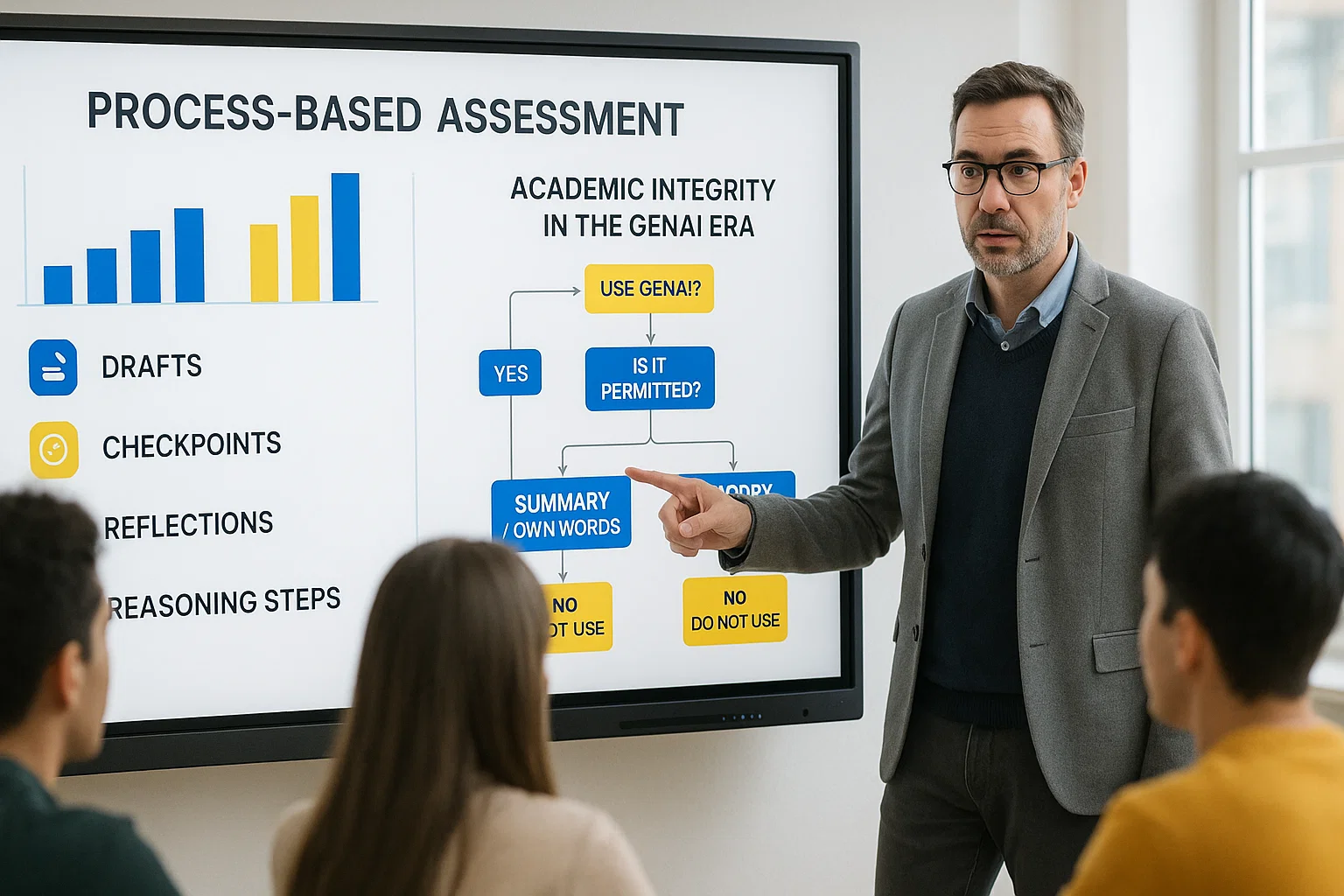
If AI can generate polished final products, then educators must evaluate the steps that lead to those products. Process-based assessment focuses on the learner’s reasoning trail, not just what they submit. This includes draft logs, voice notes, iterative outlines, reflective checkpoints, and in-class decision-making.
These design choices make AI less useful as a shortcut and more useful as a thinking partner. Students become active participants, not passive consumers.
Make Thinking Visible Through Layered Checkpoints
One of the best defenses for academic honesty is transparency. Breaking major tasks into small checkpoints encourages continuous engagement rather than last-minute AI dependence. Mini-reflections, annotated research notes, early-stage drafts, or small presentations help instructors see how students move through the learning process, not just the outcome.
This approach reinforces student ethics because learners understand they are being evaluated on authenticity, progression, and thoughtful effort.
Provide Clear, Human-Friendly AI Guidelines
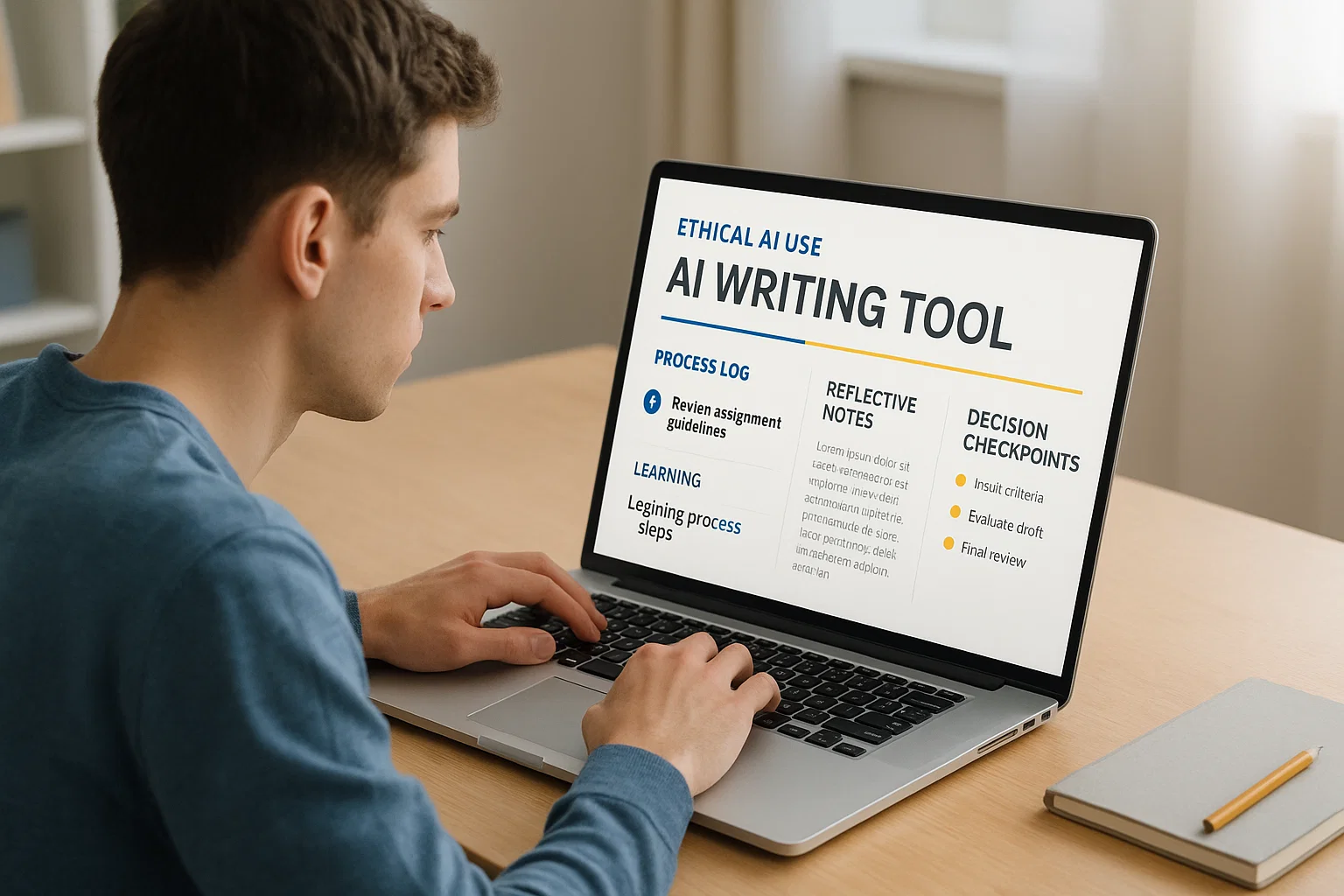
Many students aren’t trying to cheat, they simply don’t know what “ethical AI use” means. Clear expectations around AI-supported brainstorming, outlining, or translation help reduce confusion and misuse. When instructors explicitly define boundaries, students feel supported rather than policed.
Including examples of acceptable and unacceptable AI use directly in the assignment instructions strengthens how to use AI ethically as a student and reduces ambiguity.
Build AI Literacy Into Every Course
Today’s students will enter workplaces that rely heavily on simulation software, automated tools, and data-driven strategy systems. Integrating small AI literacy lessons, even 10–15 minutes per unit, helps them understand how AI functions, where it’s appropriate, and when it violates integrity.
This prepares learners for careers in entrepreneurship, business, startups, and small businesses, where AI-assisted decision-making is becoming the standard.
Integrate Simulation-Based Assessment to Reduce AI Shortcutting
Simulations are one of the most powerful ways to protect AI and academic integrity because they rely on real-time decisions, not static prose. When students participate in business simulation, business simulation games, or simulation games, the learning becomes intrinsic. AI cannot replace strategic thinking in a live scenario.
Simulation-based assessment also aligns with experiential learning, making it harder for students to outsource tasks and easier for educators to observe authentic decision-making.

Practical Design Ideas You Can Apply Immediately
Here are quick, integrity-supporting assessment ideas that work well in the GenAI era:
- Require short decision logs to show reasoning steps
- Use in-class simulation challenges powered by experiential learning
- Add brief oral reflections after major assignments
- Let students compare human vs AI drafts and critique differences
- Incorporate real-time business scenarios using the for students pages from Startup Wars
- Use the for educators features to track thinking patterns and strategy choices
- Replace static case studies with dynamic simulator tasks
- Add frequent checkpoints where students must justify strategy choices
All simulation-based elements reinforce authenticity because students can’t ask AI to make unique in-the-moment decisions for them.
Use Startup Wars Features to Align AI Tools With Integrity
Startup Wars naturally supports process-based learning by creating environments where the learning process is more important than the final deliverable. The platform’s experiential structure available through its for students, for educators, and AI in higher education resources helps students engage in hands-on strategy building, not AI-enabled shortcuts.
These features shift assessment from “What did you produce?” to “How did you think, decide, and adapt?”, directly reinforcing AI and academic integrity.
A Vision for the Future: Integrity, Innovation, and AI-Ready Learning

How Startup Wars Creates Integrity by Design
Startup Wars is built for the GenAI era because it evaluates learning where AI cannot interfere: inside real decision-making. Through hands-on scenarios, dynamic challenges, and evolving simulations, students must actively engage with content in ways AI tools cannot replicate.
This is where Startup Wars becomes a long-term integrity solution:
- Students run businesses in real-time, competing, adapting, and analyzing strategy outcomes
- AI cannot generate unique responses inside live business simulation games or simulation games
- Educators can assess decision quality, not written polish
- Reflection prompts, analytics, and in-simulation checkpoints reinforce authentic learning
Educators also gain access to structured support through resources like the for students, for educators, and AI in higher education sections, helping them integrate simulation-based assessments seamlessly into their curriculum.
Preparing Students for the AI-Driven Future
The coming decade will demand graduates who understand both technology and ethics — not one or the other. By embracing simulation-based learning, experiential decision-making, and process-focused assessment design, universities prepare students for real-world challenges where judgment, integrity, and thoughtful AI use matter most.
Startup Wars provides the environment where this vision becomes practical. It creates a classroom where students think boldly, behave ethically, and learn authentically. In a GenAI world, that combination will define the next generation of leaders.
Conclusion — Designing for Integrity in the GenAI Era
The rise of GenAI didn’t break higher education. It revealed where our assessment systems were already fragile. When writing tasks can be completed by a tool, the foundation of authentic learning must shift toward the reasoning, reflection, and decision-making that AI cannot imitate. This is where educators have a tremendous opportunity to elevate both learning and trust.
By focusing on the process instead of the final polish, instructors naturally strengthen AI and academic integrity. Students learn to articulate their choices, reflect on their strategies, and practice accountability the very skills they’ll need in workplaces shaped by AI, automation, and digital transformation. Integrity becomes part of the learning culture rather than a policy to enforce.
Simulation-based environments make this easier. Through experiential learning, hands-on decision-making, and dynamic business scenarios, students engage with material in ways AI simply cannot replicate. Platforms like Startup Wars help educators build classes where thinking is rewarded, shortcuts fail, and authentic learning thrives.
If your institution is ready to safeguard academic honesty, modernize assessment design, and give students experiences that prepare them for entrepreneurship, business strategy, and an AI-powered future, now is the perfect time to take the next step.
📅 Schedule a Free Demo and discover how simulation-based learning and process-driven assessment can transform your classroom for the GenAI era.
Frequently Asked Questions
1. What is AI and academic integrity?
2. How can educators prevent AI misuse in assignments?
3. What is process-based assessment?
4. How can students use AI ethically?
5. Why are simulations effective for academic integrity in the GenAI era?
People Also Searched For:
-
The Real Reasons Startups Fail - What 2 Startups & 70+ Startup Investments Teach You About Success
-
Most Founders Build Too Fast and That’s Why Startups Fail
-
ChatGPT 5 Release: What Educators and Students Should Know
-
Case Study in Education vs Simulation: Which Is Better for Teaching Entrepreneurship?
-
How to Use Business Simulations in the Classroom