Table of Contents
A business program director checks the enrollment numbers for next semester. They’re lower than expected. This isn’t an isolated incident. It’s happening at colleges across the country. Enrollment has been declining for years, and the trend shows no signs of reversing.
Administrators are asking tough questions at budget meetings. How do we attract more students? How do we convince them to choose our program over competitors? The old methods, glossy brochures, campus tours, reputation alone, aren’t working like they used to.
The problem goes deeper than marketing. Traditional teaching methods aren’t enough anymore. Students want more than lectures and textbooks. They want skills they can actually use in their careers, and they’re getting savvier about spotting the difference.
This is where enrollment-driven teaching begins. It means creating courses that students actively want to take. It means using methods that prove a program’s value before students even apply.
Business simulation games are one of the most effective tools for this. They provide hands-on learning that students find genuinely engaging. They develop real business skills that employers actively seek. And they give programs something concrete to showcase during recruitment.
This article shows how simulations can help attract and retain students. The impact on enrollment numbers can be significant.
The Enrollment Challenge in Higher Education
Key Statistics on Declining College Enrollment
The pressure administrators feel to attract and retain students is backed by hard data. Higher education is facing a long-predicted demographic shift that will reshape the student landscape for years to come.
Key Statistics on Enrollment Declines:
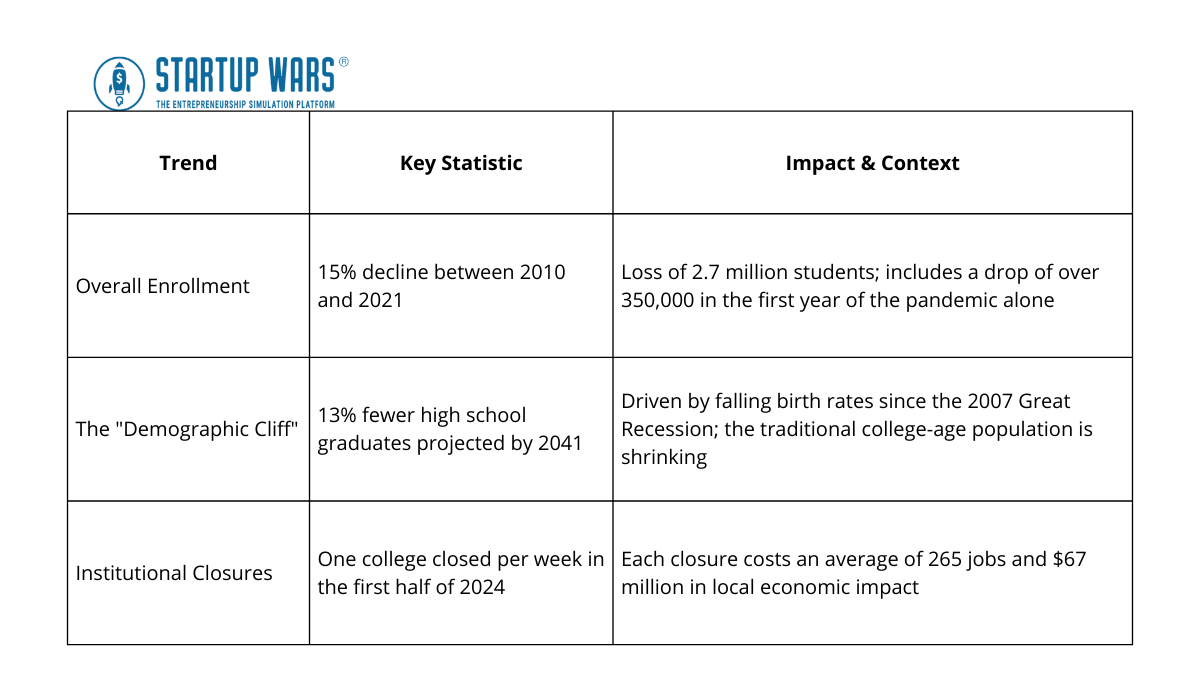
Source for all statistics in this table: NPR analysis of the “Demographic Cliff”.
This decline is compounded by economic and perceptual factors. A strong labor market with relatively high starting wages provides alternatives to college for some students. At the same time, public perception of the value of a degree has fallen, with only one in four Americans now saying a bachelor’s degree is extremely or very important to get a good job.
For business programs specifically, the news is a mix of challenge and opportunity. Business-related bachelor’s degrees remain the most popular major in the U.S. However, this dominance makes business programs a key battleground. To protect their enrollment, they must compete not only with other institutions but also with alternative education paths and a skeptical public.
Student Demand for Experiential Learning and Career Skills
Today’s students are strategic investors in their future. Their expectations from higher education have fundamentally shifted toward practical, career-focused outcomes.
The number one reason students choose higher education is to develop useful skills. This isn’t a vague desire. It’s a demand for tangible capabilities they can use in their careers. When asked which specific skills they prioritize, the answers are clear:
- Problem Solving (49%)
- Critical Thinking (45%)
- Teamwork and Networking (43%)
- Research (42%)
- Management (33%)
This focus on practical skills now outweighs traditional markers of prestige like university rankings. For the first time, internships and employability are more important draw factors than a school’s rank.
This shift explains why traditional lectures are less effective for attracting modern students. Research shows that people retain only about 10% of what they read and 20% of what they hear, but up to 90% of what they do through hands-on learning. Students are actively seeking programs that offer experiential learning through simulations, project-based work, and real-world applications.
Using Business Simulations to Solve Enrollment Problems

Attracting Students with Innovative Business Simulation Games
Business simulation games make business programs stand out. When students compare options, they notice programs that offer hands-on experience. Running a virtual company sounds more exciting than just reading case studies about other people’s businesses.
This approach gives programs a marketing advantage. Admissions teams can show prospective students what they’ll actually do. Instead of just listing course titles, they can demonstrate the learning experience.
Here are ways to feature simulations in recruitment:
- Add simulation screenshots to program websites
- Include student simulation results in viewbook materials
- Demonstrate the platform during campus tours
- Share student success stories from simulation experiences
- Feature simulation work in social media content
These elements show a program is innovative and practical. They prove the focus is on real skill development. Learn more about entrepreneurship simulations to see examples.
Boosting Retention Through Hands-On Learning
Students who are engaged tend to stay in their programs. Business simulation games create high levels of engagement because students become invested in their virtual companies. They care about the outcomes of their decisions in ways they don’t with traditional assignments.
Active learning leads to higher satisfaction. Students feel more connected to material they’ve practiced themselves. This approach is particularly effective for combatting student fatigue.
Research shows that experiential learning creates stronger memories. Students remember running their virtual company long after they’ve forgotten specific lecture content. These memorable experiences build stronger connections to programs.
The data supports this approach. Programs using simulations report better retention rates. Students who participate in active learning are more likely to complete their degrees and recommend their programs to others.
Developing Career-Ready Skills with Entrepreneurship Simulations
Business simulation games develop the specific skills employers want. Students practice decision-making, financial analysis, and strategic planning in realistic contexts. They learn to manage resources and respond to market changes, skills that translate directly to workplace settings.
These are not theoretical skills. Employers recognize simulation experience as valuable preparation. Students who have run virtual companies understand how business functions connect in ways that lecture-only students often don’t.
This career focus appeals to students and parents. Both groups want education that leads to jobs. Simulations demonstrate a program’s commitment to employment outcomes in concrete, visible ways.
The experience has clear resume value. Students can list specific simulation achievements in job applications. They can discuss strategies they implemented and results they achieved. This gives them concrete examples to share in interviews.
Implementing a Business Simulation for Enrollment Growth

How to Start with a Business Simulation Sprint
Programs don’t need to redesign entire curricula to start. A business simulation sprint lets schools test the approach quickly.
Choose the right course first. Introduction to Business courses work well. They have broad appeal and cover fundamental concepts. First-year courses are ideal because they reach more prospective students who might share their experiences during recruitment cycles.
The setup process is straightforward:
- Select a simulation module that matches course content
- Create the class in the instructor dashboard
- Distribute access codes to students
- Use the prepared lesson plans and materials
The timeline is realistic. Setup takes about 30 minutes. Student onboarding requires one class session. The sprint itself runs for two weeks. This approach is similar to the 2-week business curriculum sprint framework.
Marketing Your Program with Simulation Software
Show, don’t just tell. Prospective students respond better to demonstrations than descriptions.
Add simulation content to marketing materials. Include screenshots on program websites. Feature student simulation results in viewbooks. Share short videos of students discussing their experiences in their own words.
During campus visits, make it interactive. Set up a simulation station where visitors can try a simplified version. Let them make a few business decisions and see the results. This creates a memorable experience that distinguishes the program from competitors.
Train admissions staff to talk about simulation learning. Give them key talking points:
- Students run virtual companies and make real business decisions
- The experience builds resume-worthy skills
- Employers value this practical experience
- It makes learning more engaging and effective
Measuring the Impact of Business Simulations on Enrollment
Track the right metrics to prove the approach works. The simulation software provides automatic data on student performance. Decision patterns and learning progress become visible and measurable.
Gather student feedback through simple surveys. Ask about engagement levels and perceived skill development. Use quotes from students in recruitment materials. Positive student comments are powerful evidence.
Share results with stakeholders. Create brief reports for administrators showing:
- Student participation rates
- Performance improvement data
- Student satisfaction scores
- Retention comparisons between participating and non-participating students
This data helps justify continued investment in simulation learning. It shows tangible benefits for both students and the institution.
Addressing Concerns About Simulation Based Learning Implementation

Time and Resource Requirements for Business Simulations
Many instructors worry about the time required. The setup is designed to be quick. Most professors need about 30 minutes to get started with the business simulation platform.
Support systems are built into the platform. Pre-made lesson plans and teaching guides come included. The grading happens automatically. This saves time on routine tasks.
The cost is reasonable when considering the alternative. Empty seats cost much more than simulation software. If simulations help keep just a few additional students enrolled, they pay for themselves quickly.
Special training isn’t required to begin. The platform is designed for educators, not tech experts. Most instructors feel comfortable after their first simulation cycle.
Integrating Simulations into Your Existing Business Curriculum
Business simulation games work alongside current materials. They don’t replace textbooks or lectures. Instead, they bring those concepts to life.
For example, when professors teach marketing mix, students can immediately apply the concepts in their simulation. They set prices, create promotions, and see customer responses. This reinforces what they learned in class.
The time commitment is manageable. A two-week simulation fits into most course schedules. Students typically spend 2-3 hours per week on simulation work outside class.
Instructors control how much weight to give simulation performance. Many professors make it 20-30% of the course grade. This balances the simulation with other assignments and exams.
The best part is how simulations connect different topics. Students see how finance affects marketing and operations together. This helps them understand business as an integrated system rather than separate subjects.
The Future of Enrollment-Driven Education

The Growing Importance of Experiential Learning
Student expectations aren’t going backward. The demand for practical, hands-on learning will only grow. Students will continue to choose programs that demonstrate clear value and career relevance.
Programs that offer innovative learning have a strong competitive advantage. They stand out in a crowded market. They attract students who are looking for more than a traditional degree.
Early adopters are already seeing the benefits. Schools using simulations report better student engagement. Some see improvements in enrollment numbers for programs that feature experiential learning prominently. These schools are building reputations for innovation that help them compete for students.
The schools that adapt now will be better positioned for the future. They’ll have experience with new teaching methods. They’ll have systems in place to meet changing student needs.
Steps to Become an Enrollment-Driven Program
Start with a clear action plan. Choose one course to pilot the approach. Select a professor who is open to trying new methods. Set a timeline for implementation and review.
Build support by sharing information. Show colleagues examples of successful simulation use. Share data from other institutions. Highlight the benefits for both students and faculty.
Starting small is key. A two-week business simulation sprint is low risk. It requires minimal investment of time and resources. Results can be assessed before expanding to other courses.
The goal is gradual implementation. Begin with one course this semester. Add another course next semester. Scale up as positive results emerge and experience grows.
Conclusion: Transforming Challenges into Opportunities

Enrollment challenges are real and pressing. But they also create an opportunity to improve how business education works. Business simulation games address these challenges directly. They make programs more attractive to today’s students. They improve engagement and retention. They build career-ready skills that employers value.
This approach is practical and achievable. Schools can start with a small simulation sprint. The setup is simple. The resources are ready to use. Many instructors are already seeing positive results.
The future of business education will belong to programs that adapt. Schools that offer hands-on, relevant learning will thrive. They’ll attract motivated students and build strong reputations.
See the Business Simulation Platform in Action
Ready to see how business simulation games work in practice?
A 30-minute demo is available with no commitment required. Specific questions about courses and students can be addressed directly.
Schedule a free demo to see the simulation platform. See how other schools are using simulations to boost enrollment and improve student outcomes.
📅 Schedule a Free Demo and see how Startup Wars can help you lead beyond the classroom today.
Frequently Asked Questions About Business Simulations
What are the benefits of business simulations for student recruitment?
How much does it cost to implement business simulation software?
How much time is required for faculty to implement simulations?
Can business simulations work for different types of courses?
What evidence shows that simulations improve student outcomes?
People Also Searched For:
-
The Real Reasons Startups Fail - What 2 Startups & 70+ Startup Investments Teach You About Success
-
Most Founders Build Too Fast and That’s Why Startups Fail
-
ChatGPT 5 Release: What Educators and Students Should Know
-
Case Study in Education vs Simulation: Which Is Better for Teaching Entrepreneurship?
-
How to Use Business Simulations in the Classroom