Let’s start with a simple question.
When did teaching become a 60-hour workweek?
Lesson planning, grading, administrative tasks, responding to students, updating course materials… and somehow still finding time to actually teach.
Many educators feel like they’re drowning in preparation work before they even step into the classroom.
That’s exactly why AI tools for teachers are exploding in popularity in 2026.
Artificial intelligence isn’t replacing educators.
Instead, it’s becoming the most powerful teaching assistant ever created.
The best AI tools help teachers:
- Create lesson plans in minutes
- Automate grading and feedback
- Generate engaging learning materials
- Personalize student learning
And most importantly, they give teachers their time back.
In this guide, we’ll explore the best AI tools for teachers in 2026 and how educators are using them to transform their classrooms.
Table of Contents
Why Teachers Are Turning to AI
Most teens approach jewelry as a creative outlet.
Smart teen founders approach it as:
A micro startup
A brand experiment
A real business with margins
The global jewelry market is projected to exceed $350 billion in the coming years. That’s not a hobby economy, that’s a global industry.
The shift is simple:
Hobby mindset:
“I hope someone buys this.”
Founder mindset:
“Who is this for, and why will they buy?”
That’s the difference between random sales and sustainable income.

The time crisis in modern education
Teachers today face unprecedented demands.
Educators often spend over 50% of their time on administrative and preparation tasks rather than direct teaching.
These include:
- grading assignments
- preparing lectures
- creating worksheets
- responding to emails
- designing classroom materials
It’s no surprise that burnout has become a major issue across the education sector.
AI tools help shift this balance.
Instead of spending hours writing lesson plans or grading papers, teachers can now automate repetitive work and focus on what matters most: teaching and mentoring students.
AI as a teaching co-pilot
Think of AI as a co-pilot for educators.
Teachers still guide the learning journey, but AI can assist with:
- research
- content creation
- feedback
- personalized learning support
The result?
More time for discussion, creativity, and real-world learning experiences.
Many educators exploring AI tools are also trying to understand the broader impact of artificial intelligence in the classroom. If you’re just getting started, this guide on AI in education tools and real classroom use cases explains how teachers are already integrating AI into everyday teaching workflows.
But saving time is only the first step.
Forward-thinking educators are using that reclaimed time to introduce more interactive learning formats that move beyond lectures and slides.
That’s one reason many entrepreneurship professors are pairing AI productivity tools with interactive startup simulations like Startup Wars, where students apply business concepts by running a simulated company in real time. Instead of only preparing lectures, instructors can guide students through hands-on entrepreneurial decision making.
The Basic AI Tools for Teachers in 2026
Below are some of the most effective AI tools currently used by educators.
These tools focus on saving time while improving learning outcomes.
If grading is the most time-consuming part of your workload, you may also want to explore other AI grading tools that help educators save time while maintaining fair and consistent assessment.
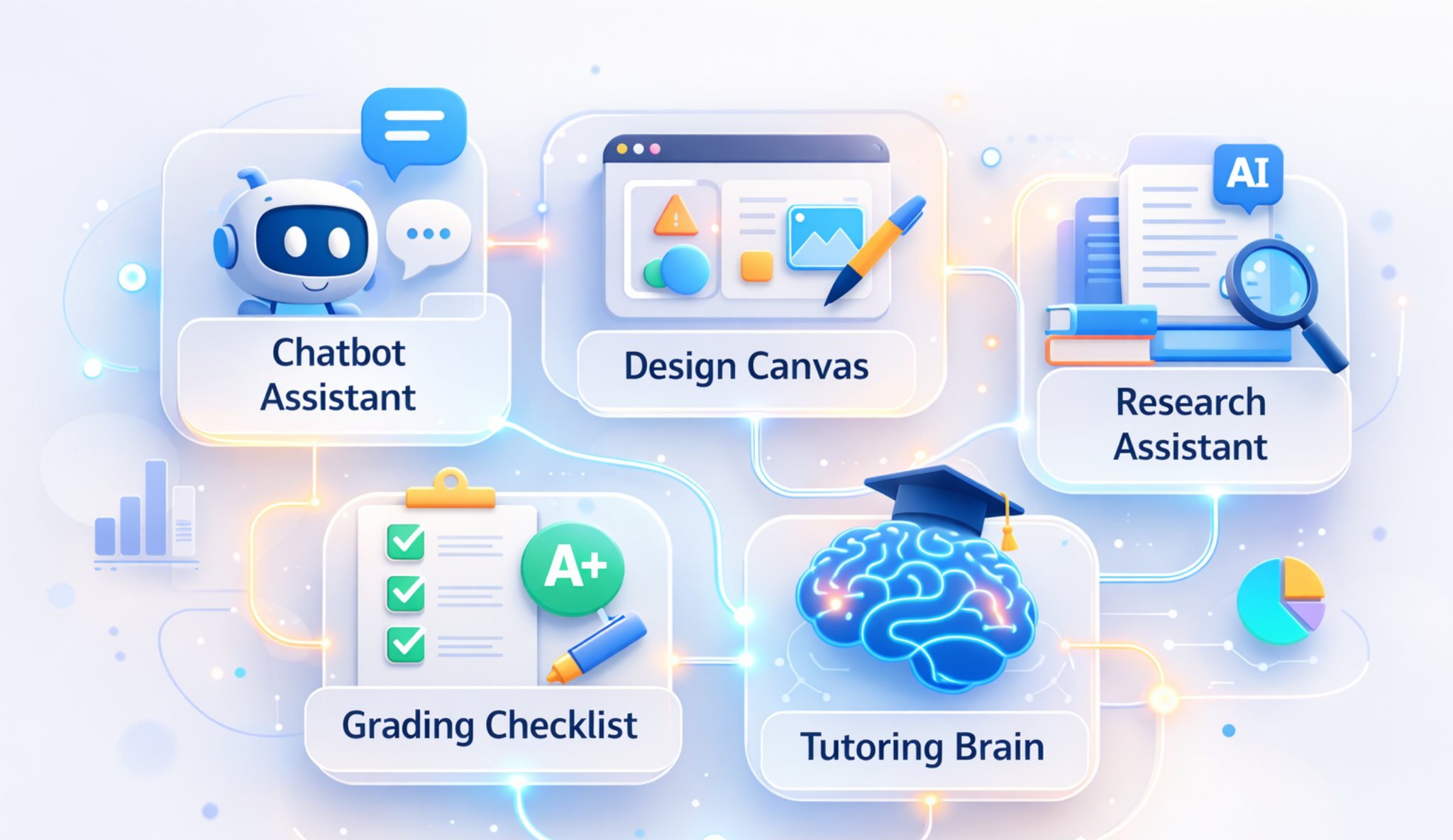
ChatGPT has become one of the most widely used AI tools for teachers.
Educators use it to:
- generate lesson plans
- create quizzes
- explain complex concepts
- develop classroom activities
- draft emails and announcements
Example use case:
A professor teaching entrepreneurship can ask:
“Create a 45-minute classroom activity on product-market fit.”
Within seconds, ChatGPT generates a structured activity plan.
What used to take 30 minutes now takes 30 seconds.
Students retain information better when learning is visual.
Canva’s AI features help teachers instantly create:
- presentations
- infographics
- classroom posters
- interactive worksheets
Instead of designing slides from scratch, teachers can simply enter a topic and let AI generate the design.
For visual learners, this dramatically improves engagement.
Grading is one of the most time-consuming tasks in education.
Gradescope uses AI to help teachers:
- grade assignments faster
- apply consistent scoring
- provide structured feedback
Large universities use Gradescope to manage thousands of assignments efficiently.
The benefit isn’t just speed, it’s fairness and consistency.
Unlike general AI tools, MagicSchool AI was designed specifically for educators.
Its tools include:
- AI lesson plan generators
- IEP support tools
- differentiated learning resources
- writing feedback tools
For teachers who want an education-specific AI assistant, MagicSchool is one of the fastest growing platforms.
Khan Academy introduced Khanmigo, an AI tutor designed to help students learn through guided reasoning.
Instead of giving answers directly, Khanmigo:
- asks questions
- prompts critical thinking
- supports problem solving
Teachers can use it as a 24/7 tutoring assistant that supports students outside class.
While these AI tools dramatically reduce preparation time, the real opportunity is what teachers do with the time they gain back.
Many business educators are using that extra time to introduce experiential learning formats such as startup simulations. Startup Wars allows students to run a virtual startup, make strategic decisions, and compete with classmates, turning theory into real-world business practice.
For educators teaching entrepreneurship or innovation, combining AI productivity tools with interactive simulations can dramatically increase engagement.
The Controversial Truth: AI Won’t Replace Teachers
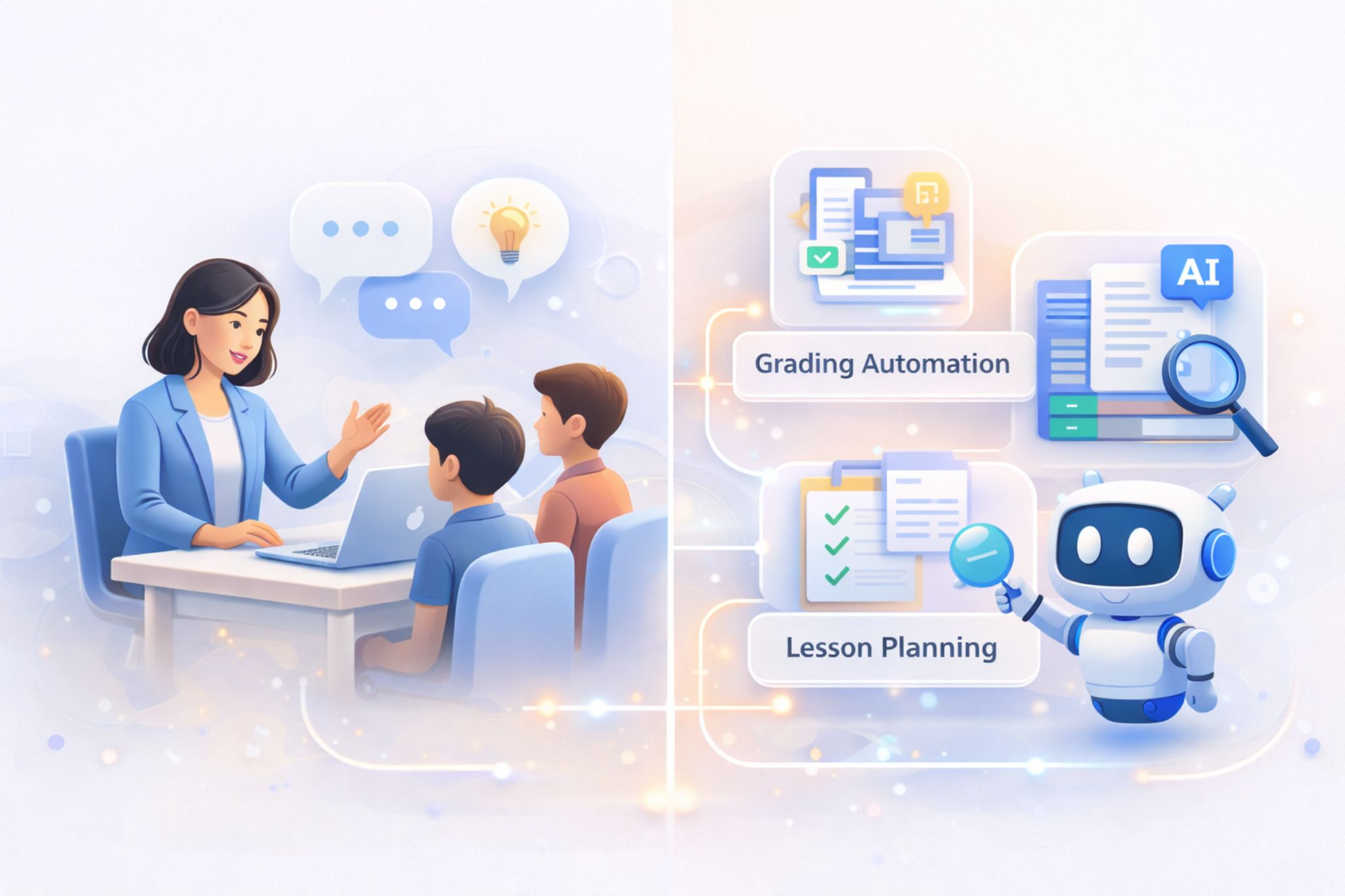
There’s a common fear in education.
“If AI can teach… will teachers become obsolete?”
The reality is the opposite.
AI is best at automating repetitive tasks.
Teachers are best at:
- mentoring students
- facilitating discussion
- guiding critical thinking
- building emotional connections
Education experts increasingly agree that AI will amplify great teachers, not replace them.
The classroom of the future isn’t teacher vs AI.
It’s teacher + AI working together.
In fact, the more AI automates routine work, the more valuable human-led learning experiences become.
That’s why many universities are investing in tools that emphasize active learning, such as entrepreneurship simulations. Startup Wars helps educators transform traditional lectures into decision-based experiences where students test ideas, analyze outcomes, and refine strategies, exactly the kinds of skills AI alone cannot teach.
Beyond AI Tools: The Next Step Is AI-Powered Learning Experiences
AI tools can save teachers time.
But they don’t automatically make learning more engaging.
That’s where experiential learning technologies come in.
Instead of passive lectures, many universities are now adopting interactive simulations that let students learn by doing.
While AI tools help educators automate preparation tasks, they don’t automatically make learning more interactive. Many universities are now combining AI productivity tools with experiential learning platforms where students practice real-world decision making.
One example is using entrepreneurship simulations for business education, where students run a startup, test strategies, and see the consequences of their decisions in real time.
Students must make decisions about:
- product development
- marketing strategy
- pricing
- hiring
- growth strategy
Instead of simply reading about business strategy, students experience the consequences of their decisions in real time.
The result?
Higher engagement and deeper learning outcomes.
How to Start Using AI in Your Classroom
Adopting AI tools doesn’t require a complete curriculum redesign.
Start with a simple framework:
Step 1 – Use AI for preparation
Let AI help with:
- lesson planning
- quiz creation
- research summaries
Step 2 – Use AI for student support
Introduce tools that help students:
- review concepts
- practice skills
- receive personalized feedback
Step 3 – Introduce experiential learning
Use the time saved by AI tools to integrate hands-on learning environments. For example, entrepreneurship instructors often combine AI-generated lesson materials with simulations like Startup Wars, where students manage a startup, make strategic decisions, and see the consequences of their choices unfold in real time.
This turns AI-assisted preparation into AI-augmented teaching experiences.
For example, many educators begin by experimenting with simple assignments designed specifically for AI-assisted evaluation. This AI assessment guide with ready-to-use assignments teachers can grade this week provides practical examples you can implement immediately.
The Future of Teaching Is AI-Augmented
Here’s the bold prediction.
Within five years, AI will be as common in classrooms as PowerPoint.
Educators who adopt these tools early will gain a huge advantage:
- more efficient teaching
- more engaging lessons
- better student outcomes
But tools alone are not enough.
The real transformation happens when AI supports active, experiential learning environments.
If you’re a business professor or curriculum director looking to increase student engagement, the next step is combining AI tools with experiential learning.
Startup Wars helps students experience entrepreneurship, not just study it.
📅 Schedule a Free Demo and see how Startup Wars can transform your classroom.
Frequently Asked Questions
1. What are the best AI tools for teachers in 2026?
2. How can AI help teachers save time?
3. Is AI replacing teachers in classrooms?
4. What is the best AI tool for lesson planning?
5. How can AI improve student engagement?
Let's Empower The Next Generation Of Founders
Schedule a call with our team to explore how Startup Wars can fit into your classroom.