Imagine this scenario.
You ask your entrepreneurship students to design a business idea.
Half of them open PowerPoint.
Some write vague mission statements.
Others create slide decks full of buzzwords.
But very few actually understand how a business works as a system.
If you’re a professor or curriculum director, you’ve probably seen this before.
The problem isn’t your teaching.
The problem is the toolset students are using.
Because whiteboards alone won’t cut it anymore.
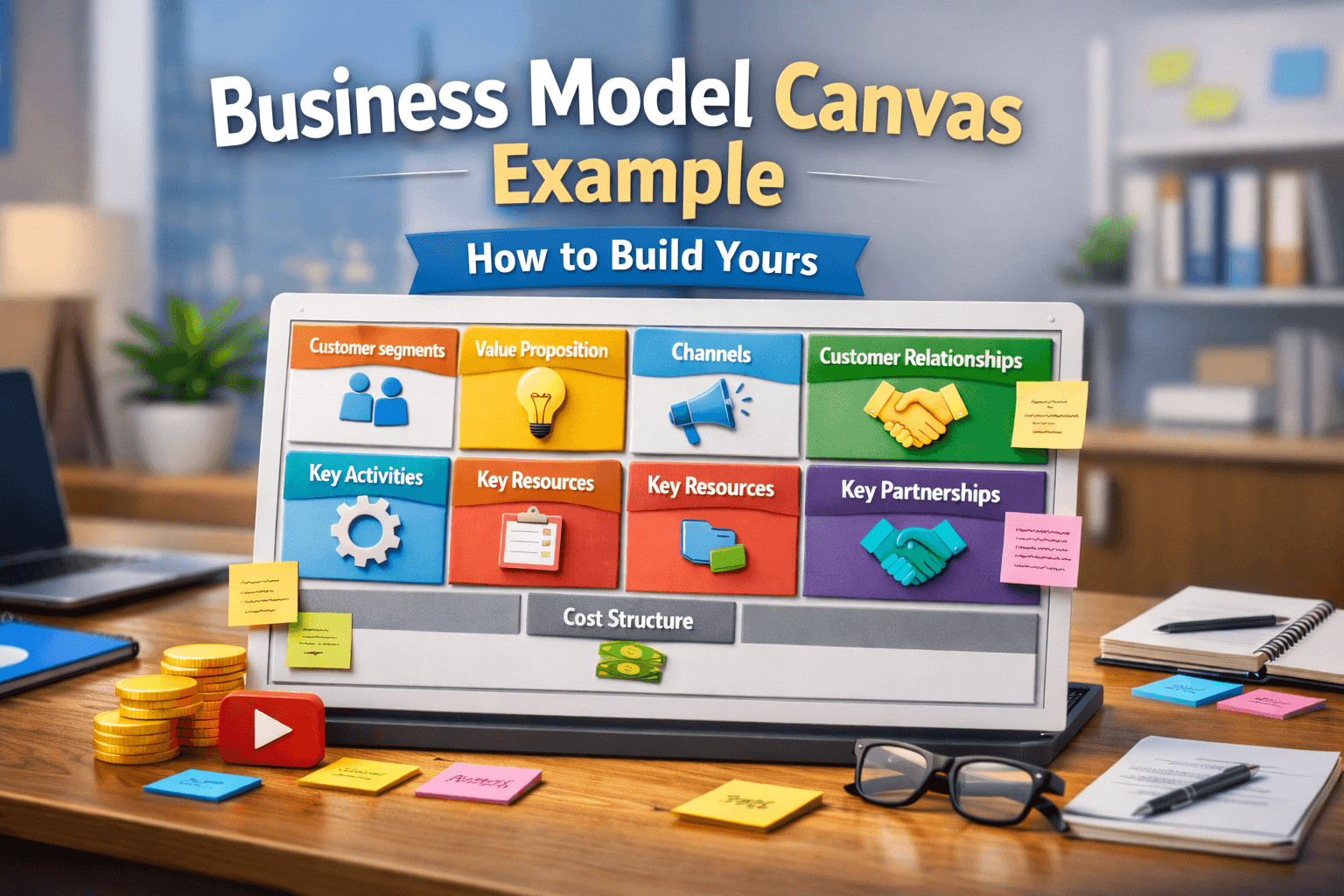
Today, one of the most powerful frameworks for teaching entrepreneurship is the Business Model Canva, a simple, visual way to design and test business ideas.
In this guide, we’ll walk through:
- A real business model canvas example
- A step-by-step method students can follow
- A free template you can use in your classroom
Let’s dive in.
Table of Contents
What Is a Business Model Canvas?
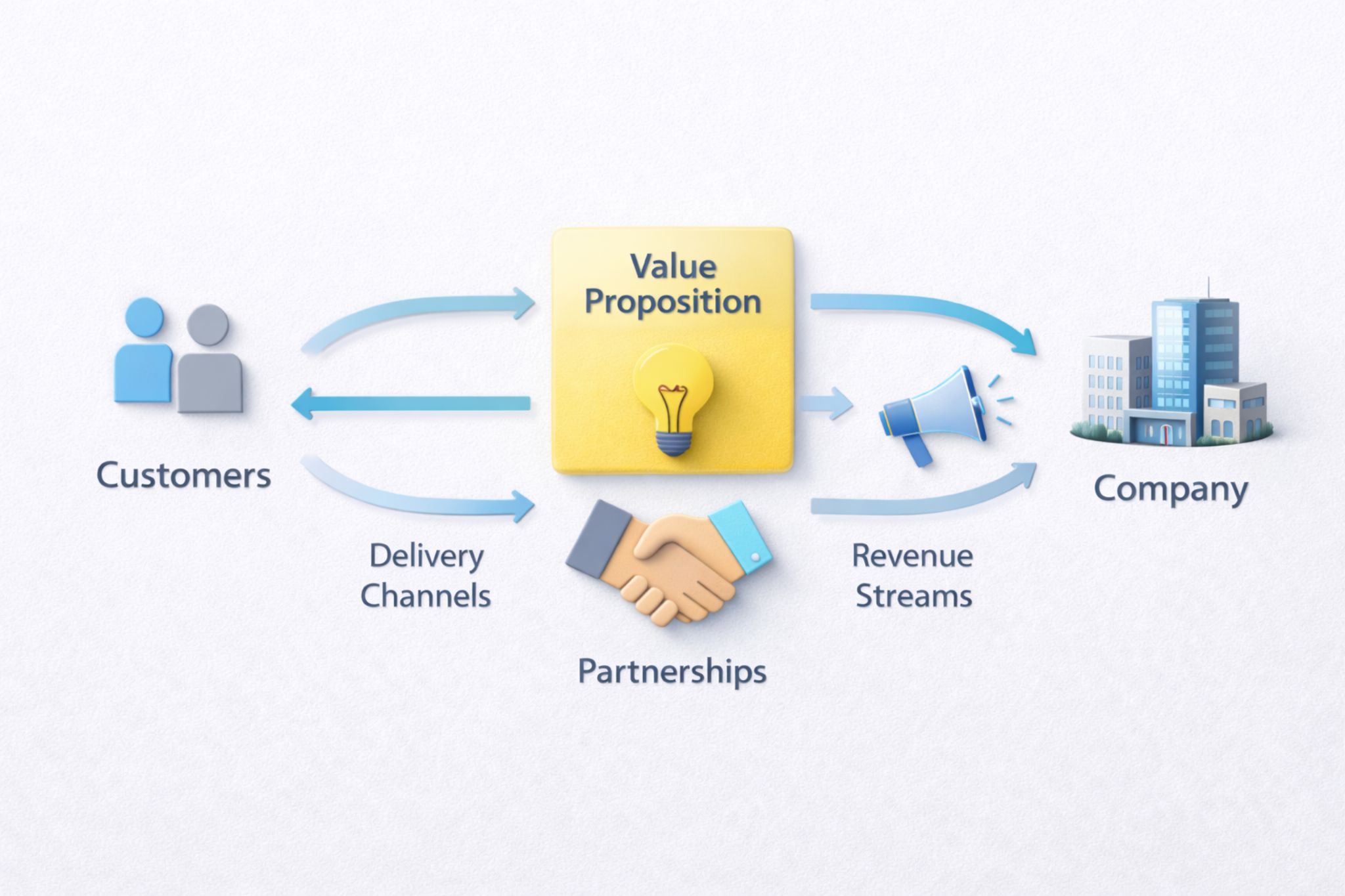
A Business Model Canvas (BMC) is a one-page framework used to describe how a business creates, delivers, and captures value.
Instead of writing a 40-page business plan, the canvas helps entrepreneurs visualize the entire business model on a single page.
It was introduced by Alexander Osterwalder and quickly became one of the most widely used tools in entrepreneurship education.
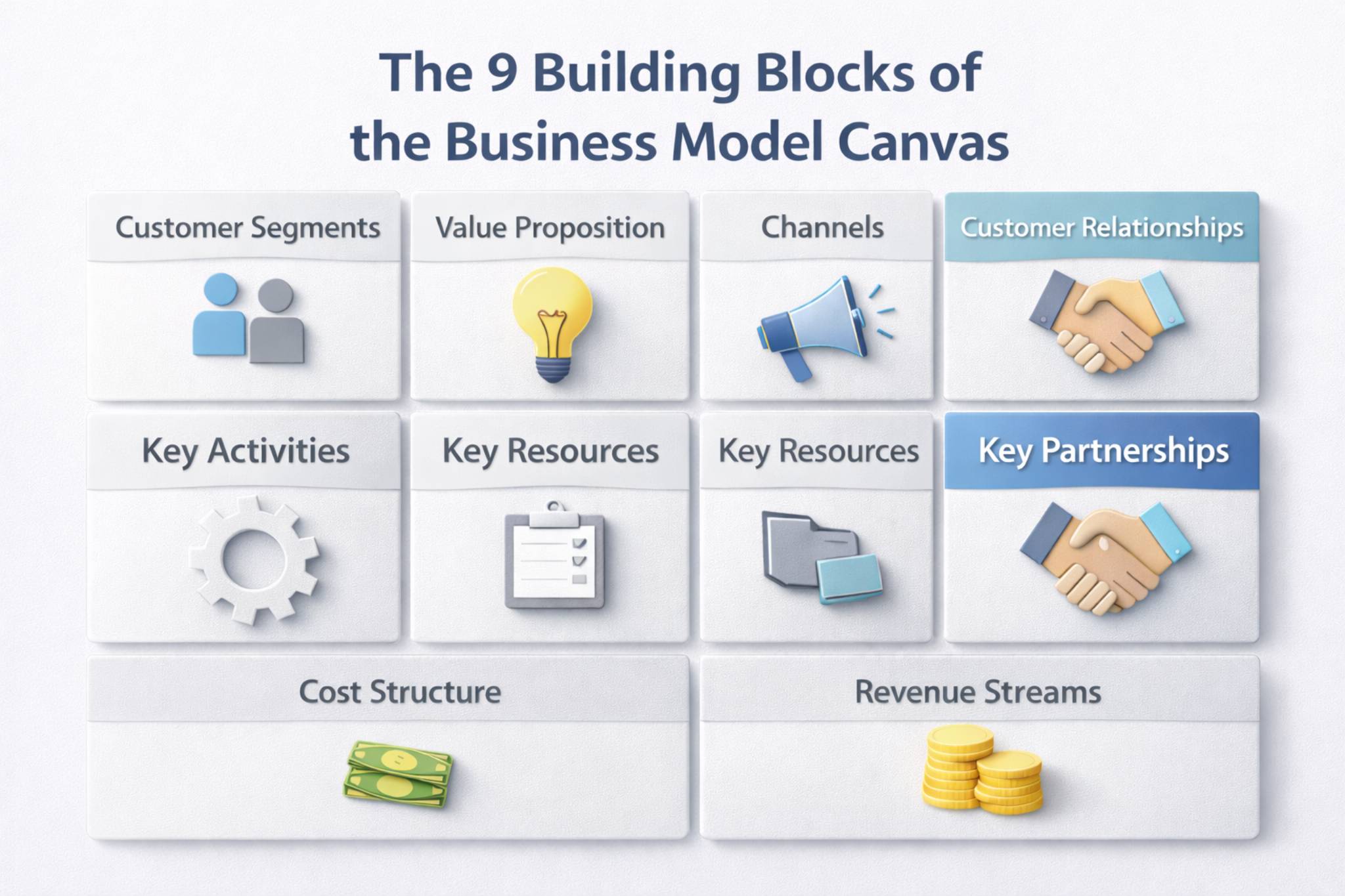
The canvas includes nine key building blocks that represent the core elements of any business.
These components allow students to understand how every part of a company connects, from customers to revenue streams.
Understanding the Business Model Canvas conceptually is one thing, actually applying it is another. Many educators find that students grasp the framework much faster when they can test it in a simulated startup environment. Platforms like Startup Wars allow students to build and iterate on business models while competing with peers, turning the canvas from a static diagram into a living strategy tool.
The 9 Building Blocks of the Business Model Canvas
Every business model canvas is built using the same nine sections.
Who are your target customers?
Examples:
- College students
- Small business owners
- SaaS startups
Understanding your audience is the foundation of the entire business model.
What problem are you solving?
Examples:
- Save time
- Reduce costs
- Improve productivity
- Provide entertainment
This is the core reason customers choose your product.
How will customers discover and purchase your product?
Common channels include:
- Online stores
- Social media
- Partnerships
- Direct sales
How will you interact with customers?
Examples:
- Self-service
- Personal assistance
- Automated services
- Communities
How does the business make money?
Examples:
- Subscriptions
- One-time purchases
- Licensing
- Advertising
What assets are required to operate the business?
Examples:
- Technology
- Employees
- Intellectual property
- Brand reputation
What must the company do to deliver its value proposition?
Examples:
- Product development
- Marketing
- Customer support
Which external partners are necessary?
Examples:
- Suppliers
- Technology providers
- Strategic collaborators
What are the major costs of operating the business?
Examples:
- Salaries
- Marketing expenses
- Infrastructure
- Software
Students often understand each block individually, but the real learning happens when they see how these blocks interact in real business scenarios. In a simulation environment like Startup Wars, students adjust pricing, customer segments, and partnerships, and immediately see how those decisions affect their company’s performance. This helps transform the canvas from theory into applied entrepreneurship.
Business Model Canvas Example
Let’s walk through a simple example.
Example Startup: CampusBites
A mobile app that helps college students discover affordable local restaurants.
Customer Segments
College students and university communities.
Value Proposition
Affordable meal recommendations near campus with student discounts.
Channels
Mobile app
Social media marketing
University partnerships
Customer Relationships
Self-service app experience
Community reviews
Revenue Streams
Restaurant advertising
Premium restaurant listings
Key Resources
Mobile app platform
Restaurant partnerships
Student marketing ambassadors
Key Activities
App development
Restaurant onboarding
Marketing campaigns
Key Partnerships
Local restaurants
Universities
Payment processors
Cost Structure
App development
Marketing
Operational costs
With just one page, students can understand how the entire business operates.
That’s the power of the canvas.
Examples like CampusBites help students visualize how a business model works in practice. However, many professors take this a step further by letting students build and compete with their own startup models. With tools like Startup Wars, students can apply the Business Model Canvas to simulated ventures, test strategies against classmates, and refine their ideas based on results.

Step-by-Step: How to Create a Business Model Canvas
Here’s a simple process students can follow in class.
Step 1 — Define the Customer
Start with a clear target audience.
Ask students:
Who specifically will use this product?
Step 2 — Identify the Problem
What frustration or need does the customer have?
The best business ideas solve specific, painful problems.
Step 3 — Craft the Value Proposition
Now define the solution.
What makes your product unique?
Step 4 — Determine Revenue Streams
How will the business generate income?
Students should think beyond pricing and consider business model types.
Step 5 — Map Channels and Relationships
How will the company reach customers and maintain relationships?
Step 6 — Identify Resources and Activities
What must the company do internally to operate?
Step 7 — Estimate Costs
Finally, identify the most significant costs.
Students quickly realize that great ideas still require sustainable economics.
Filling out a Business Model Canvas is a great first step, but entrepreneurship becomes truly engaging when students experiment with their ideas. Many instructors now pair the canvas framework with startup simulations like Startup Wars, where students can test assumptions, pivot their strategies, and experience how business models evolve in competitive markets.
How Professors Can Teach the Business Model Canvas More Effectively

Here’s where things get interesting.
Many educators introduce the canvas as a static worksheet.
Students fill it out once… and never revisit it.
But the canvas is actually meant to be iterated repeatedly.
Entrepreneurship is experimentation.
Students should test assumptions, refine their model, and update their canvas.
One of the most effective ways to teach this process is through interactive business simulations.
Instead of just filling out templates, students can:
- Launch simulated companies
- Compete with peers
- Adjust pricing and strategy
- See real outcomes
This transforms the canvas from theory into experiential learning.
And that’s where platforms like Startup Wars come in.
Startup Wars allows educators to turn entrepreneurship courses into interactive startup competitions, where students apply frameworks like the Business Model Canvas in real-world scenarios.
Research consistently shows that students retain knowledge better through experiential learning and simulations. When entrepreneurship courses integrate tools like Startup Wars, students move beyond memorizing frameworks and instead learn by building companies, making decisions, and seeing the consequences in real time.
Why Experiential Learning Is the Future of Entrepreneurship Education
Students don’t learn entrepreneurship by memorizing frameworks.
They learn by building, testing, failing, and iterating.
The Business Model Canvas is powerful because it simplifies complex business systems into something students can actually experiment with.
But when combined with simulations, competitions, and real-time decision making, the learning impact becomes dramatically stronger.
That’s why more universities are shifting from lecture-based teaching to interactive entrepreneurship platforms.
Ready to Bring Startup Simulations Into Your Classroom?
If you want students to move beyond theory and actually experience entrepreneurship…
Startup Wars helps professors transform courses into startup competitions where students build and test real business models.
Professors use Startup Wars to:
- Teach entrepreneurship faster
- Increase student engagement
- Simulate real startup environments
- Apply tools like the Business Model Canvas in practice
📅 Schedule a Free Demo
See how universities are using Startup Wars to turn entrepreneurship courses into immersive startup experiences.
Frequently Asked Questions
1. What is a business model canvas?
2. What are the 9 elements of the business model canvas?
3. Why is the business model canvas useful for students?
4. Is the business model canvas better than a business plan?
5. How can professors teach the business model canvas effectively?
Let's Empower The Next Generation Of Founders
Schedule a call with our team to explore how Startup Wars can fit into your classroom.