
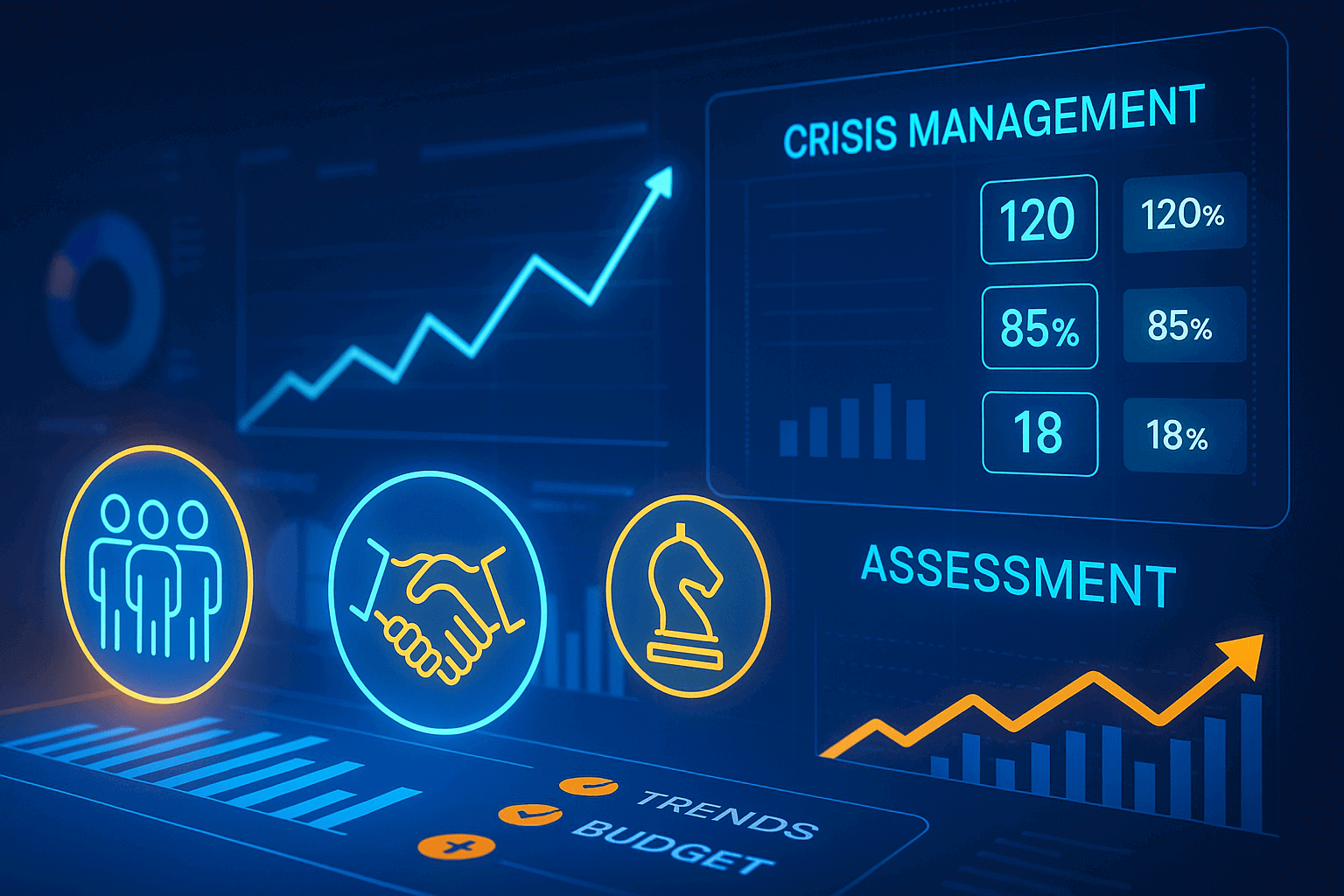
Business simulations can help learners practice complex decisions in a setting where mistakes become material for discussion instead of real-world losses. The strongest learning outcomes come from the way an instructor connects the experience to course goals, assessment, feedback, and reflection.
This guide explains the outcomes a business simulation can support. It does not claim that using a simulation automatically produces a particular percentage improvement. Results depend on the learners, course design, facilitation, time available, and evidence an instructor collects.
Learning outcomes business simulations can support
Applying business concepts
Students move beyond defining a concept and use it in a connected situation. A pricing decision can affect demand, revenue, inventory, staffing, and cash. Seeing those relationships helps learners explain why a business choice cannot be evaluated in isolation.
Decision-making under constraints
A simulation can give learners a limited budget, incomplete information, and several reasonable options. Students must identify priorities, state assumptions, choose a direction, and accept tradeoffs. Instructors can assess the quality of that reasoning even when the simulated result is not the highest score.
Financial literacy
Learners can practice reading business information, estimating costs, managing cash, and connecting operating choices to financial results. A useful assessment asks students to interpret what changed and recommend a next step, not simply report a final number.
Strategic thinking
Business decisions unfold over time. Students can form a hypothesis, make a choice, observe the result, and revise their plan. This cycle supports conversations about positioning, opportunity cost, risk, and the difference between a short-term reaction and a longer-term strategy.
Communication and collaboration
Team-based simulations give learners a reason to compare evidence and defend a recommendation. Instructors can make the outcome visible by requiring a decision memo, role-based team notes, a presentation, or an individual reflection alongside group work.
Adaptability and reflection
An unexpected result can be more useful than an easy success when learners have time to examine it. A structured debrief can ask what the team expected, what happened, which assumption changed, and what they would do next.
Entrepreneurial understanding
Running a simulated venture can help students see how customers, operations, marketing, people, and finance connect. The experience does not replace customer discovery, work experience, or launching a real business. It provides a lower-risk place to practice the thinking those activities require.
How instructors can measure these outcomes
Start with one or two course outcomes and decide what evidence will demonstrate them. Useful evidence may include:
- a rationale recorded before a decision;
- a calculation or forecast;
- a comparison between expected and actual results;
- a team recommendation supported by evidence;
- an individual reflection on a mistake or changed assumption;
- a revised strategy for the next round.
This approach separates participation from learning. Completing a simulation shows that a learner took part. The accompanying work shows how well the learner understood, applied, and reflected on the concepts.
What the public evidence currently shows
The Startup Wars Evidence and Outcomes Center distinguishes independently verifiable information from company-reported adoption figures. Public sources document specific educational uses of Startup Wars and its recognition in the 2023 QS Reimagine Education awards. Those sources do not establish that every learner will achieve a fixed improvement in engagement, confidence, retention, or job readiness.
Educators and procurement teams should evaluate the platform against their own learning objectives, accessibility requirements, implementation needs, and assessment plan. When outcome data is collected, the course context and measurement method should be reported with it.
A practical course-planning sequence
- Name the business skill students should demonstrate.
- Choose a simulation series and scenario that creates the relevant decisions.
- Explain the constraints and success criteria.
- Require students to record their reasoning before results appear.
- Debrief the outcome and identify changed assumptions.
- Collect an individual artifact that can be assessed.
Business simulations are most useful when they create evidence for teaching. The decision starts the learning process; feedback, discussion, and reflection make that process visible.
Educators can explore the Startup Wars simulation series, review documented evidence and its limits, or contact the team to discuss course fit.
About the author
Startup Wars Editorial Team
Entrepreneurship education contributors
The Startup Wars editorial team shares practical guidance on experiential learning, business education, and helping learners build real-world skills.