Product Launch Plan Lessons from Logan Jones
What First-Time Founders Should Do Before Launch
A lot of startup stories begin with a polished product.
But many real founder journeys begin much earlier, with a rough idea, an unfinished MVP, and one urgent question:
How do we get this in front of the right people?
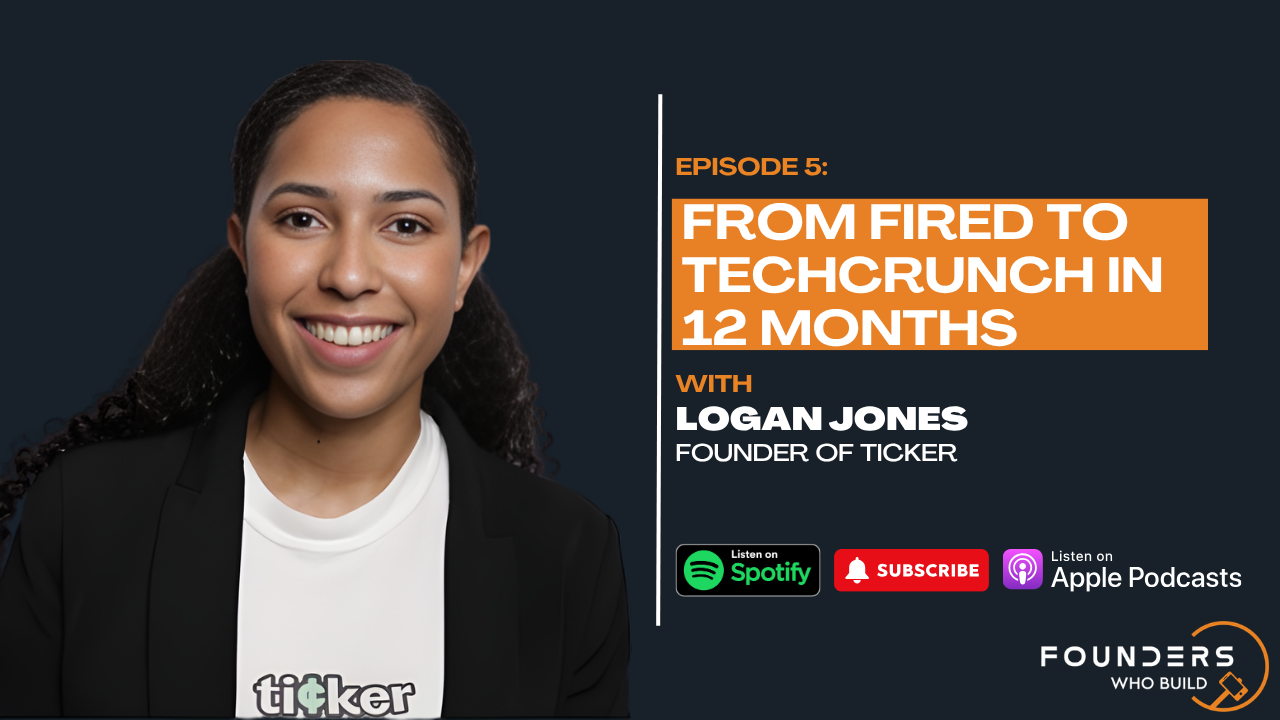
For Logan Jones, founder of Ticker, that question became one of the biggest lessons in her startup journey. In this episode of Founders Who Build, Logan shares how she went from getting fired to pitching at TechCrunch, building a team, finding early users, and learning why a product launch plan matters before everything feels perfect.
Her story is not just about launching a fintech app. It is about what first-time founders often learn the hard way: shipping fast, testing with real users, building systems, and preparing for distribution before the product feels completely ready.
For students, educators, and aspiring founders, Logan’s journey offers a practical look at entrepreneurship beyond the classroom: messy, resourceful, imperfect, and deeply real.
TL;DR: Product Launch Plan Lessons from Logan Jones
A strong product launch plan should help founders get in front of users early, even before the product feels perfect.
In this episode of Founders Who Build, Logan Jones shares how she built Ticker from rough mockups to a real app preparing for launch.
One of Logan’s biggest lessons was that first-time founders can lose time by over-focusing on product instead of learning from real users.
She says Ticker should have shipped earlier, gathered feedback faster, and improved the product based on what users actually needed.
Her early user strategy focused on college investing clubs because one club could introduce the app to dozens of potential users.
That approach turned customer acquisition into a group-based strategy instead of a one-user-at-a-time process.
The episode also shows why launch readiness is not just about the app. It includes user research, distribution, feedback loops, systems, and timing.
Logan used tools like ChatGPT, Notion, Slack, and Fathom to organize accelerator applications, investor outreach, hiring, and team communication.
For first-time founders, the takeaway is simple: build the product, but do not wait too long to test it with real people.
For educators, this founder story can help students understand product launch planning, customer discovery, MVP testing, and go-to-market strategy in a practical way.
Founders Who Build is a content series by Startup Wars, where high school students and college-aged young adults build entrepreneurship skills in a risk-free digital learning environment.
Watch the Full Founders Who Build Interview
Prefer to watch instead of read? Watch the full conversation with Logan Jones, founder of Ticker, on Founders Who Build.
How to Build a Product Launch Plan Before Everything Feels Ready
A product launch plan is not just a checklist for launch day. For first-time founders, it is a way to answer a few critical questions before the pressure gets loud:
-Who needs this product?
-How will we reach them?
-What feedback do we need before launch?
-What systems will keep the team moving?
-What should we ship now, and what can wait?
Logan’s experience building Ticker shows why those questions matter early. Ticker is a social investing app that lets users see what their friends, family, and network are buying and selling in the stock market, with trades verified directly from brokerages.
The product idea came from a personal frustration. Logan had received a free share of GameStop, sold it after doubling her money, and then watched the stock climb dramatically months later. That moment led her to ask a bigger question: how did other people know not to sell?
The answer was not simply more research. It was visibility.
That insight became the foundation for Ticker. But turning an idea into a real product required much more than inspiration. Logan had to think through mockups, compliance, developers, user feedback, pitch opportunities, launch timing, and distribution.
That is where the real product launch plan began.
From Getting Fired to Building Ticker
Logan’s founder journey did not begin with a perfect setup. She had a background in business and law, worked as chief of staff at a legal AI startup, and later worked in financial services. In the background, she kept thinking about Ticker.
Then she got let go from her job.
For many people, that kind of moment can feel like a full stop. For Logan, it became a push. She described it as being kicked out of the nest to work on Ticker.
That shift forced her to take the idea more seriously. What started as a concept became mockups. The mockups led to conversations. The conversations led to collaborators. Eventually, she built a team and started preparing Ticker for launch.
One of the most useful parts of her story is that she did not pretend to have everything figured out. She was not technical. She did not have a huge budget. She was learning product, hiring, startup operations, and fundraising while building.
That is what makes her journey valuable for students and first-time founders. It shows that entrepreneurship is rarely a straight line. More often, it is a series of decisions made with imperfect information.
The Product Idea: Turning a Real Frustration Into a Startup
Ticker started with a clear problem: investing can feel social, but the information people share online is often noisy, unverified, or influenced by hype.
Logan saw this firsthand through online investing communities. People were discussing trades, stocks, and strategies, but it was hard to know who was actually acting on what they said.
So Ticker was built around a different idea: what if users could see verified trading activity from people in their network?
That product idea is important because it came from a real behavior. People were already talking about investments with friends. People were already looking online for clues. People were already trying to understand what others were doing with their money.
A strong product launch plan should begin there: with a real behavior, pain point, or repeated question.
For founders, the goal is not just to ask, “What product can we build?” It is to ask, “What problem are people already trying to solve, and how can we make that easier, clearer, or more valuable?”
Why First-Time Founders Should Ship Before the Product Feels Perfect
One of Logan’s biggest reflections from the interview was that Ticker should have gotten in front of users faster.
She explained that the team did not love the front end and ended up rebuilding much of it. That decision uncovered additional backend and infrastructure issues, pushing the MVP timeline further back.
Her takeaway was blunt but useful: something ugly is better than nothing at all.
That does not mean founders should launch careless products. It means they should avoid hiding from feedback behind endless improvements.
For a first-time founder, this is one of the hardest product launch lessons to learn. It is tempting to keep polishing. It feels safer to fix one more screen, adjust one more feature, or wait until the product looks closer to the dream version.
But real users teach you things that internal debates cannot.
They show you what is confusing.
They reveal what matters most.
They expose wrong assumptions.
They help you see whether the product solves the problem you think it solves.
A product launch plan should include a clear moment when the product gets into users’ hands, even if the founder still sees flaws.
Especially if the founder still sees flaws.
How to Find Early Users Before Launch
Logan’s early user strategy is one of the strongest practical lessons from the episode.
Instead of trying to reach individual users one by one, she asked a smarter question:
How can I get a lot of the right people at once?
Because Ticker was built for social investing, Logan looked for groups where people were already interested in investing. That led her to college investing clubs, finance clubs, business clubs, and crypto clubs.
The logic was simple. One individual user is valuable, but one club could represent dozens of potential users.
So she built a list manually. She researched universities state by state, found club contact information, created a spreadsheet, and started reaching out. It was time-consuming, but it helped her validate the idea, pitch potential users, and collect feedback.
That is a key product launch plan lesson: early distribution often starts with the smallest audience that already cares.
Founders do not always need to reach “everyone.” They need to find the group most likely to understand the problem, try the product, and give useful feedback.
For Ticker, that group was college investing clubs. For another startup, it might be local business owners, teachers, student organizations, online communities, niche Slack groups, or professional associations.
Startup Go-to-Market Lessons from Ticker’s College Club Strategy
Logan’s college club strategy also shows the difference between product planning and go-to-market planning.
A product plan asks: what are we building?
A go-to-market plan asks: how will people discover, trust, and use it?
Ticker’s college club strategy worked because it matched the product’s social nature. The app depended on network effects, which means it became more useful when people joined with others they knew.
That made clubs a smart launch channel. Students were already connected, already discussing investing, and already part of a shared community.
This is a useful lesson for first-time founders: your launch channel should fit your product behavior.
If your product is social, look for groups.
If your product solves a workplace problem, look for teams.
If your product helps educators, look for schools, programs, or departments.
If your product supports creators, look for creator communities.
A strong product launch plan should not treat distribution as an afterthought. It should connect the product, the audience, and the channel from the beginning.
Product Launch Checklist for First-Time Founders
Before launch, first-time founders should be able to answer a few practical questions. Logan’s story gives us a useful product launch checklist:
1. Is the problem clear?
Ticker was built around a specific insight: people wanted more visibility into what others were actually doing in the market, not just what they were saying online.
2. Do you know who the first users are?
Logan focused on college investing clubs because they were a concentrated group of people likely to care about the product.
3. Have real users seen the product?
One of Logan’s biggest lessons was that Ticker should have gotten in front of users sooner. Feedback matters more when it comes from the people you are building for.
4. Is the team ready to learn after launch?
Launch is not the end of the process. It is the beginning of better learning.
5. Do you have a distribution path?
For Ticker, clubs became a path to early users. For other startups, this might be partnerships, communities, email lists, events, or direct outreach.
6. Are your systems organized?
Logan used tools like Notion, Slack, ChatGPT, and Fathom to manage workstreams, hiring, investor outreach, and accelerator applications.
7. Are you willing to ship before it feels perfect?
This may be the hardest question. But as Logan’s experience shows, waiting too long can delay the feedback founders need most.
How Customer Feedback Can Change the Product Before Launch
Another important part of Logan’s story is how feedback changed the product.
She brought in product managers who challenged her assumptions. Some were not instantly sold on the idea, and that was exactly why they were useful. They pushed her to prove what she believed about users.
Through user interviews, the team learned more about different investor types. New investors often felt hesitant because they lacked confidence and information. Intermediate investors wanted validation. More experienced investors wanted better ways to manage research without spending endless hours.
That feedback helped Logan see how AI could fit into the product in a meaningful way, not just as a buzzword.
This is a great example of customer development in action. Feedback did not simply confirm the original idea. It made the product sharper.
For educators teaching entrepreneurship, this is an especially useful example. Students often think validation means asking, “Do people like my idea?” But real validation goes deeper. It asks:
What are users struggling with?
What assumptions are we making?
What would make the product more useful?
What behavior are users already showing?
What would make them trust this solution?
Those are the questions that turn a product idea into a stronger launch strategy.
Founder Systems That Keep a Product Launch Moving
Logan also emphasized the importance of systems.
She used Notion to track accelerator applications, investor outreach, hiring, and team workflows. She used Slack for communication, ChatGPT to speed up applications and messaging, and Fathom to summarize calls and create follow-up tasks.
Her philosophy was simple: you can plug people into systems, but people cannot replace systems.
That is a powerful lesson for first-time founders. When a startup is small, it is easy to keep everything in your head. But as soon as more people join, that approach breaks.
A product launch plan needs systems for:
Hiring
User research
Investor outreach
Product feedback
Team communication
Launch tasks
Partnerships
Follow-ups
Without systems, important details disappear. With systems, the team can move faster without relying on one person to remember everything.
What Students Can Learn from Real Product Launch Decisions
Logan’s story is valuable because it shows entrepreneurship as it actually happens.
There are rough mockups.
There are timeline delays.
There are technical setbacks.
There are feedback loops.
There are moments of doubt.
There are small opportunities that lead to bigger ones.
That kind of story is especially useful for students because it makes business concepts feel real. Product launch planning is not just a diagram in a textbook. It is a series of decisions under uncertainty.
Should we ship now or wait?
Should we rebuild or test?
Which users should we talk to first?
Which channel gives us the best chance to learn?
How do we know if the idea is working?
Those questions help students practice the founder mindset.
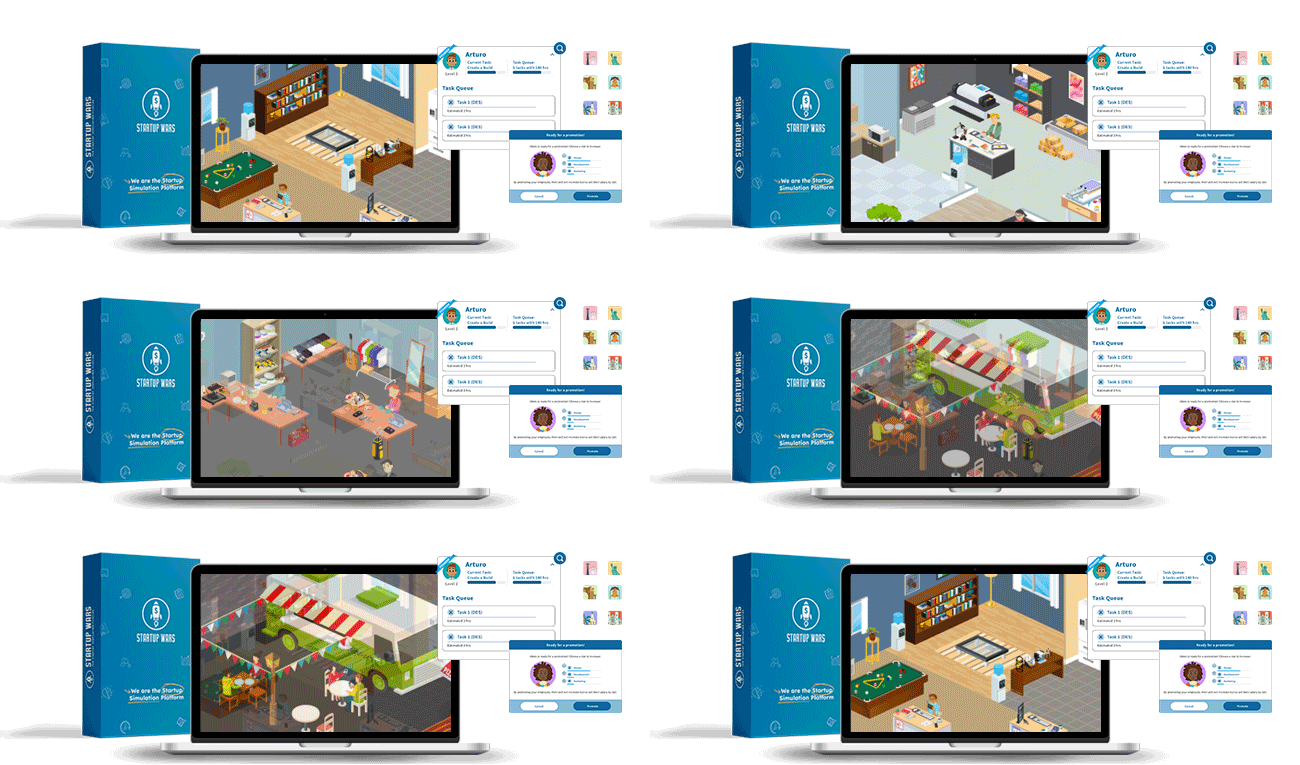
Startup Wars helps students go one step further by letting them practice those decisions through hands-on business simulations. Students can test strategies, make tradeoffs, build confidence, and experience the challenges of entrepreneurship before launching something of their own.
For educators who want a deeper look at how this type of learning works, Startup Wars also explains what a business simulation is and how it helps students practice entrepreneurship in a risk-free environment.
Practice Entrepreneurship in a Risk-Free Digital Environment
Founder stories like Logan’s remind us that entrepreneurship is not only about the big launch moment. It is about the decisions that happen before launch: the research, the user conversations, the systems, the pivots, and the willingness to learn before everything feels perfect.
A strong product launch plan gives founders a way to move from idea to action. It helps them test earlier, listen better, and build with users instead of guessing from a distance.
For students, that kind of learning can be transformative.
Startup Wars gives high school students and college-aged young adults a risk-free digital environment where they can build entrepreneurship skills through simulated ventures like supply management, marketing, business strategy, and more.
If you are an educator looking for a more engaging way to teach entrepreneurship, Startup Wars can help students move beyond theory and into real-world decision-making.