If you’re a business professor, dean, or curriculum director, you already know this:
Student engagement isn’t about attendance. It’s about ownership.
And in 2026, universities are investing heavily in student engagement platforms to solve this challenge.
But here’s the uncomfortable truth:
Most platforms increase communication.
Few increase transformation.
Brace yourself, because whiteboards alone won’t cut it anymore.
Table of Contents
A student engagement platform is software designed to improve student participation, communication, retention, and academic success through digital tools such as messaging systems, analytics dashboards, AI support, and interactive learning features.
Most platforms focus on:
Communication automation
Behavioral tracking
Early-alert systems
Predictive analytics
Chatbots and AI advising
But engagement ≠ notification frequency.
Engagement means students care about the outcome.
And that’s where the conversation gets interesting.
The Mindset Shift: Engagement Is Not Clicks
Students don’t engage because you emailed them more.
They engage when they are:
Responsible for decisions
Under pressure to perform
Competing or collaborating
Seeing real-world consequences
That’s not a messaging feature.
That’s experiential learning.
And most student engagement software doesn’t address that layer.
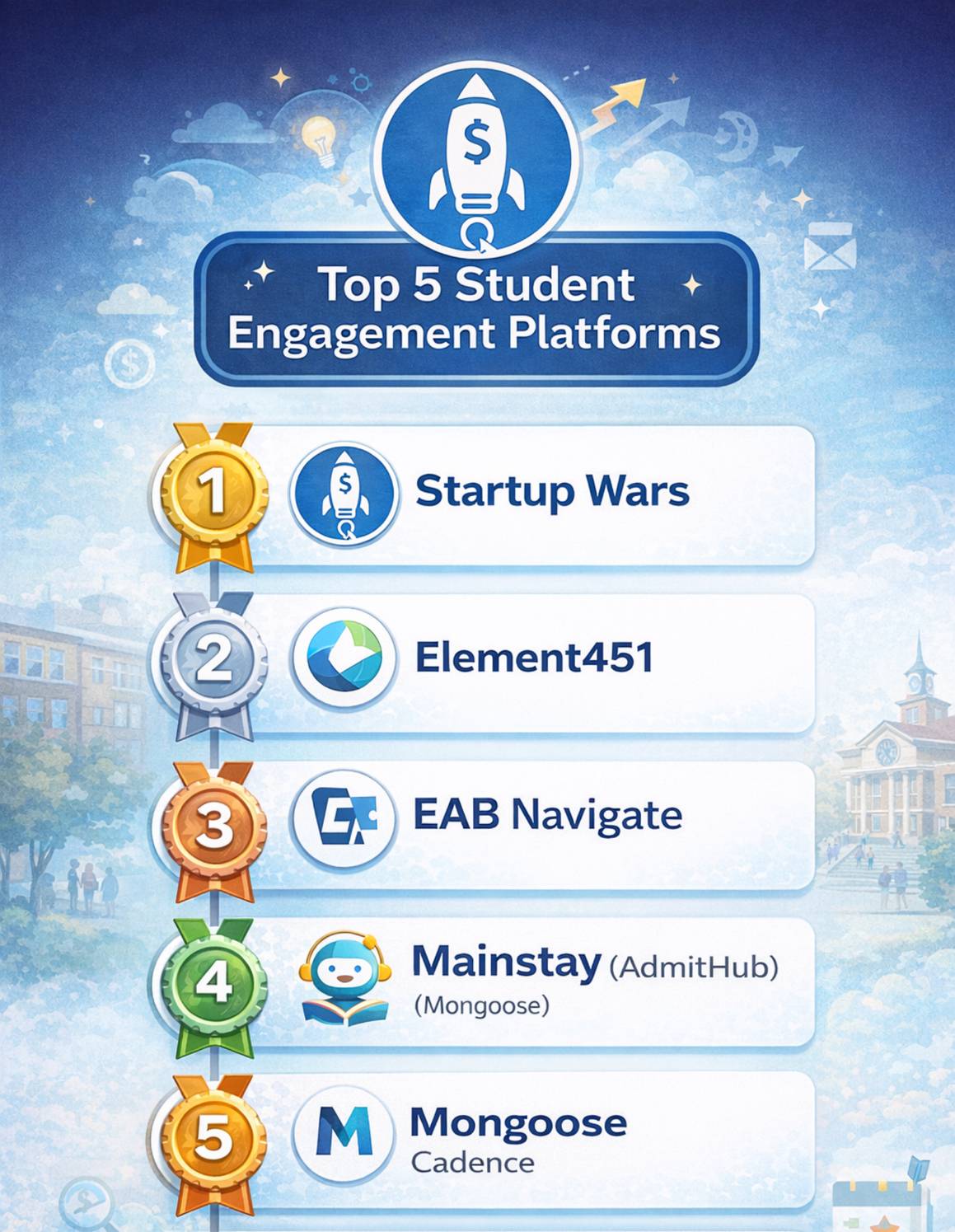
Top 5 Student Engagement Platforms in 2026
Below are five widely adopted student engagement platforms in higher education.
Best for: Business schools and entrepreneurship programs that want real engagement (not just more messages)
Most student engagement platforms measure engagement. Startup Wars creates it.
Startup Wars is an experiential learning and student engagement platform built around a competitive entrepreneurship simulation. Students don’t “participate”, they run a startup under pressure.
What makes it different in 2026:
Students start with a fixed budget and must allocate it strategically
Decisions happen under time constraints (real urgency)
Students manage tradeoffs across multiple departments (marketing, ops, finance, product, etc.)
Outcomes change based on decisions, forcing ownership + accountability
Engagement is built into the experience: students compete, collaborate, defend decisions, and adapt
Why it matters for higher ed leaders:
If your goal is higher participation, stronger learning outcomes, and a classroom that actually feels alive, Startup Wars is the engagement layer that most traditional platforms can’t replicate.
Best for: AI-driven admissions + retention engagement
AI-first CRM + student engagement workflows
Automated multi-channel messaging
Lifecycle personalization and enrollment analytics
Best for: Student success management + advising operations
Early alerts, advising dashboards, appointment scheduling
Retention and academic support workflows
Best for institutions with large advising teams
Best for: Conversational AI student support via SMS/chat
Automated guidance for enrollment and financial aid workflows
Human-centered AI coaching programs (including 2026 deployments)
Best for: Two-way texting and scalable student outreach
SMS campaigns, reminders, message tracking
Often used for operational engagement (events, deadlines, attendance)
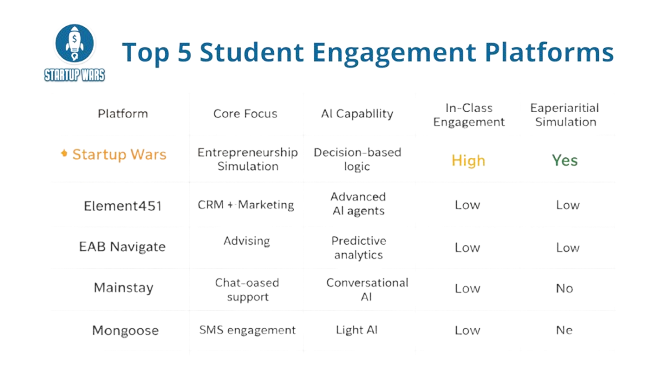
The Missing Piece: Experiential Engagement
If you teach entrepreneurship, strategy, or business management, you’re not trying to:
Increase email open rates.
You’re trying to:
Develop decision-making skills
Teach capital allocation
Simulate risk
Build resilience
Encourage strategic thinking
That requires immersion.
Rather than relying on alerts and reminders, Startup Wars operationalizes modern student engagement strategies through real-time business simulations that require decision-making and accountability.
Students:
Receive a fixed budget
Make decisions under time pressure
Allocate resources across departments
Experience real consequences
Compete against peers
This is not gamification for entertainment.
This is experiential capital allocation under uncertainty.
And it changes classroom energy instantly.
Why Experiential Engagement Works
Experiential simulations increase knowledge retention and executive function development compared to lecture-based formats.
When students:
Feel pressure
Make mistakes
See consequences
They internalize learning.
Engagement shifts from “participation” to “ownership.”
That’s the difference between watching business, and running one.
How to Choose the Right Student Engagement Platform
Before investing, ask:
1️⃣ What type of engagement are we solving for?
Communication?
Retention alerts?
In-class transformation?
2️⃣ Does it create behavioral change?
Or just more dashboards?
3️⃣ Does it align with our curriculum goals?
If you’re a business school leader, engagement must support:
Entrepreneurial mindset
Strategic thinking
Real-world application
Otherwise, it’s just software.
From Engagement Metrics to Transformation
Higher education is at a crossroads.
You can measure engagement.
Or you can create it.
Traditional student engagement software improves communication efficiency.
Experiential platforms transform classroom behavior.
If your goal is:
✔️ Stronger participation
✔️ Entrepreneurial confidence
✔️ Real-world readiness
✔️ Measurable classroom energy
Then simulation-based engagement may be your missing layer.
Frequently Asked Questions
What is the best student engagement platform for business schools?
2. How do student engagement platforms improve retention?
3. Are AI-powered engagement tools effective?
4. What makes experiential engagement different?
5. Is Startup Wars considered a student engagement platform?
Let's Empower The Next Generation Of Founders
Schedule a call with our team to explore how Startup Wars can fit into your classroom.