You made a bracelet. A friend asked to buy it. Someone else asked if you’re on Etsy.
That moment? That’s not cute. That’s market validation.
If you’re wondering how to start a jewelry business, especially as a teen, here’s the truth:
You don’t need a storefront.
You don’t need thousands of dollars.
You don’t need to wait until you’re older.
But you do need structure.
Let’s break it down.
Table of Contents
The Mindset Shift — You’re Not “Selling Crafts.” You’re Building a Brand.
Most teens approach jewelry as a creative outlet.
Smart teen founders approach it as:
A micro startup
A brand experiment
A real business with margins
The global jewelry market is projected to exceed $350 billion in the coming years. That’s not a hobby economy, that’s a global industry.
The shift is simple:
Hobby mindset:
“I hope someone buys this.”
Founder mindset:
“Who is this for, and why will they buy?”
That’s the difference between random sales and sustainable income.

What Most Young Founders Don’t See (But Educators Should)
When teens ask how to start a jewelry business, they’re usually thinking about beads and branding.
They’re not thinking about:
Cash flow timing
Inventory turnover
Cost of customer acquisition
Marketing ROI
Budget allocation under pressure
And that’s the real opportunity for entrepreneurship educators.
In platforms like Startup Wars, students experience these exact pressures inside a simulated business environment:
They receive a fixed budget.
They must allocate it across departments.
They make decisions under time constraints.
They see the consequences instantly.
It’s the difference between reading about margins… and feeling the impact of mispricing.
That experiential layer transforms a simple “how-to” topic into a full business education moment.
 See how to Turn Hobbies into a Profitable Side Hustle. Book a Demo.
Step-by-Step — How to Start a Jewelry Business Online
Don’t just “sell jewelry.” That’s too broad.
Examples:
Personalized name necklaces
Anime-inspired charm bracelets
Minimalist gold layering chains
Faith-based jewelry
Sustainability-focused recycled pieces
Micro-niches convert better than generic stores.
If you’re asking, how much does it cost to start a jewelry business?, here’s a realistic breakdown:
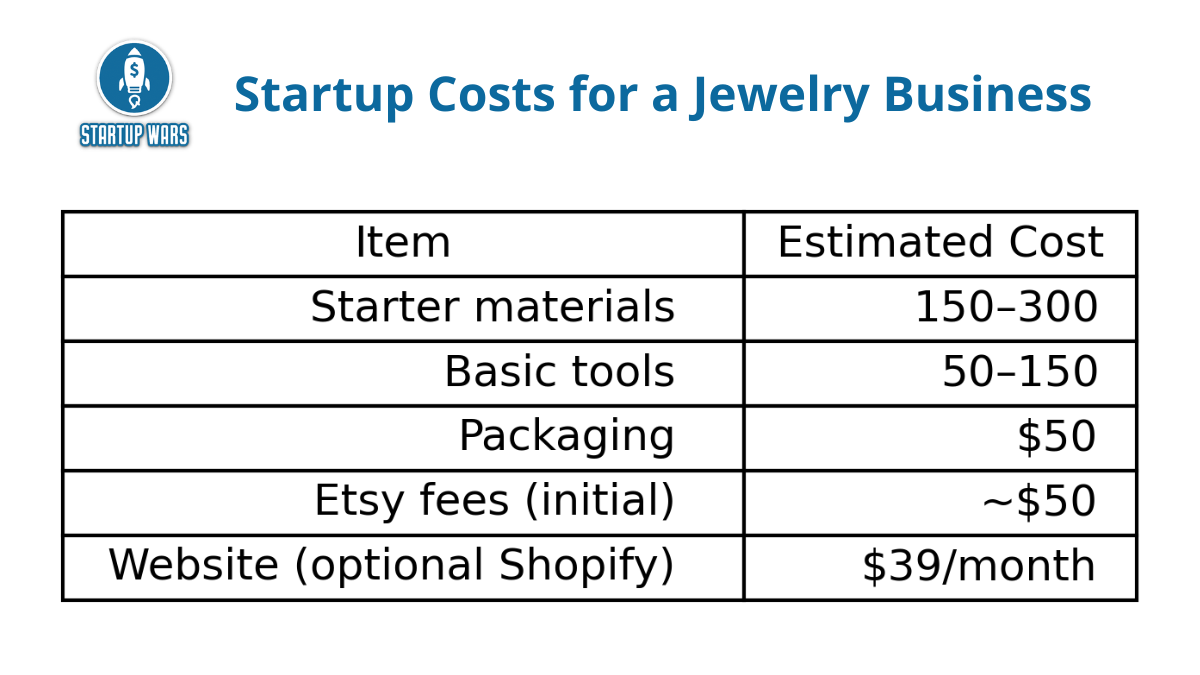
You can realistically launch with $300–$500.
That’s less than many people spend on a phone upgrade.
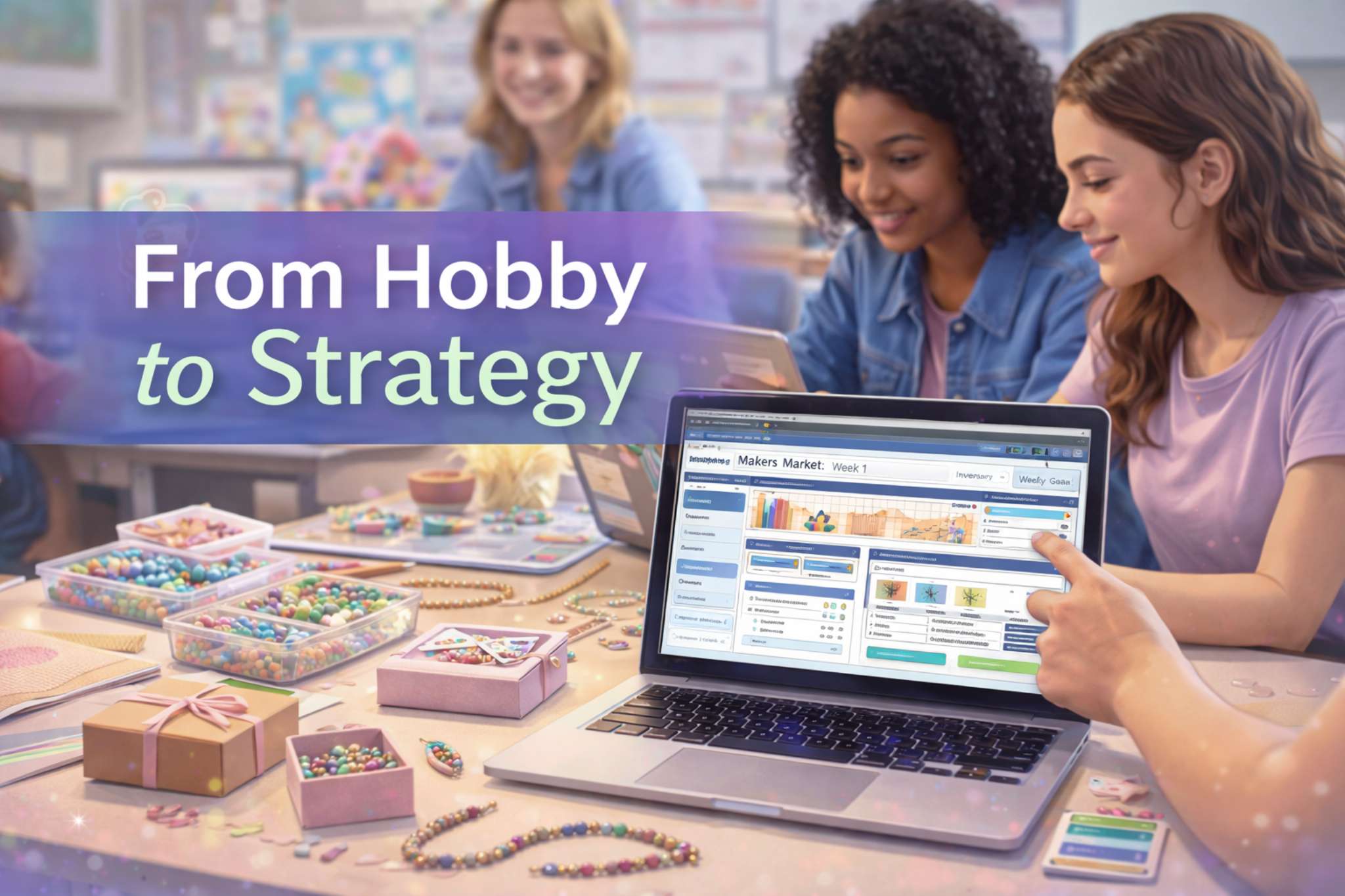
In the Makers Market Simulation, students don’t just learn pricing formulas, they budget for materials, calculate profit, and manage expenses like real founders.
Common teen mistake? Underpricing.
Use this formula:
(Material cost + Packaging + Platform fees) × 2.5–3 = Retail price
Why?
Because you must:
Cover reinvestment
Cover mistakes
Cover growth
If it costs $5 to make, selling it for $8 is not a business. It’s a break-even hobby.
Most students understand the formula intellectually.
Few understand the trade-offs emotionally.
In Startup Wars simulations, learners don’t just calculate margins, they allocate capital across marketing, operations, HR, and R&D with limited resources.
They discover firsthand:
Over-investing in marketing without product readiness can backfire.
Cutting quality to improve margins can reduce brand perception.
Underpricing can strangle long-term growth.
That’s not theory. That’s consequence-driven learning.
And it sticks.
If you’re under 18:
You may need a parent/guardian to open Etsy or Shopify accounts.
You may need a local business license (varies by state).
Sales tax rules apply depending on location.
The Balance notes that small business compliance is often simpler than expected, but ignoring it can create problems later.
Pro tip: Start simple. Use parental partnership if required.
Best platforms to start:
Etsy (built-in marketplace traffic)
Shopify (full brand control)
TikTok Shop (high organic reach)
Instagram + DMs (lean model)
Begin where attention already exists.
Most teen founders start with Etsy or TikTok because they remove friction.
Forget complicated funnels.
If you’re starting a jewelry business online, focus on:
1. Short-Form Video
“Packing orders with me”
“POV: You love minimalist jewelry”
“Making custom name necklaces”
2. Social Proof
Screenshots of reviews
User-generated content
Before/after style reels
3. Scarcity Drops
Limited edition collections create urgency.
Brace yourself:
Consistency beats perfection. Posting 3 times per week is better than disappearing for a month.
The Unexpected Truth — Don’t Stay Small
Here’s the bold take:
Most teen jewelry businesses fail not because they lack creativity, but because they stay micro.
If your jewelry business hits:
$1,000/month → reinvest.
$3,000/month → systematize.
$5,000/month → build brand assets.
Real founders:
Develop brand identity
Create email lists
Track margins
Analyze conversion rates
This is where education matters.
Understanding:
Budget allocation
Marketing ROI
Supply chain costs
Unit economics
Separates teen sellers from teen CEOs.
And this is why entrepreneurship education shouldn’t be theoretical.
Why Entrepreneurship Education Matters (And Where Simulation Comes In)
Many young founders learn through trial and error.
But imagine if they could:
Practice capital allocation decisions
Experience supply chain pressure
Run marketing campaigns under budget constraints
Make pricing decisions under time pressure
Before real money is at risk.
That’s the shift modern entrepreneurship education is making.
Instead of passive lectures (because whiteboards alone won’t cut it anymore), students simulate business decisions in real-time environments.
Platforms like Startup Wars allow learners to experience:
Budget management
Departmental trade-offs
Strategic decision-making
Market reaction scenarios
Not theory.
Practice.
For educators teaching entrepreneurship, whether at high school or university level, this bridges the gap between “how to start a jewelry business” and understanding how businesses actually operate.
Start Small — But Think Like a Founder
If you’re searching how to start a jewelry business, you’re already ahead of most people.
But here’s the real secret:
The jewelry is the product.
The business is the skill.
The earlier you learn:
Pricing strategy
Marketing psychology
Financial decision-making
Operational trade-offs
The faster you grow beyond side income.
For educators shaping the next generation of founders:
It’s time to move beyond case studies.
📅 Want students to experience what it takes to launch a handmade jewelry business? Schedule your free demo of the Makers Market Simulation and see how learners turn creativity into business skills.
Frequently Asked Questions
1. Can a 15-year-old start a jewelry business?
2. How much money do I need to start a jewelry business?
3. Do you need a license to sell jewelry online?
4. Is selling jewelry online profitable?
5. What is the best platform to sell handmade jewelry?
Let's Empower The Next Generation Of Founders
Schedule a call with our team to explore how Startup Wars can fit into your classroom.