Your students are already using AI tools for assignments, research, presentations, and even business model drafts.
Generative AI adoption in higher education has surged at record speed. Students aren’t experimenting anymore, they’re integrating AI into daily academic workflows.
The question is no longer:
Should we allow AI? It’s:
How do we redesign learning so AI strengthens critical thinking instead of replacing it? Because whiteboards alone won’t cut it anymore.
What Are the Best AI Tools for Students Today?
1️⃣ Writing & Research AI Tools
These are the most searched and commonly used tools:
-
ChatGPT
-
Google Gemini
-
Perplexity AI
-
Grammarly AI
They help students:
-
Draft essays
-
Summarize research
-
Generate outlines
-
Refine grammar
-
Brainstorm ideas
The Benefit
Efficiency increases dramatically.
The Risk
Cognitive struggle decreases.
And struggle is where real learning lives.
Startup Wars integrates Milton AI, but not as a writing shortcut.
Instead of generating answers, Milton:
-
Prompts reflection
-
Challenges assumptions
-
Encourages strategic trade-offs
-
Operates inside a live business simulation
Students don’t copy answers.
They make decisions.
📅 See how Milton AI turns AI from shortcut into skill-builder. Book a Demo.
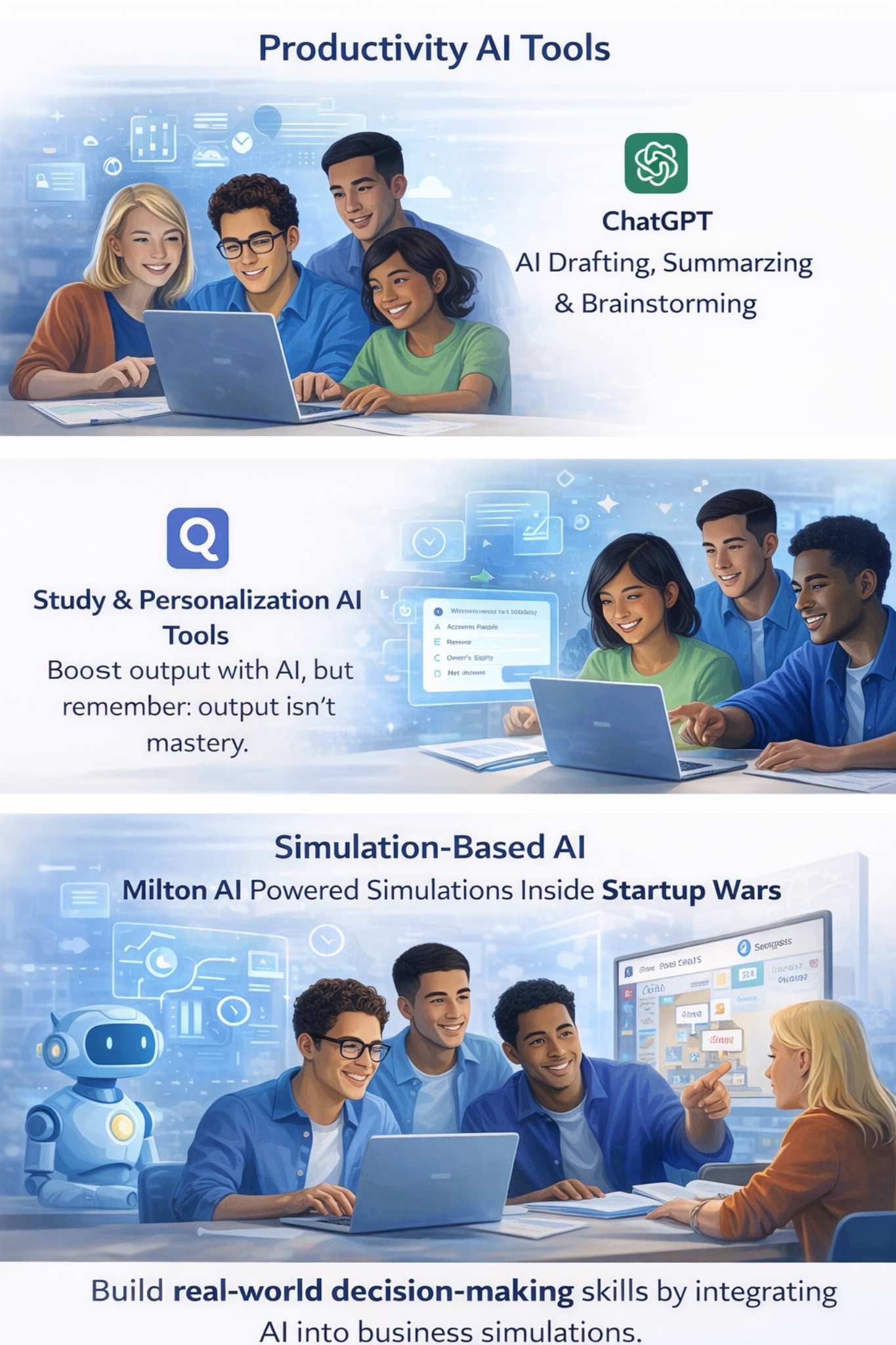
2️⃣ Study & Academic Support AI
Examples include:
-
Quizlet AI
-
Khan Academy’s Khanmigo
-
Notion AI
These tools:
-
Personalize quizzes
-
Identify weak knowledge gaps
-
Create adaptive learning paths
They support retention and organization.
But they rarely simulate ambiguity.
And business leadership thrives in ambiguity.
Inside Startup Wars simulations:
-
Students manage budgets.
-
Departments depend on each other.
-
Markets shift.
-
Competitors respond.
-
Time pressure exists.
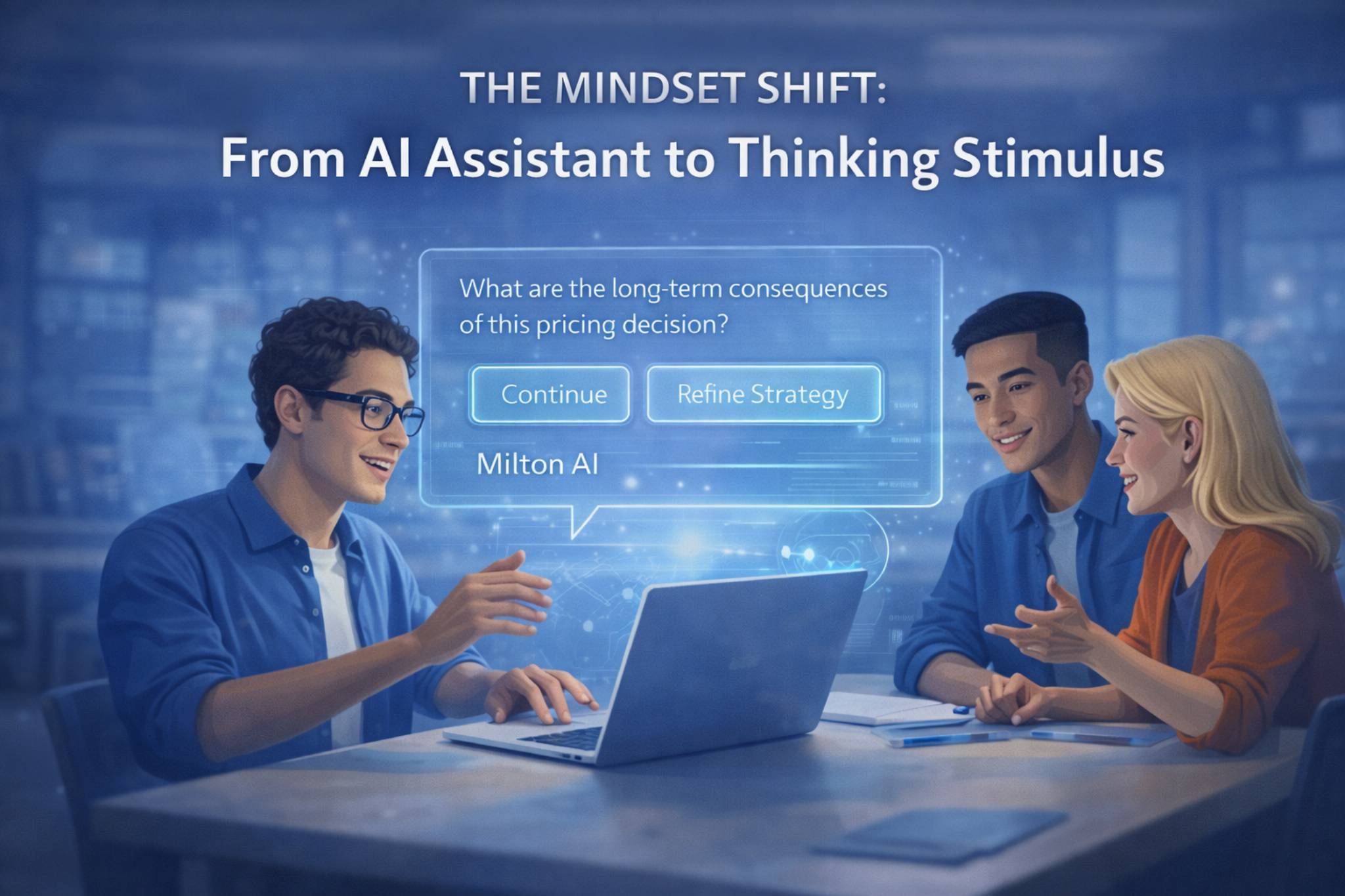
Milton AI doesn’t give the “right” answer.
It asks:
What are the long-term consequences of this pricing decision? That’s cognitive development.
📅 Explore how Startup Wars builds decision-makers, not just test-takers. Schedule a Free Demo.
3️⃣ Experiential AI: The Missing Piece in Higher Education
Here’s what most “best AI tools for students” lists miss.
AI should not only generate answers.
It should create environments.
Simulation-based AI platforms:
-
Force real-time decision-making
-
Simulate competitive markets
-
Require budget allocation
-
Introduce time pressure
-
Measure performance outcomes
This is where the next evolution of business education lives.
The Problem with Most AI Tools for College Students
AI Improves Output, But Does It Build Judgment?
While AI enhances productivity, strategic thinking and leadership skills still depend heavily on experiential learning models.
Let’s translate that into the classroom.
AI can:
- Write a marketing plan.
But it cannot:
-
Teach students what happens when their pricing strategy collapses.
-
Simulate investor pressure.
-
Force trade-offs under financial constraints.
Traditional AI tools optimize for:
-
Speed
-
Convenience
-
Content generation
Entrepreneurship education requires:
-
Scarcity
-
Risk
-
Competition
-
Strategic consequence
These elements rarely exist in prompt-based AI tools.
Startup Wars was built for exactly this gap. Instead of using AI to generate answers, our simulations, powered by Milton AI, challenge students to evaluate trade-offs, manage budgets, and defend their strategic decisions in real time.
📅 See how Startup Wars turns AI into a decision-making engine. Schedule a Free Demo.
Academic Integrity Isn’t the Core Issue
Many universities are focusing on:
-
Detection software
-
AI policy restrictions
-
Usage guidelines
But academic integrity concerns are symptoms.
The root problem is outdated assessment models.
If assignments can be automated, the assignment model must evolve.
AI isn’t breaking education.
It’s exposing weaknesses in passive learning structures.
The Mindset Shift, From AI Assistance to AI Training Grounds
The best AI tools for students should not remove friction.
They should simulate real-world friction.
Why Experiential Learning + AI Wins
Experiential learning as one of the most effective methods for long-term retention and engagement.
Now combine:
-
AI analytics
-
Real-time feedback
-
Performance-based grading
-
Competitive simulations
That’s not AI assistance.
That’s AI immersion.
Why Business Schools Must Lead This Shift
Business students must develop:
-
Financial judgment
-
Competitive strategy
-
Risk management
-
Leadership under uncertainty
Those competencies are built through:
-
Simulation
-
Consequence
-
Decision-making loops
This is precisely where platforms like Startup Wars redefine how AI is used in entrepreneurship education.
Instead of asking AI for answers, students:
-
Launch simulated companies
-
Allocate budgets
-
Compete against peers
-
Operate under time pressure
-
Experience market consequences
That is AI as a decision-making engine, not a writing shortcut.
Simulation-Based AI — The Most Underrated AI Tool for Students
Here’s the uncomfortable truth:
If AI can generate your assignment, your assignment no longer measures learning.
Simulation-based AI changes the metric.
Instead of grading essays, you evaluate:
-
Strategic choices
-
Financial allocation
-
Market performance
-
Adaptability
That’s experiential AI.
Why Milton AI Is Different from ChatGPT
-
Operates only within entrepreneurship simulations
-
Does not generate essays
-
Does not replace instructors
-
Encourages structured reflection
-
Reinforces business context
It is not a general-purpose AI.
It is a thinking partner embedded inside Startup Wars simulations.
That distinction matters.
📅 Discover how Startup Wars integrates AI responsibly and strategically. Book Your Demo.
The Institutions That Adapt Will Lead
AI is not a temporary classroom trend.
It is infrastructure.
Higher education leaders now face a strategic choice:
Option A:
Allow students to use AI tools passively.
Option B:
Redesign curriculum to integrate AI into high-engagement, decision-based learning environments.
One path preserves tradition.
The other builds competitive advantage.
If you’re a dean, professor, or curriculum director asking:
How do we move from AI awareness to AI implementation? There is a practical next step.
See how Startup Wars transforms AI from a content assistant into a real-world entrepreneurial training ground.
Because the future of business education isn’t smarter prompts.
It’s smarter decision-makers.
Frequently Asked Questions
1. What are the best AI tools for students?
The best AI tools for students include writing assistants like ChatGPT and Gemini, study tools like Quizlet AI, and simulation-based platforms that build real-world decision-making skills.
2. Are AI tools helpful for college students?
Yes, AI tools increase efficiency and personalization. However, they are most effective when integrated into experiential learning models rather than used solely for content generation.
3. How should universities use AI in the classroom?
Universities should embed AI into simulations, real-time decision exercises, and performance-based learning environments instead of relying only on AI for writing assistance.
4. Do AI tools reduce critical thinking?
AI tools can reduce critical thinking if they replace effort. However, when used in simulation-based learning, AI can enhance strategic thinking and judgment.
5. What is the future of AI in business education?
The future lies in AI-powered experiential learning platforms that simulate markets, competition, and financial trade-offs in real time.
Let's Empower The Next Generation Of Founders
Schedule a call with our team to explore how Startup Wars can fit into your classroom.
About the author
Andrea Martinez
Startup Wars marketing and content contributor
Andrea writes about entrepreneurship education, experiential learning, and the programs and product ideas shaping Startup Wars.