
In recent times, with the advent of modern technological advances in the field of computer sciences, the educational landscape has undergone a tremendous transformation; experiential learning has become a more engaging approach to student learning by integrating practical elements into the learning process. It is based on the idea of putting theoretical knowledge into practice, making learning more valuable and authentic.
It piques a student’s curiosity by allowing them to experience what is written in books. Students start to make sense of education by applying real-world context to the things taught in this educational trend.
Understanding the Shift in Modern Education
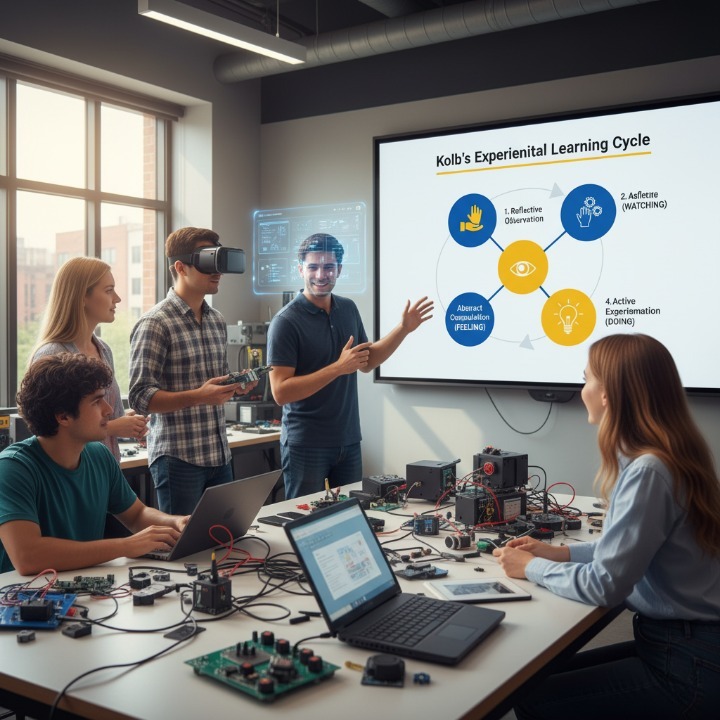
Experiential learning system in 2026 is more like an active learning process rather than a purely theoretical approach. In 1984 David Kolb developed a four-stage learning cycle to enhance learning and help people reach concrete, logical conclusions. These four stages of the learning cycle include:
1- Concrete Experience
Students begin with a concrete experience, such as making a pricing decision or conducting an approved customer interview. It gives them something specific to examine. Possible activities include:
-
Gaining new experience from old ideas by reworking
-
New implications for old ideas
-
Involving students practically and actively
-
Develop an approach of flexibility and openness
2- Reflective Observation
Students review what happened and compare it with their expectations. They describe observations before rushing to an explanation. Reflection can include:
-
Learning new things from existing studies.
-
Having new experiences of old ideas
-
Making sense of the relationship between expertise and comprehension among students.
3- Abstract Conceptualization
Students connect their observations to a concept or model, such as the relationship between price, demand and contribution. They develop an explanation that can be tested. This includes:
-
Developing new ideas
-
Modify the existing ideas
-
Sharing knowledge for others to create or modify new ideas
4- Active Experimentation
Students apply their explanation in another attempt or context. They predict what a change will do and examine the result. This includes:
-
Creating fundamental concepts from theories
-
Creating new concepts
-
Testing the new and modified concepts
This method is innovative for students to reflect on their thoughts on existing studies. This methodology also poses a challenge for teachers, who must adapt to students’ thinking and guide them through this relatively modern approach to teaching and learning. It is redefining the conventional way of teaching by transforming a teacher into a guide for your practical self-study and helping you come to your own conclusions.
Why 2026 Marks a Turning Point for Global Education
For educators planning in 2026, digital tools offer options for practical activities, but the date itself does not establish a global turning point. The useful question is whether students have an experience they can reflect on and apply.
Compare case studies and simulation activities against your objective, available time and assessment needs.
Here are some factors playing a big role on active learning:
-
Technological Advances: In recent years, AI has emerged as the biggest game changer in online platform. AI, VR and AR are providing an immersive environment for creating replicates real-world experiences to generate new thoughts and ideas.
-
Personalized Learning: Recently, a new trend has emerged with greater effectiveness, helping and encouraging people to introduce new ideas that open a window on seeking more solutions by providing them with more options for their digital presence. Educators can seek help from data analysts to reevaluate their approach to this modern way of teaching and learning.
These education trends in 2026 reflect a scenario that enables students to create and modify ideas by reflecting on the existing ones.
Implementation of Experiential Learning in the Classroom

All ideas begin with a thought in mind and are made into reality with practical efforts. No matter how big or revolutionary idea there is, it has to replace some existing one. This needs a serious doing on part of people inspired by it who can see some potential benefits in it. Even though the modern technology has facilitated experiential learning, still, the most important thing now is how educators will implement this learning within the existing education system.
Experiential learning is an established teaching approach. Bringing it into a course requires careful design, active participation, reflection and a chance to apply the learning. It can complement direct instruction and existing assessments.
Challenges for Educators
Our education system is based on the theoretical approach and the teachers are trained well in this system. Making a change in centuries old system is not easy yet the idea of active learning methodology sounds promising, but incorporating it in classrooms can present some challenges. Active and reflective learning presents a challenge to the old education system, which needs a major push to adopt new teaching strategies. Some of the biggest challenges presented to the educators can be:
-
Resource Limitations: Incorporating new ideas requires resources to ensure smooth integration into the system. To implement this student engagement-based learning in 2026, we need the following resources:
-
-
Fieldwork
-
Equipment
-
Technology
-
Funding for planning
-
-
Assessment Barriers: An assessment focused only on recall may miss reasoning, teamwork or reflection. Use explicit criteria and collect evidence suited to the intended skill.
-
Teacher Preparedness: Teachers in classrooms are using a conventional teaching style that does not align well with new methods that incorporate a practical approach. The educators also need professional development to adapt to this new approach and apply the techniques to help students feel confident in using their own thoughts on old ideas.
-
Curriculum Constraints: Schools’ curricula adopt a theoretical approach to teaching. The conventional academic structure does not support the flexibility of thoughts to manipulate existing ideas.
All the above-mentioned challenges are real and need teamwork to overcome the obstacles preventing implementation. This teamwork can take the form of institutional support and community collaboration. NGOs and industries can also play their part by providing students with a practical platform that goes beyond the classroom.
Final Word

Startup Wars offers business simulations that instructors can evaluate as one setting for experiential learning. The instructional design still needs a clear objective, reflection and assessment.
This system has the potential to prepare students to face the real world and engage with the corporate world straight out of the classroom.
As education trends in 2026 continue to evolve, teachers who integrate meaningful experiences into their lessons will shape a generation that learns not by memorizing, but by doing, thinking, and creating.
📅 Schedule a Free Demo and see how Startup Wars can help you lead beyond the classroom today.
Frequently Asked Questions
What is experiential learning?
Experiential learning is learning through experience, reflection, conceptual understanding and further application. For example, students can make a pricing choice, examine its consequences, explain a business tradeoff and test a revised decision.
Why is it becoming a major trend in 2026?
Digital tools give educators more ways to organize practice and feedback. Experiential learning predates 2026; this guide treats the year as a planning context rather than evidence of a universal trend.
How can teachers introduce experiential activities?
The teachers can start by assigning projects and collaborating with industry to help students gain practical experience with the theories they learn in the classroom. This approach will provide students with an environment to reflect on existing procedures for useful work.
What are the main benefits for students?
Some of the main benefits for students include direct engagement and critical thinking. Social interaction and the development of problem-solving skills are also a part of learning in this system.
What challenges might schools face?
School can face challenges like: Limited resources Conventional methodologies Need for educators to adopt a practical approach
Plan an experiential learning activity for business students
Worksheet and worked example by Startup Wars. Experiential learning connects an experience with reflection, an explanation and a further test. An activity becomes more useful when students can describe what happened, connect it to a concept and apply what they learned to another decision.
The Northern Illinois University teaching guide explains the relationship between experience, reflection and application. The worksheet below turns that approach into a concrete business lesson. It works with paper, a shared document or a suitable simulation; technology is optional.
Open the printable experiential-learning planner. Copy the prompts, complete the plan and keep the student evidence after the lesson. This is a worksheet experiment, with a completed example to help you get started.
Copyable planning worksheet
| Planning field | Prompt to complete |
|---|---|
| Topic and learner level | What concept will students practice? What do they already know? |
| Time and format | How long is the session? Will students work individually, in teams or online? |
| Observable objective | By the end, students will be able to ___, shown by ___. |
| Preparation | What information, materials, access checks and worked examples are needed? |
| Concrete experience | What choice or task will students complete? What constraint makes the choice meaningful? |
| Reflective observation | What happened compared with the prediction? What surprised students? |
| Abstract conceptualization | Which concept explains the result? What alternative explanation remains possible? |
| Active experimentation | What will students change or test next? What evidence would show a difference? |
| Assessment | Which work will you collect, and what criteria show understanding? |
| Adaptation | What support, access alternative or extension will different learners need? |
Choose one learning objective first. “Students will understand pricing” is difficult to assess directly. “Students will compare contribution at three prices and defend a recommendation using stated demand assumptions” identifies an action and evidence. A lively discussion alone does not establish that every student can do this.
Completed example: a 50-minute pricing decision
Context: An introductory high-school business class has practiced revenue and variable cost. Students work in pairs with a calculator. All figures below are fictional teaching inputs, not real customer evidence or simulation outputs.
Objective: Each student will calculate contribution, explain a pricing tradeoff and revise a recommendation after a cost change. Prepare the pricing worksheet and answer key, and separate the answer key from the initial student brief.
Minutes 0–5, predict: A made-to-order T-shirt costs $14 to produce. Choose among $18 with 100 expected sales, $24 with 70, or $30 with 45. Write a prediction before calculating. Only shirts sold are produced; fixed costs are excluded.
Minutes 5–20, experience: Calculate revenue and contribution for each price. Total contribution equals (price − variable cost) × units sold. The results are $400, $700 and $720 respectively. The highest revenue comes from the $18 price, while the highest contribution comes from $30 under these assumptions.
Minutes 20–30, reflect: Compare the prediction with the calculation. What did the team initially prioritize? Which demand estimate is most uncertain? Ask every student to explain why revenue and contribution point to different choices.
Minutes 30–40, explain and test: Connect the result to unit contribution and demand. Increase variable cost to $16 while keeping the same demand estimates. Recalculate: contribution becomes $200, $560 and $630. Explain whether the recommendation changes and why. This second round tests reasoning within a simplified model, not customer willingness to pay.
Minutes 40–50, transfer: Individually propose a customer research question or a second demand scenario that could change the decision. State the evidence needed and one limitation of the model. Collect the two calculations and the explanation.
Assess the full cycle, not just participation
Use four criteria, each scored from 0 to 3: accurate calculation, explanation of a tradeoff, evidence-based revision and a sensible next test. Zero means missing; one means attempted with major gaps; two means mostly sound with a specific gap; three means accurate and supported. Share the criteria before the activity.
A correct price without an explanation is incomplete evidence. A learner who changes their mind can demonstrate strong reasoning if they identify the relevant change and calculate its effect. Ask for an individual response alongside team work so a confident speaker does not hide another student's uncertainty.
Reflection questions that lead to another attempt
- What did you predict, and what actually happened in the exercise?
- Which choice influenced the result? What other explanation could matter?
- Which business concept helps explain the tradeoff?
- What assumption would you investigate before spending real money?
- What will you change next, and what result would challenge your explanation?
Give students time to answer before opening whole-class discussion. Use their responses to choose the next worked example or mini-lesson. Reflection should influence the next action rather than serve only as a closing paragraph.
Adapt the planner for classroom, online and college use
For learners new to business, provide definitions, a partially completed table and one decision at a time. Allow written explanations or an accessible audio response where appropriate. Verify accommodations with the institution rather than assuming one format serves everyone.
For an online class, post the scenario and instructions together. Require an individual prediction before the team discusses it, then use a shared log for the joint decision. Provide an asynchronous route for learners who cannot attend a live discussion.
For college groups, add fixed costs, uncertain demand or a capacity limit. Ask students to compare scenarios and identify what the model leaves out. Preserve the original learning objective; extra complexity is useful only when students can explain its effect.
If you use software, preview the scenario and confirm the available decisions and feedback. The entrepreneurship simulation catalog is the place to compare Startup Wars scenarios. The high-school and CTE page and college page cover their respective adoption settings.
Choose the next teaching resource
Use the seven entrepreneurship lesson examples for individual activities or the two-week business curriculum sprint for a sequence. The business competition preparation guide adds a pitch template and rubric when students are ready to explain a venture idea.
After trying the worksheet, record which prompt helped, where students needed support and what you changed. You can send optional planner feedback without including student names or work. Educator use and feedback will guide whether a more customizable planner is useful.
About the author
Andrea Martinez
Startup Wars marketing and content contributor
Andrea writes about entrepreneurship education, experiential learning, and the programs and product ideas shaping Startup Wars.