A business class can be full of smart students and still feel strangely quiet. You explain pricing, market research, hiring, cash flow, or competitive strategy, ask whether everyone understands, and get a roomful of polite nods. Then the assignment arrives, and half the class is not quite sure what to do with the idea outside the notes.
That gap is exactly where interactive teaching strategies help. They move students from hearing a concept to using it, defending it, testing it, and revising it. In business and entrepreneurship classes, that matters because the subject is built around judgment. Students need opportunities to make choices before the stakes involve real money, real employees, or real customers.
This guide shares 12 practical teaching strategies for teachers who want more participation without turning every lesson into a giant group project. Each strategy includes a business-class example, a simple way to run it, and a form of evidence you can actually assess.
What Are Interactive Teaching Strategies?
Interactive teaching strategies are methods that require students to respond, discuss, create, decide, test, or reflect during the learning process. Instead of treating students as an audience, these approaches give them an active role in building and applying knowledge.
For a business class, the best interactive teaching strategies usually have three parts: a decision, a consequence, and a chance to reflect. A student might choose a price, defend a hiring plan, test a customer message, or adjust a budget after new information appears. That turns an abstract concept into something the student can examine.
Why Interactive Learning Belongs in Business Education
The evidence for active learning is broader than business education alone, but it gives educators a useful starting point. A meta-analysis of 225 undergraduate STEM studies found that active-learning sections improved examination performance by about 6%, while students in lecture-based classes were 1.5 times more likely to fail. The subject area was STEM, so those numbers should not be treated as a direct estimate for entrepreneurship courses, but the study supports a larger point: students learn more when they do more than listen.
Research focused more directly on simulations points in the same direction. A study of 177 college students using a virtual entrepreneurship simulation found that learning engagement was positively connected to entrepreneurial skill development, while teamwork and self-efficacy affected skills both directly and through engagement. A 2025 study of 312 business-simulation learners also found that interactivity, multimedia richness, teamwork, and novel business challenges supported memorable learning experiences, which then predicted satisfaction and continued participation.
Startup Wars reports that its simulations have reached more than 10,000 learners across more than 100 institutions, with more than 35,000 completed simulations. Those are company-reported adoption figures rather than independently audited learning outcomes, but they offer a useful practical reminder: educators are looking for ways to make business decisions visible, discussable, and repeatable.
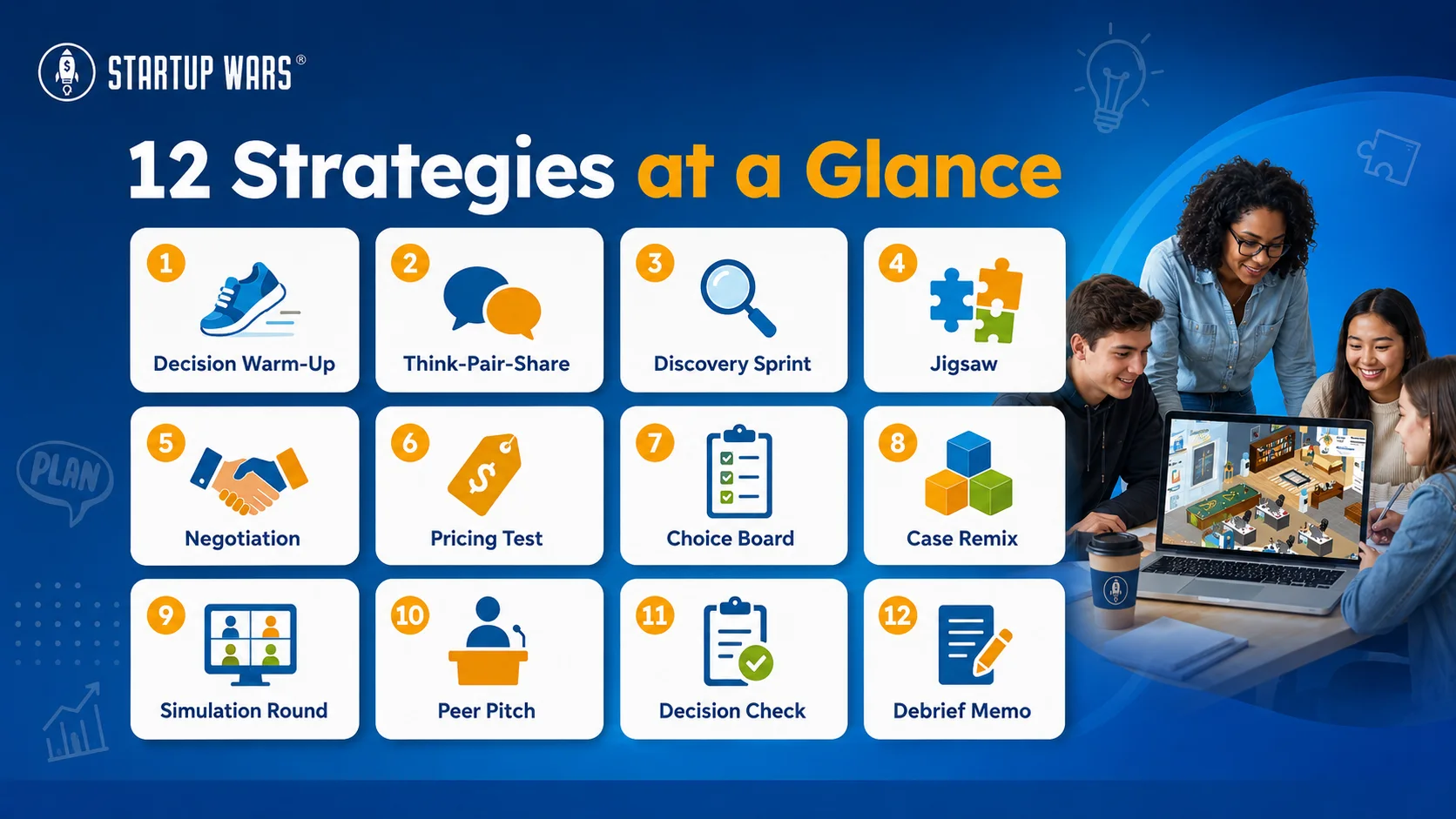
The 12 Strategies at a Glance
| Strategy | Best for | Typical time | Evidence students produce |
|---|---|---|---|
| Decision-first warm-up | Activating prior knowledge | 5–10 min | Written rationale |
| Think-Pair-Share tradeoff | Broad participation | 10–15 min | Revised answer |
| Customer discovery sprint | Market research | 20–40 min | Interview questions and insights |
| Jigsaw business functions | Cross-functional thinking | 30–45 min | Functional brief |
| Stakeholder negotiation | Communication and ethics | 25–40 min | Agreement and reflection |
| Pricing experiment | Quantitative reasoning | 20–30 min | Pricing hypothesis |
| Choice board | Differentiation | 30–60 min | Student-selected artifact |
| Case-study remix | Strategic judgment | 25–40 min | Decision map |
| Business simulation round | Integrated application | 45–90 min | Decisions, results, and notes |
| Peer pitch protocol | Communication | 30–60 min | Pitch and structured feedback |
| Formative decision check | Quick assessment | 5–10 min | Exit ticket or poll |
| Debrief and iteration | Metacognition | 15–25 min | Next-decision memo |
1. Start With a Decision, Not a Definition
Before explaining a concept, give students a choice that exposes why the concept matters. For example: "Your food truck has $1,000 left. Do you spend it on inventory, an event fee, or marketing?" Students choose, write one sentence defending the decision, and compare answers.
After the discussion, introduce opportunity cost, cash constraints, or demand uncertainty. The definition now answers a question students already care about. This is one of the easiest effective teaching strategies to use because it requires almost no setup and works in both high-school and college classrooms.
2. Use Think-Pair-Share for Business Tradeoffs
Think-Pair-Share becomes more useful in business courses when the prompt has no painless answer. Ask students whether a growing company should raise prices, hire another employee, or reduce product variety. Give everyone one minute to decide alone, two minutes to compare reasoning with a partner, and a few minutes to share.
Require students to note whether the conversation changed their decision. That small revision turns participation into evidence of learning. It also prevents the quickest speaker in the room from setting the direction before everyone else has thought.
3. Run a Customer Discovery Sprint
Give small groups a proposed product, customer segment, or startup idea. Their task is to write five questions that uncover a real problem without pitching the solution. Groups then interview classmates, compare what they heard, and identify one assumption they would change.
This strategy makes market research feel less like a chapter and more like an investigation. It also teaches a crucial entrepreneurial habit: evidence should shape the idea, not simply decorate it after the fact.
4. Build a Jigsaw Around Business Functions
Divide a business challenge into finance, marketing, operations, and human resources. Students first meet in expert groups to analyze one function. Then create mixed groups with one representative from each area and ask them to recommend a single business plan.
The useful friction appears when the recommendations conflict. Marketing may want a larger launch budget while finance wants to preserve cash. Operations may need more staff before sales can grow. These instructional strategies show students that business functions do not operate in separate textbook chapters once a company is running.
5. Stage a Stakeholder Negotiation
Assign students roles such as founder, employee, investor, supplier, customer, or community representative. Present a decision with competing interests, such as moving production, cutting staff, changing suppliers, or using customer data in a new way.
Each student receives a goal and one concern they cannot ignore. The group must reach an agreement and explain what each stakeholder gained or gave up. This creates a practical way to teach communication, ethics, leadership, and negotiation without pretending every conflict has a perfect solution.
6. Turn Pricing Into a Live Experiment
Give teams the same product and cost structure, then ask each team to choose a price for a different customer segment. Reveal changing demand estimates or allow classmates to "buy" with a limited number of tokens. Teams calculate revenue, margin, or break-even implications and revise their price.
The point is not to find one magical number. It is to help students see that pricing connects customer perception, costs, positioning, and risk. Interactive learning works especially well here because students can compare the logic behind different answers instead of memorizing a formula in isolation.

7. Offer a Choice Board With Common Learning Goals
Create a menu of ways students can demonstrate the same business competency. One student might design a one-page launch plan, another might record a two-minute investor explanation, and another might build a simple decision table.
Choice does not have to mean five grading systems. Use one shared rubric focused on the quality of reasoning, use of evidence, feasibility, and reflection. This gives students room to work through a format that fits their strengths while keeping the academic standard consistent.
8. Remix the Case Study
Traditional cases often end with students explaining what a company should have done. A case-study remix asks students to make the decision before they know the outcome.
Pause the case at a critical point, give groups two or three options, and ask them to commit. Then reveal the next development and require a second decision. Students create a short decision map showing what they knew, what they assumed, and what changed. This keeps the strengths of case teaching while adding uncertainty and consequence.
9. Run a Short Business Simulation Round
A business simulation combines multiple concepts in one environment. Students might set prices, manage inventory, hire staff, choose marketing activities, and respond to changing results. Startup Wars, for example, uses five browser-based startup scenarios that place students in charge of businesses such as a food truck, mobile app, apparel company, vertical farm, or makers-market venture.
Keep the first round short. Ask students to record three decisions, one surprise, and one question. The simulation should create material for teaching, not replace the instructor. A focused debrief is where students connect the experience to the course concepts.
10. Use a Peer Pitch Protocol
Instead of asking the class, "Any feedback?", give listeners three jobs: identify the strongest assumption, flag the riskiest assumption, and ask one question the presenter must answer with evidence.
Students can pitch a product, pricing plan, market entry, hiring proposal, or recovery strategy. The structure improves the quality of feedback and keeps the audience involved. It also helps presenters learn that communication is not only about confidence; it is about making a decision understandable and defensible.
11. Check Understanding With a Decision, Not Just a Quiz
A quick formative assessment can ask students to choose the next move in a scenario and explain why. The answer can be collected through a poll, index card, shared document, or short response in the learning platform.
A selected option tells you what the student chose. The explanation tells you what they understand. This distinction matters in business education, where two people may choose the same action for very different reasons. Use the responses to decide whether the next class needs clarification, deeper practice, or a more challenging scenario.
12. End With a Debrief and Next-Decision Memo
Interactive teaching loses much of its value when the activity ends at the result. Reserve time for students to explain what happened, which assumption failed, and what they would do next.
A simple next-decision memo can use four prompts:
- What did you decide?
- What happened?
- What evidence changed your thinking?
- What will you do next?
This final step turns activity into reflection and reflection into a plan. It also gives instructors a compact piece of evidence that can be assessed without grading every click or conversation.
A Simple Framework for Choosing the Right Strategy
A long list of teaching strategies for teachers is only useful when instructors can choose among them. Start with four questions:
- What should students be able to do? If the goal is recall, a short retrieval check may be enough. If the goal is judgment, use a scenario, negotiation, experiment, or simulation.
- What evidence do you need? Decide whether you need a written rationale, a team recommendation, a calculation, a reflection, or a record of decisions.
- How much uncertainty can students handle? Beginners may need constrained options and guided practice. Advanced students can work with incomplete data and competing goals.
- How much class time is available? A five-minute decision prompt can make a lecture more interactive, while a simulation or project can connect several weeks of content.
The Decision-Consequence-Reflection Loop
Across these instructional strategies examples, one pattern keeps appearing. We call it the Decision-Consequence-Reflection loop:
- Decision: The student must choose, create, prioritize, or defend something.
- Consequence: New information, peer response, data, or a simulated outcome shows what the decision produced.
- Reflection: The student explains what changed and what should happen next.
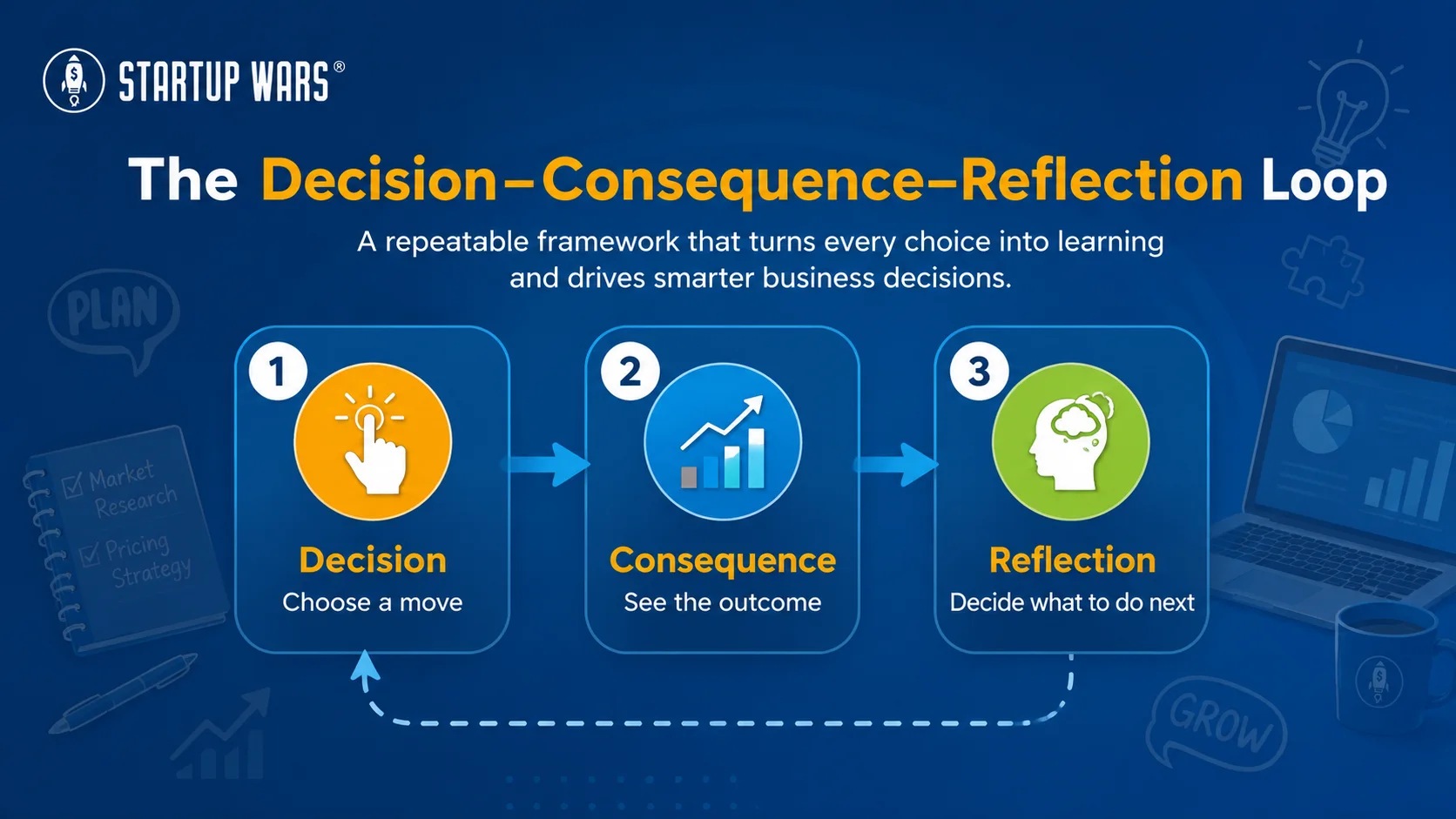
This is an editorial framework, not a claim that every lesson needs software or a full simulation. A five-minute pricing prompt can use the same loop. The value is that students leave behind evidence of their thinking, not only evidence that they were present.
Interactive Does Not Have to Mean Chaotic
The most useful teaching strategies for teachers are not the loudest activities or the ones with the most technology. They are the methods that give students a meaningful role while keeping the learning goal visible.
Start with one strategy that fits a lesson you already teach. Add a decision. Decide what evidence you want students to produce. Then leave time to discuss what happened. You do not need to rebuild the whole course by Monday morning. Business education becomes more practical one well-designed choice at a time.
For educators who want students to run a connected business rather than complete a single classroom exercise, Startup Wars offers entrepreneurship-first business simulations for high-school, CTE, college, and university courses. Students make founder decisions across five industry-themed startups, while instructors guide the learning with course materials, assessment, and reflection.
If you would like to see how that could fit a course you already teach, schedule a free demo and bring your learning goals. The conversation can start there.
Frequently Asked Questions
Which Teaching Strategies for Teachers Work Best in Business Classes?
The strongest approach depends on the learning goal. Decision prompts, customer discovery, stakeholder negotiations, pricing experiments, business simulations, and structured debriefs work well when students need to apply business concepts rather than only remember them.
What Is the Best Interactive Teaching Strategy for Entrepreneurship?
A decision-based scenario followed by reflection is a strong starting point because it is easy to run and reveals student reasoning. For integrated practice across finance, marketing, operations, and human resources, a business simulation can provide a broader experience.
How Can I Make an Entrepreneurship Class More Interactive?
Replace part of the explanation with a choice students must make. Ask them to defend the choice, reveal new information or consequences, and let them revise. This structure can be used in a five-minute warm-up, a full case, or a multi-round simulation.
Do Interactive Teaching Methods Require Technology?
No. Think-Pair-Share, stakeholder negotiations, jigsaw activities, choice boards, and decision memos can all run without specialized technology. Digital tools are useful when they make feedback, participation, or complex outcomes easier to manage.
How Should Interactive Learning Be Assessed?
Assess the evidence connected to the learning objective. That may include decision rationale, use of data, calculations, collaboration, reflection, or improvement after feedback. Avoid grading participation volume alone, since speaking often does not necessarily show deeper understanding.
Research and Source Notes
- Freeman and colleagues' meta-analysis compared active learning with traditional lecturing across 225 undergraduate STEM studies. Referenced source from pnas.org
- Yang, Zhang, and Lin studied engagement and entrepreneurial skill development among 177 college students using a virtual entrepreneurship simulation. Referenced source from frontiersin.org
- Pham Thi and Duong examined how interactivity, teamwork, multimedia richness, and challenge novelty shaped the experiences of 312 business-simulation learners. Designing Memorable Business Simulations For Learning Engagement — researchgate.net and Referenced source from link.springer.com
About the author
Andrea Martinez
Startup Wars marketing and content contributor
Andrea writes about entrepreneurship education, experiential learning, and the programs and product ideas shaping Startup Wars.