
A multiple-choice quiz can tell you whether a student recognizes the definition of cash flow.
It cannot tell you what that student does when the company is profitable on paper, short on cash, carrying too much inventory, and expected to make payroll on Friday.
That is the challenge of educational assessment in an experiential business course. Instructors still need to measure foundational knowledge, but they also need evidence of judgment, application, reflection, and improvement.
The best assessment tools do not merely ask, "Did the student remember the concept?" They also help answer:
- Can the student use it?
- Can they explain a decision?
- Can they respond when the result changes?
- Can they transfer what they learned to a new business problem?
What Is Educational Assessment?
Educational assessment is the systematic process of gathering and using evidence about what students know and can do to improve learning, instruction, or programs.
According to a 2025 guide from the Institute of Education Sciences, assessment evidence may include ongoing checks for understanding, student work, surveys, diagnostic information, formative measures, and summative results (IES, 2025). The guide also emphasizes a point that is easy to miss: the right assessment depends on who needs the information and what decision they need to make.
An assessment tool is only useful when the evidence fits the decision. A five-question quiz may reveal whether students understand contribution margin. It will not provide enough evidence to determine whether they can use that information in a pricing decision. In business education, assessment should capture both knowledge and action.
Assessment for, as, and of Learning
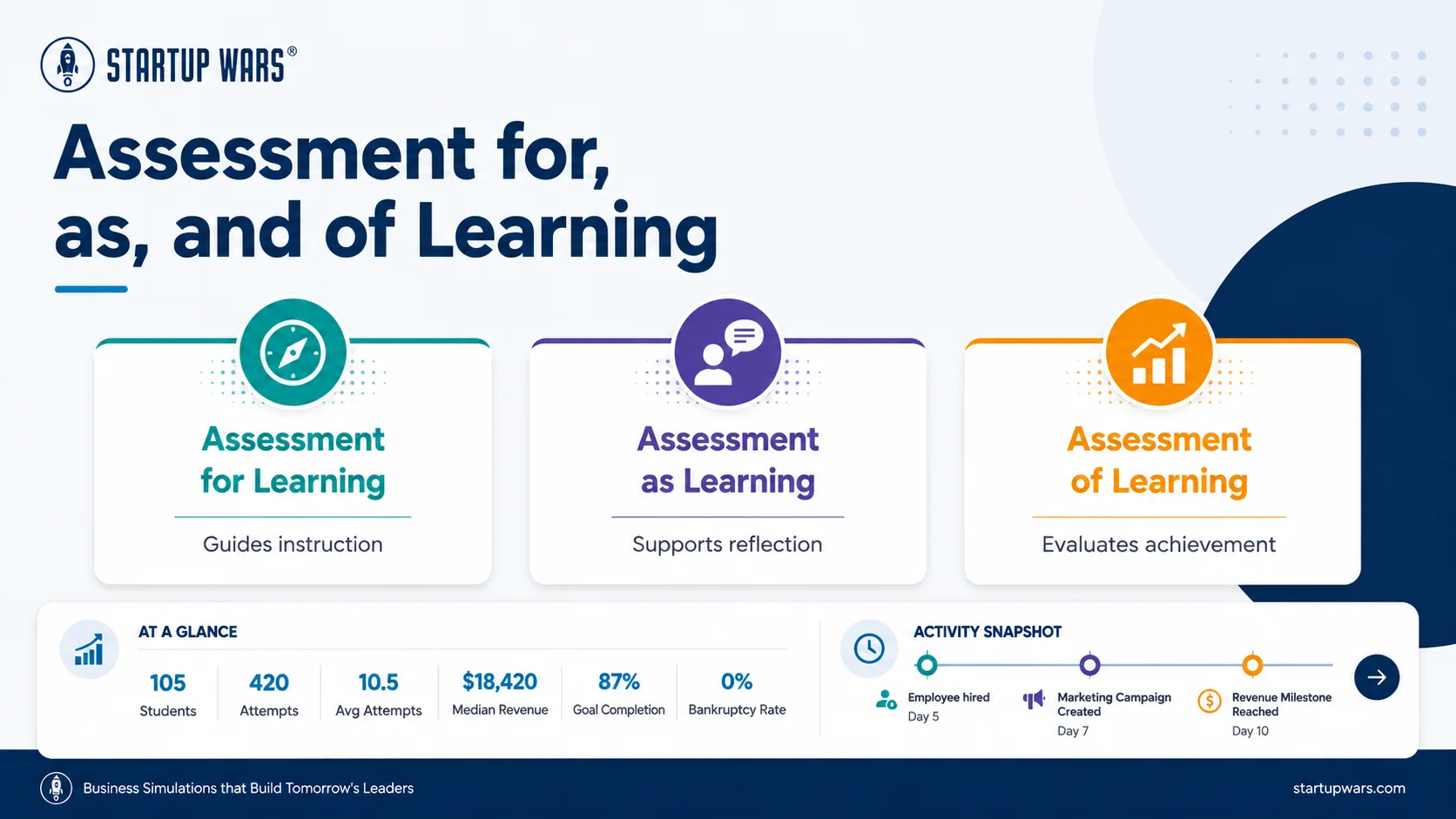
One helpful way to organize assessment tools is by the role they play in learning. The University of Illinois Chicago's teaching guide on assessment planning distinguishes among:
- Assessment for learning, which gives instructors evidence they can use to adjust teaching.
- Assessment as learning, which helps students monitor and regulate their own learning.
- Assessment of learning, which evaluates achievement after instruction.
| Assessment role | Main purpose | Business-course example |
|---|---|---|
| For learning | Identify needs and adjust instruction | A scenario before the finance unit reveals confusion about profit and cash |
| As learning | Help students examine their own thinking | A decision log asks students to compare an original strategy with the result |
| Of learning | Evaluate achievement | A final presentation and rubric measure whether students can defend an integrated business plan |
A well-designed course usually needs all three.
The Business Learning Evidence Stack
When evaluating an experiential assignment, instructors can look for four layers of evidence:
Know → Choose → Explain → Adapt
Know
Does the student understand the relevant concept?
Choose
Can the student apply it to a realistic decision?
Explain
Can they defend the choice with evidence and identify the assumptions behind it?
Adapt
Can they respond intelligently when new information or consequences appear?
This is a practical Startup Wars framework created for this guide, not a formal assessment theory. Its purpose is simple: a student should not receive full credit for memorizing the vocabulary, nor should one lucky simulation outcome automatically prove mastery.
The strongest evidence shows what the student knew, what they chose, why they chose it, and what they learned next.
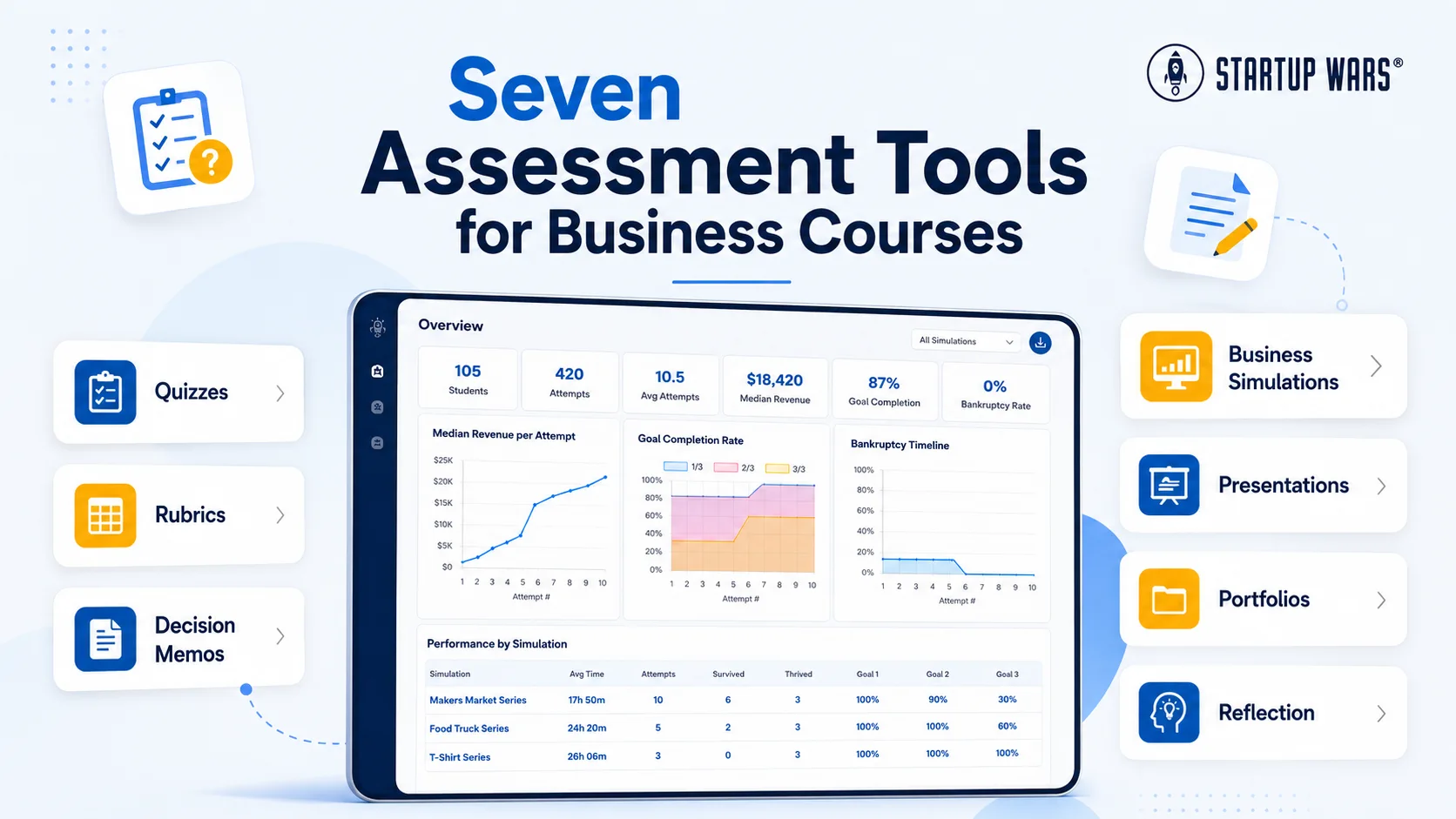
Seven Assessment Tools for Business Courses
Each of the seven tools below produces a different kind of evidence, and the strongest courses combine several of them rather than relying on just one.
1. Diagnostic Business Scenarios
A diagnostic assessment takes place before instruction and helps identify prior knowledge, strengths, or misconceptions.
Instead of beginning a finance unit with ten definition questions, give students a short business problem:
A company earned $20,000 in revenue, recorded $18,000 in expenses, and is still unable to pay a bill due today. How is that possible?
Ask students to explain their reasoning before teaching cash flow. The goal is not to grade the response. It is to discover whether students distinguish revenue, profit, available cash, payment timing, and working capital.
- Best for: Starting a unit or course
- Evidence produced: Initial reasoning and misconceptions
- Instructor workload: Low
- Watch for: Scenarios that require knowledge students have not had a fair chance to develop
2. Concept Checks and Low-Stakes Quizzes
Quizzes remain valuable when the learning objective involves recognition, recall, calculation, or basic interpretation. They work well for financial vocabulary, marketing terminology, ownership structures, basic accounting relationships, break-even calculations, and human-resources concepts.
The mistake is asking a quiz to measure everything. A student may correctly calculate gross profit without knowing whether a proposed pricing strategy makes sense. Use the quiz to verify the building blocks, then pair it with a decision. Many instructors now rely on digital assessment tools to score these checks automatically and surface patterns of error across a class.
An IES factsheet on formative assessment describes formative assessments as frequent measures used to understand what students are learning and provide feedback that can inform instruction.
- Best for: Foundational knowledge and fast feedback
- Evidence produced: Correct responses, patterns of error, and areas requiring review
- Instructor workload: Low with automatic scoring
- Watch for: Mistaking a high quiz score for evidence of applied judgment
3. Decision Memos
A decision memo asks students to choose a course of action and explain it concisely. A useful format includes:
- The decision.
- The evidence used.
- The main assumption.
- The most important risk.
- The condition that would change the recommendation.
For example:
Should the food truck spend its remaining $1,500 on inventory, an event fee, or a marketing campaign?
Students must commit. "It depends" is permitted only when they explain precisely what it depends on.
Decision memos are among the strongest student assessment tools for business education because they reveal both disciplinary knowledge and the reasoning connecting that knowledge to action.
- Best for: Finance, strategy, marketing, operations, and management
- Evidence produced: Written reasoning and use of evidence
- Instructor workload: Moderate
- Watch for: Rubrics that reward polished writing more heavily than business judgment
4. Business Simulations and Decision Logs
A business simulation gives students a connected environment in which decisions create results over time. Startup Wars uses browser-based startup scenarios in which students make choices involving pricing, marketing, money, inventory, staffing, workload, and growth, and instructors can use in-simulation decisions and outcomes to guide discussion, reflection, and assessment.
The simulation score or final profit should not be the only evidence. Require a decision log:
| Decision | Evidence used | Result | What changed next |
|---|
This captures the learning process rather than only the ending. For a longer walkthrough of running and grading a simulation in the classroom, see our full guide.
Startup Wars' public Evidence & Outcomes page also documents specific educational use at the University of San Francisco and Valdosta State University, while clearly separating those verified examples from company-reported adoption totals.
- Best for: Cross-functional application and repeated decision-making
- Evidence produced: Decisions, outcomes, explanations, and revisions
- Instructor workload: Moderate when paired with a focused rubric
- Watch for: Rewarding the highest business result regardless of the quality of reasoning
5. Analytic Rubrics
A rubric makes the criteria visible before the work is submitted. For experiential business assignments, use separate dimensions rather than one vague category called "quality." Possible criteria include use of business concepts, quality of evidence, financial reasoning, recognition of tradeoffs, feasibility, response to feedback, reflection, and communication.
Carnegie Mellon University's assessment resources emphasize alignment among goals, assignments, rubrics, and the evidence faculty want to collect, and its resource library includes rubrics for project work, presentations, participation, leadership, and finance cases.
- Best for: Projects, simulations, presentations, and case analyses
- Evidence produced: Criterion-level performance
- Instructor workload: Moderate initially, lower after the rubric is established
- Watch for: Rubrics with so many rows that grading begins to resemble forensic accounting
6. Presentations With Structured Peer Review
A presentation can reveal whether students can synthesize information, defend a recommendation, and respond to questions. The audience also needs an assessment role.
Instead of asking classmates for "any feedback," assign three tasks: identify the strongest part of the recommendation, name the assumption carrying the most risk, and ask one question the presenters must answer with evidence.
Students can evaluate peers with a short checklist while the instructor uses a fuller rubric. This combines assessment of learning with assessment as learning: presenters demonstrate achievement, while reviewers sharpen their own criteria and judgment.
- Best for: Strategy, marketing, business plans, and capstones
- Evidence produced: Oral explanation, response to questions, and peer analysis
- Instructor workload: Moderate
- Watch for: Letting confidence, slide design, or speaking style overshadow the quality of the decision
7. Portfolios and Reflective Synthesis
A portfolio collects evidence across time rather than judging learning from one performance. It might include an early diagnostic response, a customer interview, a pricing memo, a simulation decision log, peer feedback, a revised strategy, and a final reflection.
The final reflection should not be a chronological diary. Ask students to explain which assumption changed most, which evidence influenced a decision, where they repeated a mistake, which business concept transferred to another context, and what they can do now that they could not do at the beginning.
Assessment 101's teacher learning modules organize teacher learning around designing, interpreting, and using formative and summative evidence, including performance assessment and rubrics.
- Best for: Course-level growth and capstone evidence
- Evidence produced: Development over time and transfer of learning
- Instructor workload: Moderate to high unless the portfolio is tightly scoped
- Watch for: Collecting artifacts without asking students to interpret what the collection shows
Choosing the Right Assessment Tool
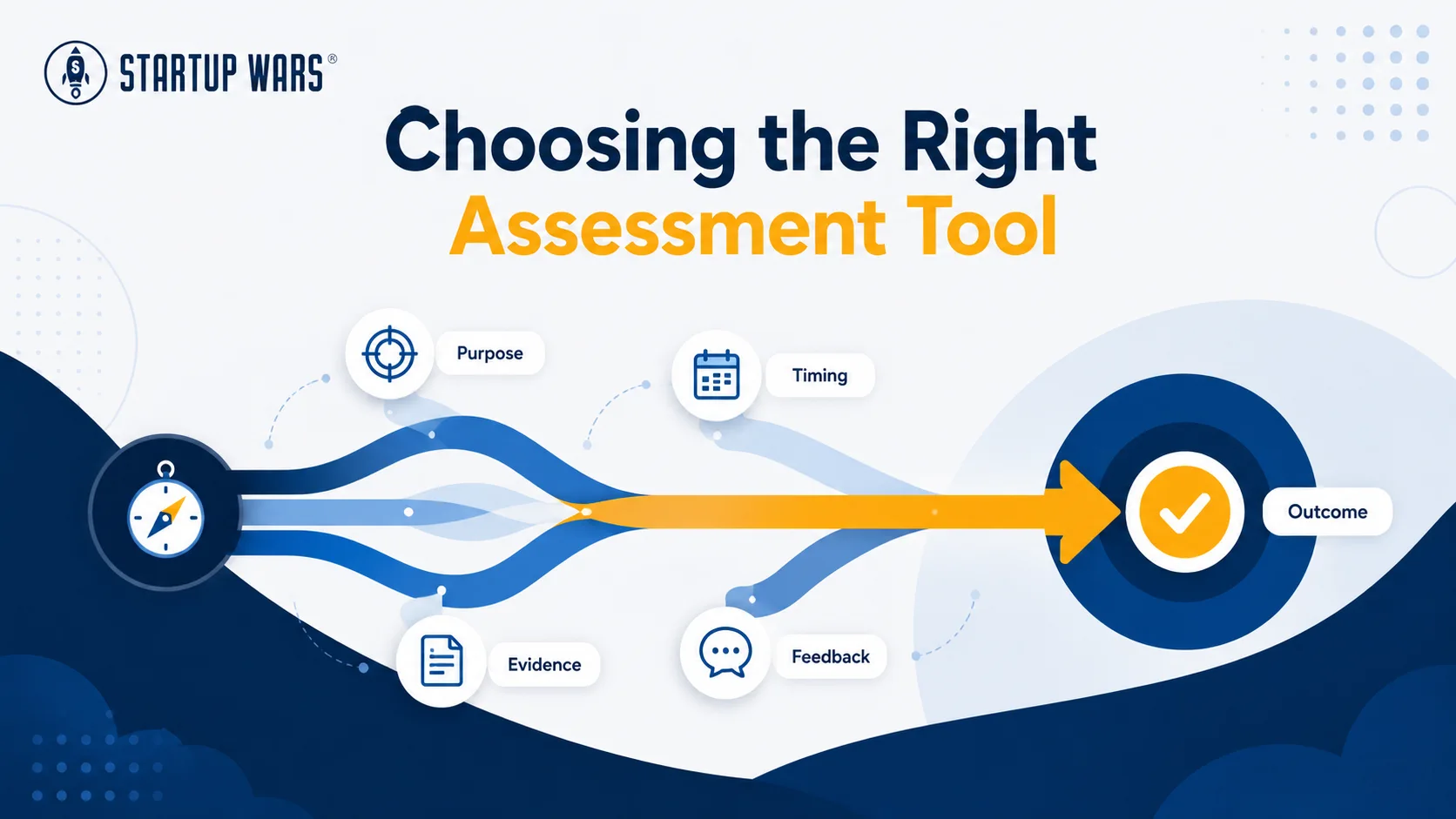
Do not begin by asking which tool is most engaging. Begin with the decision the evidence must support.
1. What is the learning objective?
Is the student expected to define, calculate, compare, recommend, create, or adapt?
2. What evidence would actually demonstrate it?
If the objective is strategic decision-making, a vocabulary quiz is aligned only with part of the goal.
3. When is the evidence needed?
Before instruction, use a diagnostic. During instruction, use a formative check. After instruction, use a summative measure.
4. Who will use the result?
The student, instructor, department, or institution may need different evidence.
5. Is the tool practical and fair?
Consider time, accessibility, scoring consistency, clarity, and whether the task introduces irrelevant barriers. NCME's Classroom Assessment Standards group sound practice around foundations, appropriate use, and quality, including accurate, reliable, and fair results.
A Sample Assessment Sequence
A short experiential business unit might use several tools without turning the course into one continuous grading event.
Before the unit
Use a diagnostic scenario to identify prior understanding.
During instruction
Use short concept checks and one decision memo.
During applied practice
Use a simulation or case with a decision log.
After the activity
Use a structured presentation, rubric, and reflection.
At the end of the course
Ask students to select portfolio evidence showing how their reasoning changed.
Each assessment has a different job. That is healthier than asking one final project to prove everything students learned over an entire semester.
A Note for College Business Programs
For college business programs pursuing accreditation, assessment carries extra weight. AACSB's 2026 Global Standards describe assurance of learning as a systematic process that connects articulated competencies with direct and indirect measures and uses the results to improve curricula.
A business simulation, rubric, presentation, or portfolio does not automatically satisfy AACSB expectations. No single tool does. The value comes from selecting evidence that aligns with the program's competencies, documenting the process, analyzing the results, and using those findings to improve learning.
Frequently Asked Questions
What Are the Three Main Types of Assessment?
The three most commonly discussed types are diagnostic assessment, used before instruction to identify prior knowledge or gaps; formative assessment, used during learning to provide feedback and adjust instruction; and summative assessment, used after instruction to evaluate achievement. Some frameworks also identify interim, placement, performance-based, self-, peer-, and portfolio assessment.
What Is Assessment for, as, and of Learning?
Assessment for learning helps instructors improve teaching while learning is happening. Assessment as learning helps students monitor and regulate their own progress. Assessment of learning evaluates achievement after a period of instruction.
What Are Examples of Educational Assessment?
Examples include quizzes, discussions, diagnostic scenarios, written assignments, case analyses, business simulations, presentations, projects, portfolios, peer reviews, self-assessments, and exams.
What Are Five Components of an Assessment Tool?
There is no single universal five-part formula, but a practical assessment tool should include a clear purpose or objective, instructions and conditions, the task or prompt required, scoring criteria, and a plan for interpreting and using the result.
Which Assessment Tools Work Best for Experiential Business Courses?
The strongest combination usually includes a knowledge check, an applied decision, a clear rubric, and a reflection. A simulation or case can provide the experience, while a decision memo or portfolio helps reveal what the student learned from it.
How Should a Business Simulation Be Graded?
Grade more than profit or final rank. Evaluate the student's use of evidence, reasoning, recognition of tradeoffs, response to outcomes, reflection, and ability to revise the strategy. Our FAQ page covers additional questions about simulation grading and authentic assessment.
Good Assessment Makes Learning Visible
The question is not whether quizzes, presentations, projects, portfolios, or simulations are the "best" assessment tools. The question is what each one allows you to see.
A quiz can show whether students know the concept. A decision memo can show whether they can apply it. A simulation can reveal how they act when several concepts collide. Reflection can show whether the experience changed their thinking. That combination gives educators something more useful than a final score: evidence of learning in motion.
Startup Wars helps educators create that evidence through entrepreneurship-first business simulations in which students make decisions, observe consequences, and explain what they would do next. The platform can support business, entrepreneurship, marketing, economics, CTE, career-readiness, and capstone courses, and the public evidence and methodology behind those results are documented on the Evidence & Outcomes page linked above.
Explore Startup Wars for Educators
About the author
Andrea Martinez
Startup Wars marketing and content contributor
Andrea writes about entrepreneurship education, experiential learning, and the programs and product ideas shaping Startup Wars.