

Leadership is easy when the team agrees, the budget is generous, the deadline is flexible, and nothing important has gone wrong.
Business students should probably practice the other version.
The best leadership games give students responsibility for a decision, place a meaningful constraint around it, and make the consequences visible enough to discuss. Students may need to divide work, choose priorities, respond to poor performance, manage limited resources, or explain an unpopular decision to several people who would prefer a different answer.
That is where leadership becomes more than confidence, charisma, or volunteering to speak first.
The 12 activities below are designed for business, entrepreneurship, management, CTE, and career-readiness courses. Most require little preparation, and each one creates evidence an instructor can assess. Several pair well with a longer business simulation for high schools and CTE when a class is ready to practice leadership across a full startup rather than a single scenario.
What Are Leadership Games?
Leadership games are structured activities in which participants practice guiding people, making decisions, communicating direction, managing resources, or responding to uncertainty.
A good leadership game should require more than completing a puzzle while one student stands nearby looking authoritative.
It should give students opportunities to:
- Set priorities.
- Gather information.
- Listen to competing viewpoints.
- Make a decision.
- Explain the reasoning.
- Assign responsibility.
- Respond to results.
- Change course when needed.
Leadership development games work best when the activity is followed by reflection. Without the debrief, students may remember who won, who panicked, and who accidentally spent the whole budget on marketing. They may not identify what the experience revealed about leadership.
What Leadership Skills Should Business Students Practice?
Leadership frameworks vary, but business students benefit from practicing several recurring behaviors:
- Communicating a clear direction.
- Using individual and team strengths.
- Gathering relevant information.
- Making decisions with incomplete data.
- Delegating responsibility.
- Managing conflict.
- Acting ethically.
- Adapting to new conditions.
- Taking accountability for results.
- Helping the team learn from what happened.
The National Association of Colleges and Employers defines leadership partly through recognizing team strengths, gathering diverse feedback, inspiring others, thinking creatively, and planning and evaluating projects.
Those are observable behaviors, which means educators can design activities around them and collect evidence that students practiced them.

The LEAD Loop
Use this four-step Startup Wars framework to turn an activity into a useful leadership exercise:
Limit → Engage → Act → Debrief
This is a practical framework created for this guide, not a validated leadership model.
Limit
Give the team a real constraint:
- Budget.
- Time.
- Staff.
- Inventory.
- Incomplete information.
- Conflicting stakeholder goals.
Engage
Make leadership relational. Students should gather input, communicate priorities, assign roles, or build agreement.
Act
Require a decision or plan. Leadership should lead somewhere.
Debrief
Examine the result:
- What information mattered?
- Whose voice shaped the decision?
- Which risk was overlooked?
- What would the leader change?
The debrief separates leadership practice from a lively classroom anecdote.
The 12 Leadership Games at a Glance
| Activity | Main skill | Time | Ideal group | Student evidence |
|---|---|---|---|---|
| The 60-Second Call | Fast decision-making | 10–15 min | Whole class | Decision and rationale |
| The Priority Auction | Resource allocation | 25–35 min | Teams of 3–5 | Priority map |
| Rotating CEO | Adaptability and continuity | 30–45 min | Teams of 4–6 | Leadership handoff |
| The Delegation Draft | Delegation and strengths | 25–35 min | Teams of 4–6 | Task plan |
| The Silent Boardroom | Listening and inclusion | 20–30 min | Teams of 4–6 | Written strategy |
| Stakeholder Switch | Perspective and negotiation | 30–40 min | Teams of 5–6 | Agreement and tradeoffs |
| The Ethical Fork | Ethical judgment | 20–30 min | Teams of 3–5 | Decision memo |
| The Capacity Crunch | Staffing and workload | 30–40 min | Teams of 3–5 | Hiring recommendation |
| The Crisis Cabinet | Crisis leadership | 35–50 min | Teams of 4–6 | Response plan |
| The Business Pre-Mortem | Risk anticipation | 20–30 min | Teams of 3–5 | Risk register |
| Feedback Under Pressure | Difficult conversations | 25–35 min | Groups of 3 | Feedback plan |
| Run, Review, Lead Again | Integrated leadership | 60–90 min | Individuals or teams | Decision log and reflection |
1. The 60-Second Call
Best for: Decision-making under pressure Time: 10–15 minutes Materials: Scenario cards
Give one student a brief business dilemma and 60 seconds to decide what the company should do.
Examples:
- A major supplier fails the day before an event.
- A top employee resigns during the busiest week of the year.
- A marketing campaign doubles demand, but inventory is nearly gone.
- A customer publicly posts a serious complaint.
- The team has enough cash for either payroll or a required repair.
The student must state:
- The first action.
- The most important missing information.
- The greatest immediate risk.
- Who needs to hear the decision.
Classmates then ask two follow-up questions.
The goal is not to reward speed alone. It is to help students distinguish between acting quickly and acting carelessly, a distinction with which business history has enjoyed a complicated relationship.
Evidence to collect: A four-sentence decision card.
Debrief: What should a leader decide immediately, and what should wait for better information?
2. The Priority Auction
Best for: Strategic priorities and resource allocation Time: 25–35 minutes Materials: 100 paper points or digital tokens
Give each team 100 points to distribute among six business priorities:
- Product development.
- Marketing.
- Staffing.
- Customer support.
- Equipment.
- Cash reserve.
Teams "bid" on the priorities by assigning points. They must agree on the allocation and explain which area receives the least support.
After teams commit, reveal a new condition:
- Demand falls.
- Equipment breaks.
- A competitor launches.
- A large customer appears.
- A key employee leaves.
Teams receive five minutes to revise the allocation, but moving points carries a cost.
This leadership game reveals how leaders balance urgent demands, future risks, and the understandable desire to label every priority "top priority."
Evidence to collect: Original allocation, revised allocation, and explanation.
Debrief: Did the team fund its stated strategy, or did the budget reveal a different one?
3. Rotating CEO
Best for: Adaptability, handoffs, and leadership styles Time: 30–45 minutes Group size: Four to six students
Give each team a business goal, such as launching a new product in four rounds.
Assign a different CEO for each round.
- Round 1: Set the strategy.
- Round 2: Respond to a cost increase.
- Round 3: Address a staffing problem.
- Round 4: Decide whether to expand or stabilize.
The outgoing CEO has one minute to brief the incoming leader. The new CEO may keep or change the strategy but must explain why.
No one gets to reset the business when leadership changes. Previous decisions remain, much like real organizations and group projects with unusually good documentation.
Evidence to collect: A one-page leadership handoff containing priorities, unresolved risks, and the next decision.
Debrief: Which decisions required continuity, and which required a change in direction?
4. The Delegation Draft
Best for: Delegation and using team strengths Time: 25–35 minutes Materials: Role cards and task cards
Give each team six fictional employees with different strengths, experience levels, availability, and development needs.
Then provide a list of tasks:
- Analyze customer data.
- Prepare a budget.
- Design a campaign.
- Negotiate with a supplier.
- Train a new employee.
- Present the plan.
- Manage the timeline.
The student leader must assign the work and explain:
- Why each person received the task.
- Which responsibility should remain with the leader.
- Where support or training is needed.
- How progress will be checked.
Halfway through, remove one employee or shorten the deadline.
This activity teaches that delegation is not the elegant practice of handing unwanted work to whoever has remained suspiciously quiet.
Evidence to collect: Task assignment matrix and revised plan.
Debrief: Did the leader delegate based on strengths, convenience, fairness, or development potential?
5. The Silent Boardroom
Best for: Listening, inclusion, and written communication Time: 20–30 minutes Group size: Four to six students Rule: No speaking during the decision round
Give teams a business decision, such as whether to:
- Close an underperforming location.
- Raise prices.
- Replace a supplier.
- Delay a product launch.
- Use customer data for a new marketing program.
Students may communicate only through written notes or a shared digital board.
Every participant must contribute one concern, one recommendation, and one response to another person before the team decides.
Silence changes the group dynamic. The fastest speaker no longer owns the opening argument, and students have more time to consider one another's reasoning.
Evidence to collect: Written discussion trail and final recommendation.
Debrief: Whose contribution became more visible without spoken conversation, and what was harder to communicate?
6. Stakeholder Switch
Best for: Negotiation and perspective-taking Time: 30–40 minutes Group size: Five or six students
Assign roles:
- Founder.
- Employee.
- Customer.
- Investor.
- Supplier.
- Community representative.
Present a decision with mixed consequences, such as moving production to reduce costs or replacing employees with automation.
Students negotiate a recommendation from their assigned positions.
After ten minutes, rotate the roles.
The founder may become the employee. The investor may become the community representative. Students then reconsider the same decision.
This activity makes one leadership lesson difficult to avoid: an option can look efficient from one chair and alarming from the next.
Evidence to collect: Final agreement with the main concession made by each stakeholder.
Debrief: Which perspective changed your original position most?
7. The Ethical Fork
Best for: Ethical judgment and accountability Time: 20–30 minutes Group size: Three to five students
Give teams two imperfect choices.
Examples:
- Report a product problem immediately and risk the launch, or investigate first while sales continue.
- Warn employees about likely layoffs early, or wait until the decision is final.
- Reject a profitable supplier with questionable labor practices, or keep the supplier while searching for alternatives.
- Use detailed customer data to improve marketing, or limit the data and accept lower campaign performance.
Teams must choose one option, name the affected stakeholders, and describe one safeguard that reduces harm.
Then ask them to argue the opposite side.
Leadership training exercises become more realistic when students cannot solve every ethical problem by selecting the option labeled "be ethical."
Evidence to collect: A short ethical-decision memo.
Debrief: What value did the team prioritize, and what cost did that priority create?
8. The Capacity Crunch
Best for: Hiring, workload, and financial judgment Time: 30–40 minutes Group size: Three to five students
A small company has more work than its current team can complete.
Give students:
- Current staffing.
- Weekly capacity.
- Expected demand.
- Wage information.
- Cash reserves.
- Overtime limits.
- Customer deadlines.
Teams choose among:
- Hiring a full-time employee.
- Hiring temporary help.
- Outsourcing.
- Turning away work.
- Delaying delivery.
- Improving the process before expanding.
After the decision, reduce expected demand or increase costs.
Students must decide whether to keep the plan.
Evidence to collect: Hiring recommendation with cost, capacity, risk, and review trigger.
Debrief: When does a busy team need more people, and when does it need a better system?
9. The Crisis Cabinet
Best for: Crisis leadership and communication Time: 35–50 minutes Group size: Four to six students
Give each team a crisis:
- A cybersecurity incident.
- A product-safety concern.
- A failed supplier.
- A public customer complaint gaining attention.
- A financial shortfall before payroll.
- A major event canceled after inventory was purchased.
Teams must produce:
- The first three actions.
- A list of people who need information.
- A public or internal message.
- A 30-day recovery plan.
- One prevention step.
Introduce an update halfway through. Perhaps the original information was incomplete, an employee leaked the issue, or the first response failed.
Leadership development simulations are useful here because students practice prioritization when there is no time to create a committee for exploring the possibility of forming another committee.
Evidence to collect: Crisis-response brief.
Debrief: Which action protected the organization immediately, and which protected trust over time?
10. The Business Pre-Mortem
Best for: Risk identification and strategic foresight Time: 20–30 minutes Group size: Three to five students
Give teams a proposed plan:
- Launch a new product.
- Open a second location.
- Hire rapidly.
- Enter a new customer segment.
- Invest most of the budget in one event.
Tell them the plan failed spectacularly six months later.
Their job is to explain why.
Teams generate possible causes, group them by likelihood and impact, and choose three safeguards to add before launch.
Unlike an ordinary brainstorm, the pre-mortem gives students permission to criticize the plan before anyone becomes personally attached to it.
Evidence to collect: Risk map with likelihood, impact, and mitigation.
Debrief: Which risk was easiest to ignore because the original plan sounded exciting?
11. Feedback Under Pressure
Best for: Difficult conversations and emotional intelligence Time: 25–35 minutes Group size: Three students
Assign three roles:
- Leader.
- Employee.
- Observer.
The employee is a strong performer with a recurring problem:
- Misses deadlines.
- Dismisses team input.
- Produces excellent work but communicates poorly.
- Makes decisions without approval.
- Resists a necessary change.
The leader has five minutes to prepare and five minutes to hold the conversation.
The observer tracks whether the leader:
- Described the behavior clearly.
- Explained the impact.
- Asked for the employee's perspective.
- Set a next step.
- Maintained respect.
- Avoided turning one incident into a complete personality biography.
Rotate roles.
Evidence to collect: Feedback plan and observer notes.
Debrief: What made the conversation direct without making it destructive?
12. Run, Review, Lead Again
Best for: Integrated leadership and business judgment Time: 60–90 minutes or multiple sessions Format: Individual or team simulation
Use a connected business simulation, instructor-built scenario, or multi-round case.
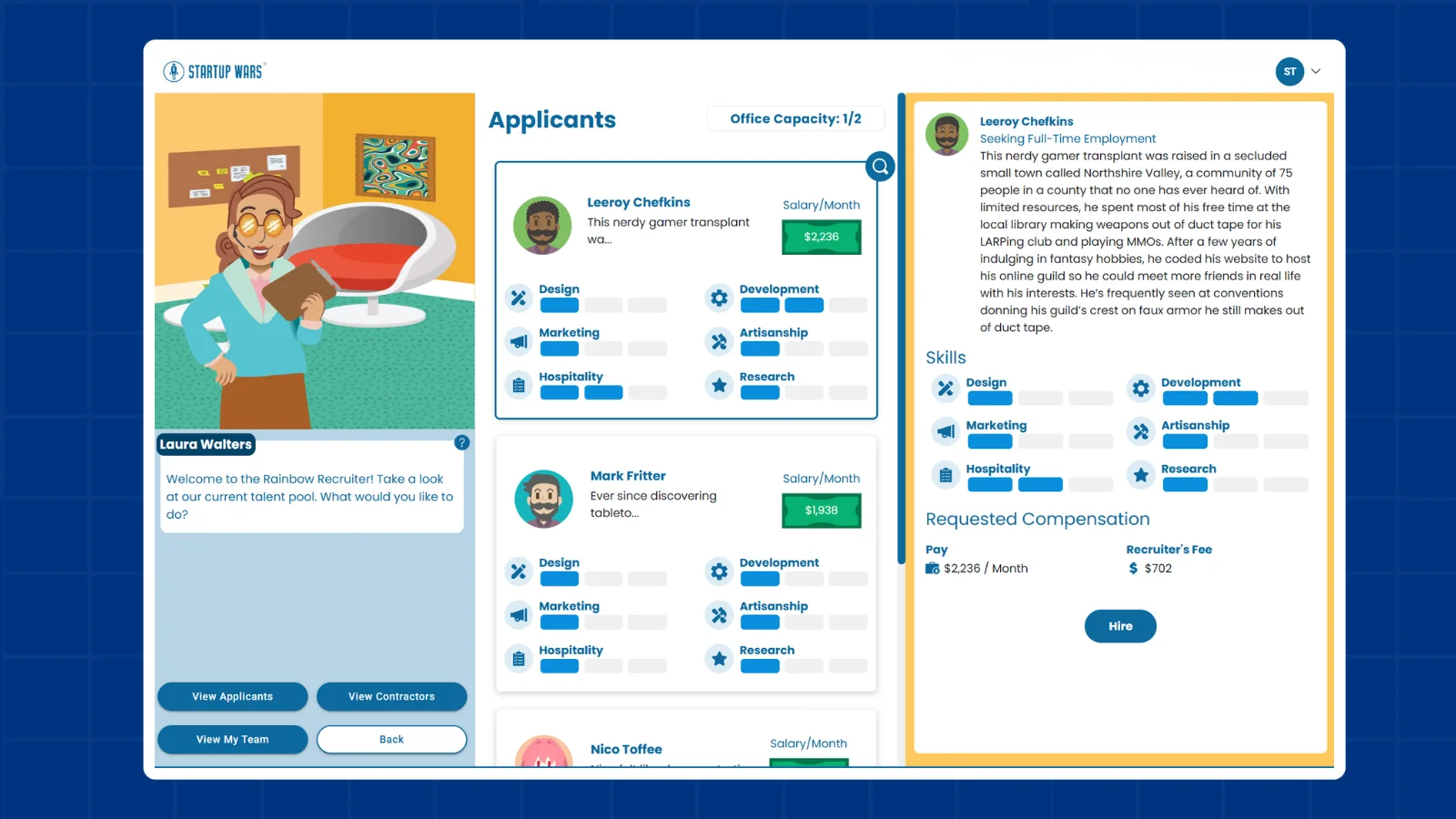
Startup Wars includes browser-based startup simulations in apparel, food service, vertical farming, mobile-app development, and makers-market businesses. Students make decisions involving resources, staffing, inventory, marketing, finances, workload, and growth — including hiring calls like the one below, where a student has to weigh an applicant's skills against salary, recruiter fees, and open office capacity before extending an offer.
Before the first round, students create a leadership plan:
- Goal.
- Priorities.
- Roles.
- Main risk.
- Decision rule.
- Metric to watch.
After the results appear, they review what happened and choose a revised strategy.
If students work in teams, rotate the leader before the next round. The new leader inherits the original choices and must decide what to preserve or change. For the data behind why this kind of connected practice helps, review the Evidence & Outcomes page.
Evidence to collect: Leadership plan, decision log, result analysis, and revised strategy.
Debrief: Did the leader adapt because the evidence changed, or simply because the first result was disappointing?
How to Assess Leadership Games
Leadership should not be assessed by volume, confidence, or whether one student naturally takes over the room.
Use observable evidence.
| Criterion | What to look for |
|---|---|
| Decision quality | The choice fits the available information and constraints |
| Use of evidence | The student gathers and applies relevant information |
| Team leadership | Responsibilities and input are shared thoughtfully |
| Communication | The direction and reasoning are clear |
| Accountability | The student owns the choice and its consequences |
| Adaptability | The plan changes appropriately when conditions change |
| Reflection | The student identifies what was learned and what comes next |
A student does not need to be the formal leader in every activity to demonstrate leadership. Listening, surfacing overlooked information, helping the team decide, or questioning a weak assumption can all provide evidence.
Facilitation Tips
For more classroom tools like these, browse our resources for business educators.
Rotate leadership
Do not let the same confident student lead every round. Leadership development requires practice from people who may not volunteer first.
Give teams imperfect information
Business leaders rarely receive a tidy folder labeled "Everything Required for the Correct Decision."
Let students identify what they know, what they need, and what cannot be known yet.
Separate leadership from winning
A team may achieve a strong outcome through luck or weak competition. Another may make a sound decision that performs poorly because the conditions changed.
Assess reasoning and response, not only the score.
Protect reflection time
The game creates the experience. The debrief creates much of the learning.
Ask students to connect the activity to:
- Business concepts.
- Team behavior.
- Career settings.
- A future decision.
Frequently Asked Questions
What Are Leadership Games?
Leadership games are structured activities designed to help participants practice skills such as communication, decision-making, delegation, teamwork, problem-solving, adaptability, and accountability.
How Do Games Build Leadership Skills?
Games create a low-risk environment where students can make choices, work with others, observe consequences, receive feedback, and revise their approach. The debrief helps turn the experience into a transferable leadership lesson.
What Are Examples of Leadership Activities for Business Students?
Useful examples include priority-setting exercises, crisis scenarios, stakeholder negotiations, delegation challenges, ethical dilemmas, feedback roleplays, hiring decisions, pre-mortems, and business simulations.
What Are Five Important Leadership Skills?
Frameworks differ, but five widely useful skills are:
- Communication.
- Decision-making.
- Teamwork.
- Adaptability.
- Accountability.
Business students should also practice ethical judgment, delegation, and strategic thinking.
Are the "Seven C's" or "Five P's" Universal Leadership Models?
No. Several organizations and authors use different versions of the Seven C's, Five P's, and similar frameworks. Educators should identify the specific source before teaching one version as a standard model.
How Long Should a Leadership Game Take?
A focused activity can take 10–30 minutes. A negotiation, crisis exercise, or leadership simulation may need 45–90 minutes. The right length depends on whether the goal is a quick discussion, skill practice, or integrated application.
How Should Leadership Games Be Graded?
Assess observable behaviors and evidence: use of information, decision quality, inclusion of team input, communication, accountability, adaptation, and reflection. Avoid grading only the final result or the student's confidence.
Leadership Is a Verb With Consequences
Students do not learn leadership only by describing admired leaders.
They learn it by setting a direction, listening to people who see the problem differently, making a choice, and taking responsibility when the result arrives.
Leadership games create a safe place to practice those moments.
A resource-allocation game teaches priorities. A stakeholder negotiation teaches perspective. A crisis scenario teaches judgment under pressure. A business simulation shows how one leadership decision can affect people, money, customers, and operations at the same time.
The goal is not to produce a room full of CEOs by Friday.
It is to help students become more thoughtful when the next decision belongs to them.
Startup Wars helps high-school, CTE, college, and university educators give learners realistic founder decisions to lead, review, and discuss. Students manage industry-themed startups, work through tradeoffs, and return to class with consequences worth examining.
Explore business simulations for high schools and CTE to give your students a longer, connected leadership challenge once these 12 games get them started.
About the author
Andrea Martinez
Startup Wars marketing and content contributor
Andrea writes about entrepreneurship education, experiential learning, and the programs and product ideas shaping Startup Wars.