These entrepreneurship lesson plan examples help educators teach entrepreneurship through practice. Some plans begin with a definition. Others begin with a student staring at a $2,000 budget, three attractive opportunities, and the unwelcome discovery that money refuses to fund all of them.
The second version tends to generate better questions.
Entrepreneurship education needs concepts, frameworks, readings, and clear instruction. Students should understand customers, value propositions, pricing, revenue, costs, staffing, marketing, and risk. They also need chances to make choices before the answer is visible, and before real money, employees, or customers are involved.
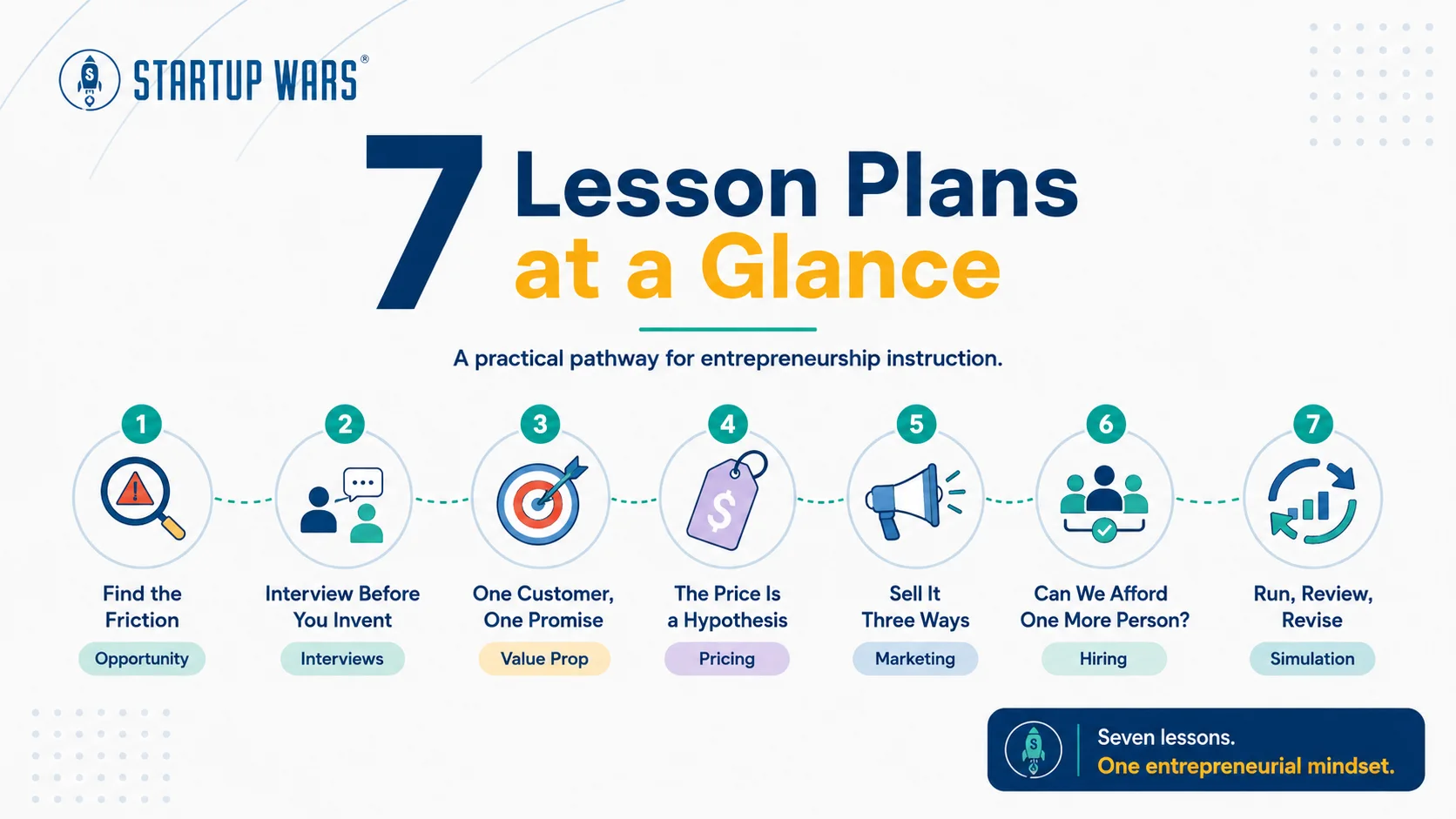
The seven lesson plan examples below help educators turn business concepts into decisions students can investigate, defend, test, and revise. They fit high-school entrepreneurship programs, CTE pathways, marketing classes, financial-literacy courses, or an introduction to business course.
Each lesson includes a measurable learning objective, a realistic business context, a student decision or deliverable, a method for checking understanding, and a reflection or transfer task. Completing the activity and learning from the activity are two different achievements, and these plans are built to produce the second one.
Want to build your own from scratch instead? Our guide to writing an entrepreneurship lesson plan includes a copyable template and a step-by-step planning framework.
What Makes a Strong Entrepreneurship Lesson Plan?
A lesson plan is an educator's guide to what students should learn, how they will learn it, and how that learning will be measured. Strong plans include objectives, standards, materials, procedures, assessment, and reflection.
For entrepreneurship, one additional ingredient matters: students need something meaningful to decide.
A business lesson becomes practical when students must choose a customer, revise a product, defend a price, allocate limited resources, or respond to an unexpected result. Even a ten-minute business scenario creates applied learning when it asks students to make a commitment and explain the reasoning behind it.
These activities are designed to give students repeated opportunities to explain and revise a decision. Evaluate their learning through the work they produce; completing an activity alone does not establish a gain in entrepreneurial intention or mindset.
The Seven Lesson Plan Examples at a Glance
| Lesson | Main skill | Suggested time | Student evidence |
|---|---|---|---|
| Find the Friction | Opportunity recognition | 45–50 min | Problem statement and evidence |
| Interview Before You Invent | Customer discovery | 50–75 min | Interview notes and revised assumptions |
| One Customer, One Promise | Value proposition | 45–60 min | One-sentence value proposition |
| The Price Is a Hypothesis | Pricing and unit economics | 50–60 min | Pricing decision and calculations |
| Sell It Three Ways | Segmentation and marketing | 45–60 min | Three audience-specific messages |
| Can We Afford One More Person? | HR, workload, and finance | 50–75 min | Hiring recommendation |
| Run, Review, Revise | Cross-functional decisions | 60–90 min or multiple sessions | Decision log and reflection |
Lesson Plan Example 1: Find the Friction
Students often begin entrepreneurship projects by proposing products: a better water bottle, a new clothing brand, an app that "uses AI," something involving coffee and probably a subscription. This lesson makes them begin with a problem instead.
Learning objective: Students will identify a recurring customer problem, distinguish the problem from a proposed solution, and support the problem with observable evidence.
Opening hook: Show students a ridiculous product, like a robotic backpack that follows students through school announcing whenever they forget homework. Ask: what problem is this solving, is the problem real, and what evidence would you need before building anything? The absurdity gives students permission to critique the idea rather than politely applauding the robot.
Activity: Students list five frustrations they've observed in school, work, transportation, shopping, food, or technology. They pick one and write: [Customer] struggles with [problem] when [context], which leads to [consequence]. Then they exchange statements and challenge each other: is this a problem or a disguised solution? Does it happen often enough to matter? What evidence supports it?
Assessment: A one-page opportunity brief with the customer, problem, context, evidence, current workaround, and one assumption that still needs testing.
Debrief: Ask why founders fall in love with a solution before understanding the problem. As an extension, students observe one real environment before the next class and document three examples of friction without proposing solutions.
Lesson Plan Example 2: Interview Before You Invent
The fastest way to ruin a customer interview is to run it like a sales pitch wearing a fake mustache. The goal is to learn what people currently do, what frustrates them, and how much the problem matters.
Learning objective: Students will design and conduct non-leading customer interviews, identify recurring patterns, and revise at least one original assumption.
Before class: Give students a proposed business concept, like a healthier campus snack service or a customizable T-shirt company. They predict the primary customer, the most important problem, current alternatives, and what customers might pay. No research yet. The assumptions are the point.
The interview guide: Students write five questions focused on past behavior: tell me about the last time you experienced this problem, what did you do, what was most frustrating, how often does it happen, have you spent money trying to solve it? Discourage questions like "would you use our amazing app?" Most people say yes to an imaginary product when the answer costs nothing and ends the conversation faster.
Run the interviews: Students interview three classmates or approved participants, then sort findings into confirmed, contradicted, still uncertain, and unexpected.
Evidence: A before-and-after assumption table.
| Assumption before interviews | Evidence collected | Keep, revise, or reject? |
|---|---|---|
| Students want faster food service | Two students cared more about price | Revise |
| Students would preorder | Three already use mobile ordering | Keep |
| Lunch is the main use case | One identified late-night study sessions | Investigate |
Reflection: Which answer surprised you most, and how did it change the business idea? This lesson leads naturally into segmentation, value propositions, or pricing.
Lesson Plan Example 3: One Customer, One Promise
Entrepreneurship students sometimes create value propositions that attempt to serve everyone: "Our platform helps people save time, money, stress, the environment, and possibly society." Very ambitious. Slightly difficult to execute before lunch. This lesson forces specificity.
Learning objective: Students will define a target customer and create a concise value proposition linking one meaningful problem to one clear benefit.
The challenge: Give each group a familiar business (food truck, T-shirt company, fitness app, vertical farm) and three possible customer segments. For a food truck: office workers with short lunch breaks, college students seeking cheap meals, event organizers needing catering. Each group chooses one.
The sentence: Students complete: For [specific customer] who [specific problem], our [product] provides [primary benefit], unlike [current alternative]. They test it against four questions: can the customer recognize themselves, is the problem specific, is the benefit meaningful, is the claim believable?
Constraint round: Introduce a twist. The customer has less money than expected, a competitor adds free delivery, or the market gets crowded. Students revise the promise without changing the target customer.
Assessment: A four-point rubric: customer is specific, problem is observable, benefit is clear, claim is credible.
Transfer: Adapt the same business for a second customer and explain why the messaging must change.
Lesson Plan Example 4: The Price Is a Hypothesis
Pricing lessons get interesting the moment students discover that "make it cheap" is an incomplete strategy.
Learning objective: Students will calculate a basic unit margin, choose a price using cost and customer information, and revise that price after receiving new evidence.
Scenario: A student-run T-shirt company has $14 in variable costs per shirt: $7 blank, $4 printing, $1 packaging, $2 fees. Three prices are on the table, with demand estimates:
| Price | Expected sales |
|---|---|
| $18 | 100 |
| $24 | 70 |
| $30 | 45 |
Students calculate expected revenue and contribution before committing to a price.
Complication: After teams commit, reveal one development: printing costs rise $2, a competitor launches at $20, customers say quality matters more than price, or demand comes in 20% under forecast. Teams decide whether to keep the price, change it, change the product, or change the customer.
Output: A pricing memo answering: what price did you choose, what assumptions support it, what does the new information change, and which metric would you monitor next?
Why it works: Students practice arithmetic, but the lesson is really about uncertainty and tradeoffs. A correct calculation can still support a poor decision when the assumptions are weak.
Lesson Plan Example 5: Sell It Three Ways
Marketing messages land when they're written for a particular audience, and this lesson proves it by making students write for three.
Learning objective: Students will segment a market and create three different messages for the same product based on distinct customer priorities.
Setup: Choose one product (specialty coffee truck, student budgeting app, meal-prep service) and give each group three customer profiles. For a budgeting app: a first-year student managing money independently, a working student balancing tuition and bills, a parent helping a teenager build financial habits.
The task: One message per audience, each with a headline, primary benefit, proof point, call to action, and the channel where it would appear. The same product should produce three genuinely different messages, and the fastest way to check is reading them aloud.
Gallery critique: Post the messages around the room. Students leave feedback notes: is the customer obvious, does the benefit matter to that person, is the proof credible?
Evidence: Original messages, peer feedback, and one revision.
Optional AI extension: Students generate one AI-assisted version after completing their own, then evaluate whether it reflects the segment or falls back into generic marketing fog. AI stays a draft partner rather than an answer dispenser.
Lesson Plan Example 6: Can We Afford One More Person?
Hiring is often taught as a human-resources topic. In practice it's simultaneously a finance, operations, workload, and leadership decision.
Learning objective: Students will evaluate whether a small business should hire by comparing labor cost, capacity, demand, and operational risk.
Scenario: A growing T-shirt company has 2 workers, 90 hours of weekly capacity, 110 hours of expected work, $3,000 in monthly cash reserves, and a major event opportunity next month. Options: hire full-time, hire temporary help, decline some orders, delay the event, or improve the process before hiring. Provide wage rates, productivity estimates, and demand uncertainty.
Decision meeting: Assign roles: founder, finance lead, operations lead, employee representative, marketing lead. Each recommends an option from their perspective, then the team makes one final call.
Assessment: A hiring recommendation covering the financial effect, capacity effect, risk, alternatives considered, and the trigger that would cause the company to revisit the decision.
Debrief: When does "we are busy" become "we need to hire"? The answer should involve more than how tired everyone feels, though that part isn't entirely irrelevant.
Transfer: Compare the same decision in a food truck, a software startup, and a seasonal retail business. Which variables change?
Lesson Plan Example 7: Run, Review, Revise
This final example uses a business simulation lesson plan to connect several course concepts in one environment.
Startup Wars offers browser-based simulations in apparel e-commerce, food service, vertical farming, mobile-app development, and makers-market businesses, where students make decisions involving inventory, staffing, marketing, financial reporting, and resource management. A similar structure works with another classroom simulation or a spreadsheet model.
Learning objective: Students will make cross-functional business decisions, analyze the resulting evidence, and revise their strategy using finance, marketing, operations, and management concepts.
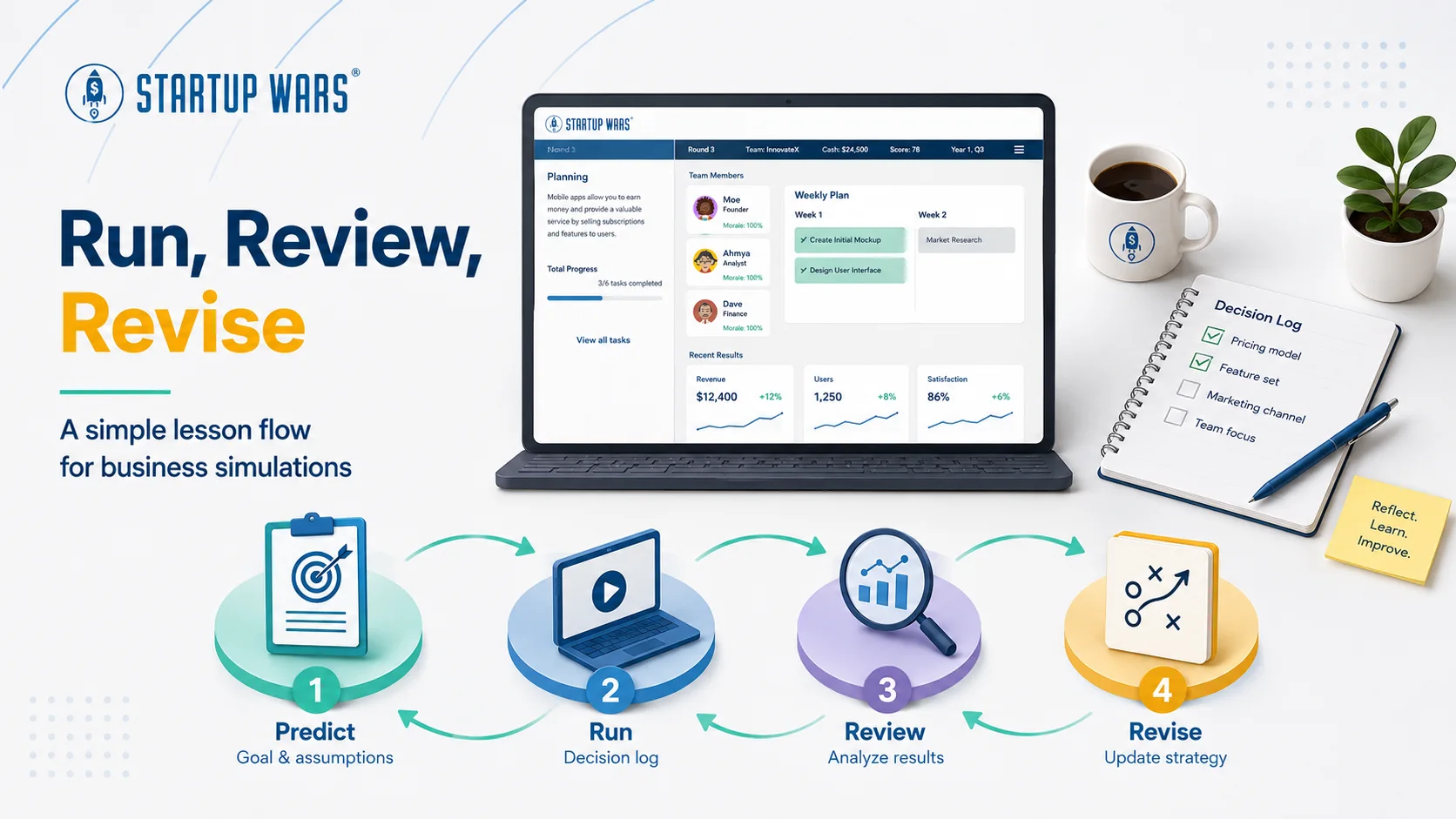
Phase 1, Predict: Before playing, students write their primary goal, three decisions they expect to make, their greatest risk, one metric they'll monitor, and their initial strategy. This keeps the result from becoming a disconnected score.
Phase 2, Run: Students complete a simulation round with a required decision log: the decision, why we made it, the result, what we learned. Avoid rescuing every difficult moment. A safe simulation is one of the few places where a questionable inventory decision can become educational instead of becoming an email from accounting.
Phase 3, Review: Students identify one decision that worked, one that underperformed, one assumption that proved inaccurate, and one decision they'd make differently.
Phase 4, Revise: Students run another attempt or write a revised strategy. Grade the analysis, since a student can produce a strong learning reflection after a weak business result, while another can stumble into profit without understanding why.
Assessment model: Initial reasoning 20%, use of business evidence 25%, decision quality 20%, reflection 20%, revised strategy 15%.
Extension: Compare results across industries. What makes inventory different in a food truck versus a T-shirt company? Which marketing choices transfer across all five businesses?
Frequently Asked Questions
What Are Examples of Entrepreneurship Lesson Plans?
Useful examples include opportunity-recognition activities, customer interviews, value-proposition development, pricing decisions, marketing-message tests, hiring scenarios, business simulations, pitch-and-feedback exercises, and budgeting labs. The seven lesson plans above cover each of these skills with ready-to-run structures.
What Types of Lesson Plans Work Well for Entrepreneurship?
Entrepreneurship works especially well with problem-based lessons, case studies, decision scenarios, customer research, simulations, and reflection-based assignments. Match the format to the learning objective rather than to whichever activity looked most exciting on social media at 11 p.m.
Turn Business Theory Into Something Students Can Test
The best lesson plan examples give students a reason to use what they've learned. A customer interview tests an assumption. A pricing exercise reveals a tradeoff. A business simulation lets several decisions collide in one environment, which is more or less what businesses do when nobody is looking.
Startup Wars helps high-school and CTE educators turn entrepreneurship concepts into browser-based decisions students can make, review, and discuss. The simulations fit introduction to business, entrepreneurship, marketing, and career-readiness courses, and they're designed to help students move from memorizing terminology to exercising business judgment.
The lesson plan still belongs to the instructor. The simulation simply gives the lesson somewhere to go.
Explore Business Simulations for High Schools
Ready-to-run pricing lesson: student brief and answer key
Teaching materials by Startup Wars. Use this complete version of lesson 4 when you need entrepreneurship lesson plans for a single 50-minute class. The figures are fictional classroom data, not platform results or a forecast for a real business. Students need paper or a shared document and a calculator; no account is required.
Open the printable pricing lesson and teacher key. Copy the student page into your learning platform and keep the answer key for the debrief.
Preparation and learning evidence
Before class, check that students can multiply a price by a quantity and subtract costs. Model one unrelated example if needed. Organize pairs, with one student calculating and the other checking assumptions; switch roles after the first round. The objective is to calculate contribution, recommend a price, and revise the recommendation when costs change. Collect a calculation table and an individual exit response.
Student instructions and 50-minute sequence
Your team sells made-to-order T-shirts. Variable cost is $14 per shirt. For this simplified exercise, only shirts sold are produced, and fixed costs are excluded. The demand estimates below are assumptions, not customer research.
- Minutes 0–5: Predict which price will earn the most total contribution. Write your reason before calculating.
- Minutes 5–15: Calculate revenue as price × units sold. Calculate total contribution as (price − variable cost) × units sold for all three options.
- Minutes 15–25: Choose a price. Explain the tradeoff between contribution per shirt and total demand. Identify one assumption you would test with customers.
- Minutes 25–35: Your teacher reveals that printing costs rise by $2 per shirt. Keep the original demand estimates for this round. Recalculate and decide whether to revise your price.
- Minutes 35–45: Compare recommendations with another pair. Explain why the highest revenue is not necessarily the highest contribution.
- Minutes 45–50: Individually answer: what changed your decision, and what new evidence could change it again?
Worked answer: contribution is not net profit
| Price | Assumed sales | Revenue | Contribution at $14 cost | Contribution at $16 cost |
|---|---|---|---|---|
| $18 | 100 | $1,800 | $400 | $200 |
| $24 | 70 | $1,680 | $700 | $560 |
| $30 | 45 | $1,350 | $720 | $630 |
Under these assumptions, $30 produces the highest contribution in both rounds. The $18 option has the highest revenue. Neither calculation establishes net profit because rent, equipment and other fixed costs are absent. At the original cost, the $30 price needs at least 44 sales to exceed the $700 contribution from 70 sales at $24: 44 × $16 = $704. That narrow margin makes demand evidence important.
A student may recommend a different price if they clearly identify a changed assumption and calculate its consequences. Do not award full reasoning credit for selecting $30 without explaining the evidence.
A common 12-point classroom rubric
Score each criterion from 0 to 3: 0 missing, 1 attempted with major gaps, 2 mostly correct with a specific gap, 3 accurate and supported. Share the criteria before students work.
| Criterion | Evidence for full credit |
|---|---|
| Calculation | Correct formula, units and totals for both rounds |
| Decision | Compares at least two prices using contribution and demand |
| Revision | Explains how the cost change affects the recommendation |
| Reflection | Names an uncertain assumption and a feasible way to investigate it |
Calibrate by scoring one anonymous sample together. Grade the individual exit response separately when you need evidence of each student's understanding. For younger learners, supply the formula and partially complete one row. For advanced students, add a fixed cost or a demand range and ask when the preferred option changes. In online classes, use a shared table and require each student to submit their own explanation.
Entrepreneurship activities for students: build a course sequence
The two-week business curriculum sprint shows how customer discovery, pricing, operations and reflection can build across ten sessions. The high-school business competition guide adds a pitch outline and preparation rubric when students are ready to present an idea.
For simulation selection, compare the scenarios in the entrepreneurship simulation catalog. Review high-school and CTE implementation or college course adoption for the relevant teaching setting. These worksheets can be used independently of a product purchase.
About the author
Andrea Martinez
Startup Wars marketing and content contributor
Andrea writes about entrepreneurship education, experiential learning, and the programs and product ideas shaping Startup Wars.