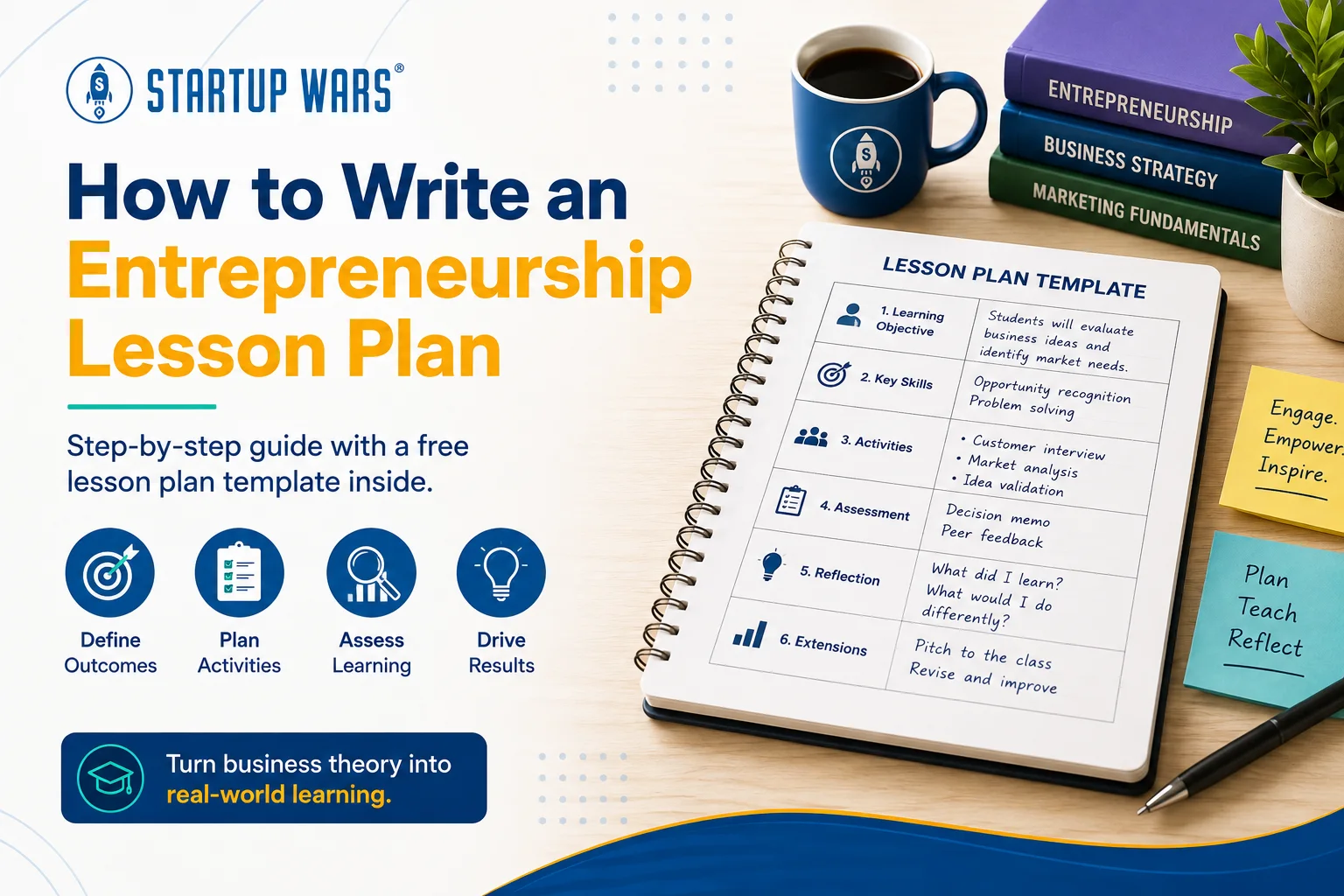
Most lesson plan templates ask what students will do. An entrepreneurship lesson plan needs a sharper question: what will students decide?
That difference shapes everything else in the plan. Entrepreneurship is a competence expressed through identifying value, mobilizing resources, and acting on ideas, which is how the European Commission's EntreComp framework describes it across its 15 competencies. Students build that competence by making choices under realistic conditions, then examining what happened.
This guide walks through how to write lesson plans built around decisions, gives you a copyable lesson plan template, and covers the mistakes that quietly flatten entrepreneurship lessons into worksheets.
Looking for ready-made lessons instead? We've built seven complete entrepreneurship lesson plan examples covering customer discovery, pricing, marketing, hiring, and simulations.
Start With the Outcome, Not the Activity
Backward design begins by identifying what students should be able to do, deciding what evidence would demonstrate that learning, and only then selecting activities and materials. Cornell's course-design guidance follows this outcome, assessment, activity sequence, and Edutopia emphasizes the same alignment.
So instead of starting with "students will make a poster about entrepreneurship," start with "students will identify a customer problem, support it with evidence, and explain why solving it could create value."
The poster may still appear. It simply has a job now.
Research supports building lessons this way. A 2024 peer-reviewed study of 669 students found a positive relationship between experiential learning and entrepreneurial intention, with self-efficacy helping mediate that relationship. NFTE's 2025 research across more than 1,200 students and 50 educators reported stronger entrepreneurial-mindset development when students had repeated opportunities to present and refine ideas.
The Founder Lab Lesson Cycle
This Startup Wars planning framework turns almost any entrepreneurship topic into an applied lesson. It's a practical editorial framework developed for this guide rather than a formal research model, and it runs in seven steps:
Outcome → Evidence → Context → Constraint → Decision → Debrief → Transfer
1. Outcome. State what students should be able to do, using an observable verb: identify, compare, calculate, design, defend, revise, evaluate. "Understand customers" is admirable but difficult to assess. "Use interview evidence to revise a customer profile" gives everyone something to work with.
2. Evidence. Decide what students will produce: a decision memo, a pricing calculation, a short pitch, a revised strategy.
3. Context. Put the objective inside a believable business. Students might be managing a food truck, a mobile app, a T-shirt brand, a vertical farm, or a makers-market business.
4. Constraint. Add limits: a fixed budget, limited staff, a deadline, uncertain demand, rising costs, an unexpected competitor. Constraints transform creativity into decision-making.
5. Decision. Require students to commit to a course of action. "It depends" only counts as an answer when they explain exactly what it depends on.
6. Debrief. Ask: what did you assume, what evidence mattered, which tradeoff was hardest, what would change your decision?
7. Transfer. Move the same principle into another context. A pricing rule that worked for a handmade product may fail for software. Transfer helps students learn the business concept rather than memorize one scenario.
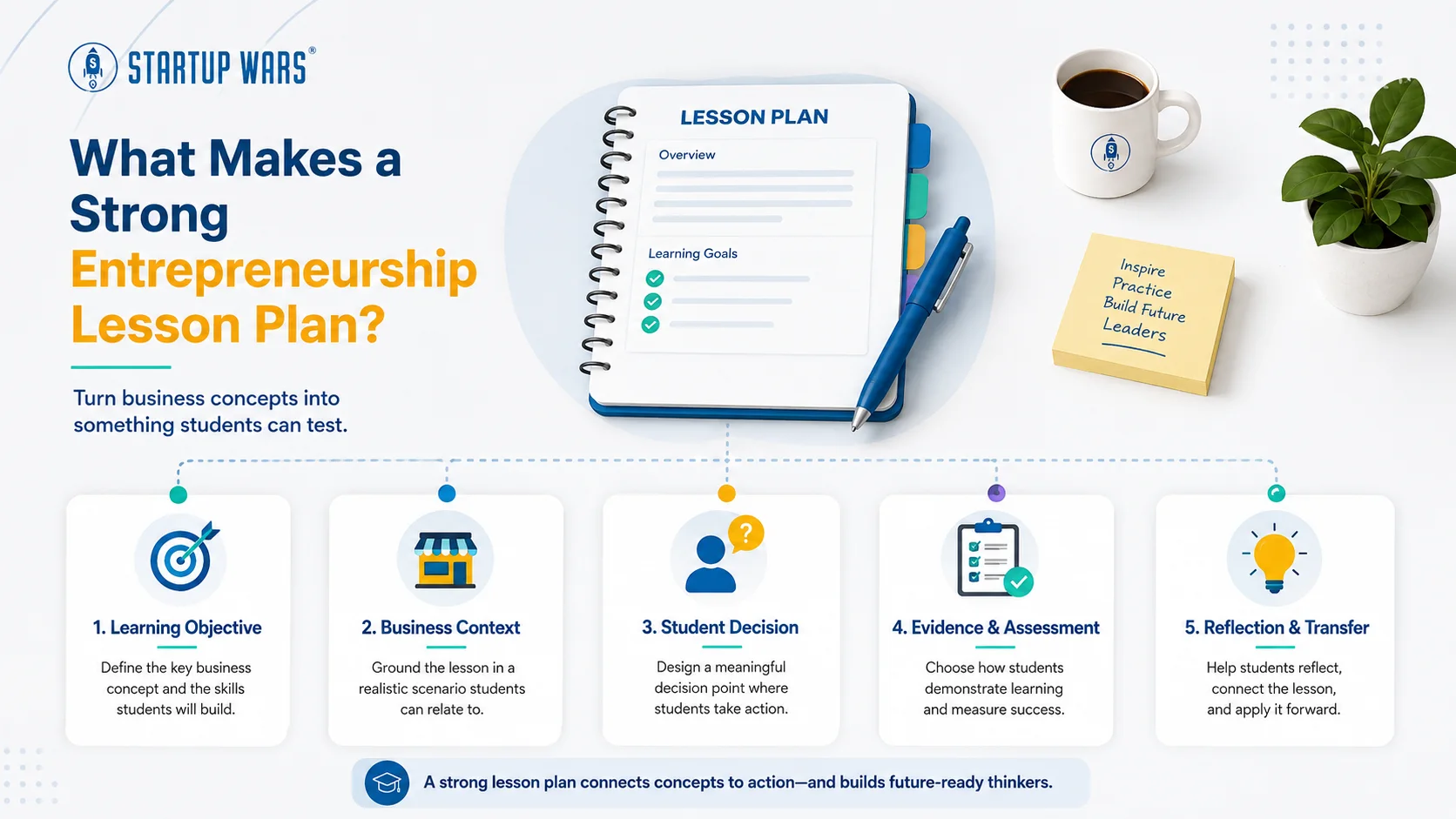
Copyable Entrepreneurship Lesson Plan Template
Use this lesson plan format as-is or adapt it to your course. It works for lesson plans for teachers in high-school CTE programs as well as introductory college courses.
Lesson information Lesson title / Course or grade / Duration / Topic / Standards or competencies
1. Learning outcome By the end of the lesson, students will be able to: [action verb] + [specific knowledge or skill] + [context or standard]. Example: evaluate three pricing options and defend one using cost, customer, and demand information.
2. Evidence of learning What students will produce: a calculation, a decision memo, an interview summary, a presentation, a reflection, a revised business strategy.
3. Business context What business, customer, or problem gives the lesson relevance?
4. Constraint What makes the decision realistic? Budget, time, staff, inventory, demand, competition, regulation, or conflicting stakeholder goals.
5. Materials Handouts, slides, worksheets, data, technology, rubric, business simulation or scenario.
6. Lesson sequence
| Time | Stage | Instructor role | Student role |
|---|---|---|---|
| 5 min | Hook | Present problem | Make initial prediction |
| 10 min | Concept | Explain and model | Ask questions |
| 20 min | Decision activity | Facilitate | Analyze and decide |
| 10 min | Evidence | Reveal result or feedback | Interpret |
| 5 min | Reflection | Prompt transfer | Write next step |
7. Assessment What will demonstrate that students met the objective?
8. Debrief questions What did you decide? What evidence supported it? What happened? What would you change? Where else does this principle apply?
9. Adaptation How can the lesson be shortened, extended, scaffolded, made more challenging, or completed asynchronously?
10. Instructor reflection Which misconception appeared? Where did students need help? Did the activity produce the intended evidence? What should change next time? Reflection is how good lesson plans stop pretending they were born perfect.
How to Adapt the Template to Different Class Formats
A 50-minute period: one measurable objective, a 5-minute hook, 10 minutes of instruction, 20 minutes for the decision, 10 minutes of discussion, and a 5-minute exit response.
A 90-minute block: add research, peer critique, a second decision round, calculations, or a fuller reflection.
Two class periods: day one covers concepts, evidence gathering, and the initial decision. Day two brings new information, revision, presentation, and reflection.
A one-week unit: connect several lessons around one startup. Monday, find the problem. Tuesday, interview customers. Wednesday, define the value proposition. Thursday, set the price and marketing message. Friday, present, simulate, or revise. The shared business context helps students see how one decision creates the next.
Common Mistakes in Entrepreneurship Lesson Plans
Starting with the activity instead of the objective. "Students will make a pitch deck" describes an assignment. The plan still needs to say what the deck should prove students can do.
Teaching too much before students act. Students need information, and they rarely need 43 slides before the first meaningful decision. Teach the minimum useful concept, let students apply it, and add depth during the debrief.
Removing every constraint. Unlimited budgets, unlimited staff, and perfectly cooperative customers produce charming businesses from a parallel universe. Constraints create entrepreneurship.
Assessing polish instead of reasoning. A beautiful presentation can hide weak assumptions. Grade the quality of evidence and decisions alongside the design of the slides.
Rewarding only the best outcome. Students can learn from business failure when they identify what happened and revise intelligently. Grading only the winners teaches students to hide mistakes.
Skipping the debrief. An engaging activity can remain only an engaging activity. Reflection is where students name the concept, interpret the consequence, and prepare to transfer the learning.
Frequently Asked Questions
What Is a Lesson Plan?
A lesson plan is an educator's structured guide to what students should learn, how instruction and activities will support that learning, and how the educator will assess whether the objective was achieved.
What Are the Five Main Parts of a Lesson Plan?
A practical five-part structure is: learning objective, materials and context, instruction and activity, assessment, and closure or reflection. Some formats separate standards, differentiation, or homework into additional sections.
What Are the Seven Steps of an Entrepreneurship Lesson Plan?
Define the outcome, select the evidence, establish the business context, add a realistic constraint, ask students to decide, debrief the result, and transfer the lesson to a new situation.
How Do I Write an Entrepreneurship Lesson Plan?
Start with a specific skill students should demonstrate. Decide what evidence would prove they can do it. Create a realistic business problem, give students enough information to act, add a meaningful constraint, and include time for reflection.
What Is the Best Lesson Plan Format?
The best lesson plan format is the one that keeps objectives, activities, and assessment aligned. The 10-part template above works for most entrepreneurship courses and compresses easily for shorter lessons.
Why Do Educators Write Lesson Plans?
Lesson plans help instructors align objectives, activities, materials, time, and assessment. They also make lessons easier to repeat, share, revise, and adapt for different learners or course formats.
Put the Template to Work
A good template gets you to the starting line. The lessons themselves are where students choose a customer, defend a price, or discover their assumptions were optimistic.
For ready-to-run versions, our seven entrepreneurship lesson plan examples apply this exact framework to customer discovery, value propositions, pricing, marketing, hiring, and business simulations. And when a lesson needs somewhere for several decisions to collide at once, Startup Wars gives students browser-based businesses to run, review, and revise.
Explore Entrepreneurship Simulations
About the author
Andrea Martinez
Startup Wars marketing and content contributor
Andrea writes about entrepreneurship education, experiential learning, and the programs and product ideas shaping Startup Wars.