Ten years ago, the biggest debate in education technology was whether students should use laptops in class.
Today, the conversation is very different.
Professors, curriculum directors, and university leaders are now asking:
- Should students be allowed to use AI tools like ChatGPT?
- Can AI actually improve learning outcomes?
- And most importantly: how can educators use AI responsibly without losing academic rigor?
The truth is simple: AI in education is no longer optional, it’s inevitable.
AI technologies could significantly transform how learning is delivered, personalized, and assessed in the coming decade. Universities and schools that adopt these tools strategically may gain a massive advantage in student engagement, learning outcomes, and career readiness.
But adoption requires clarity.
In this guide, we’ll break down:
- What AI in education actually means
- The most useful AI tools for educators
- Real classroom use cases
- Ethical considerations every institution must address
And most importantly, how educators can use AI to enhance, not replace, teaching.
Table of Contents
AI in education refers to the use of artificial intelligence technologies to enhance learning, teaching, and educational decision-making.
These technologies can analyze data, automate tasks, personalize learning, and simulate real-world scenarios.
Examples include:
- AI tutoring systems
- automated grading tools
- adaptive learning platforms
- classroom simulations
predictive analytics for student performance.
AI is already improving teaching efficiency, student engagement, and personalized learning experiences. In fact, educators are beginning to see measurable outcomes in areas like feedback speed, learning analytics, and classroom engagement, benefits explored in more detail in our guide on The real benefits of AI in education for teachers and students.
The Most Impactful AI Tools for Educators
Not all AI tools are created equal.
Some automate small tasks, while others completely transform how students learn.
Here are the three categories making the biggest impact.

AI tutoring systems provide students with personalized support outside class hours.
These tools can:
- answer questions instantly
- explain complex topics step-by-step
- adapt difficulty levels to the student’s progress
Platforms like Khan Academy’s AI tutor and ChatGPT-powered assistants are already being used to supplement classroom instruction.
For educators, this means students receive continuous learning support without increasing faculty workload.
Grading essays, assignments, and quizzes can consume hours of a professor’s time.
AI-powered assessment tools can help automate parts of this process by:
- evaluating short-answer responses
- identifying patterns in student performance
- generating feedback suggestions
Importantly, these tools should assist educators, not replace human evaluation.
The goal is to reduce administrative workload so educators can focus on mentoring and teaching.
Read our AI Assessment Guide to know the assigments you can grade with your students.
One of the most powerful uses of AI in education is simulation-based learning.
Instead of studying theory alone, students can interact with simulated environments where decisions have real consequences.
Examples include:
business strategy simulations
entrepreneurship startup simulations
economic decision-making games
These tools help students practice real-world decision making in a safe environment.
Platforms like Startup Wars, for example, combine business simulations with built-in AI guidance through Milton AI, an intelligent assistant designed to support student reasoning during simulations.
Rather than giving students the “right answer,” Milton prompts deeper thinking by asking questions such as:
Why did your strategy work or fail?
What alternative decisions could you have made?
How might competitors react to your next move?
This approach transforms AI from a shortcut into a thinking partner that encourages reflection and critical decision-making.
For educators, this means AI can support deeper learning without replacing the student’s reasoning process.
From writing assistants to research tools and AI tutors, the number of platforms available to students continues to grow. If you’re exploring the most widely used options today, you can also review our list of the top AI tools every college student should use.
Real Use Cases of AI in the Classroom
AI adoption is no longer theoretical.
Educators across universities and schools are already implementing it in meaningful ways.
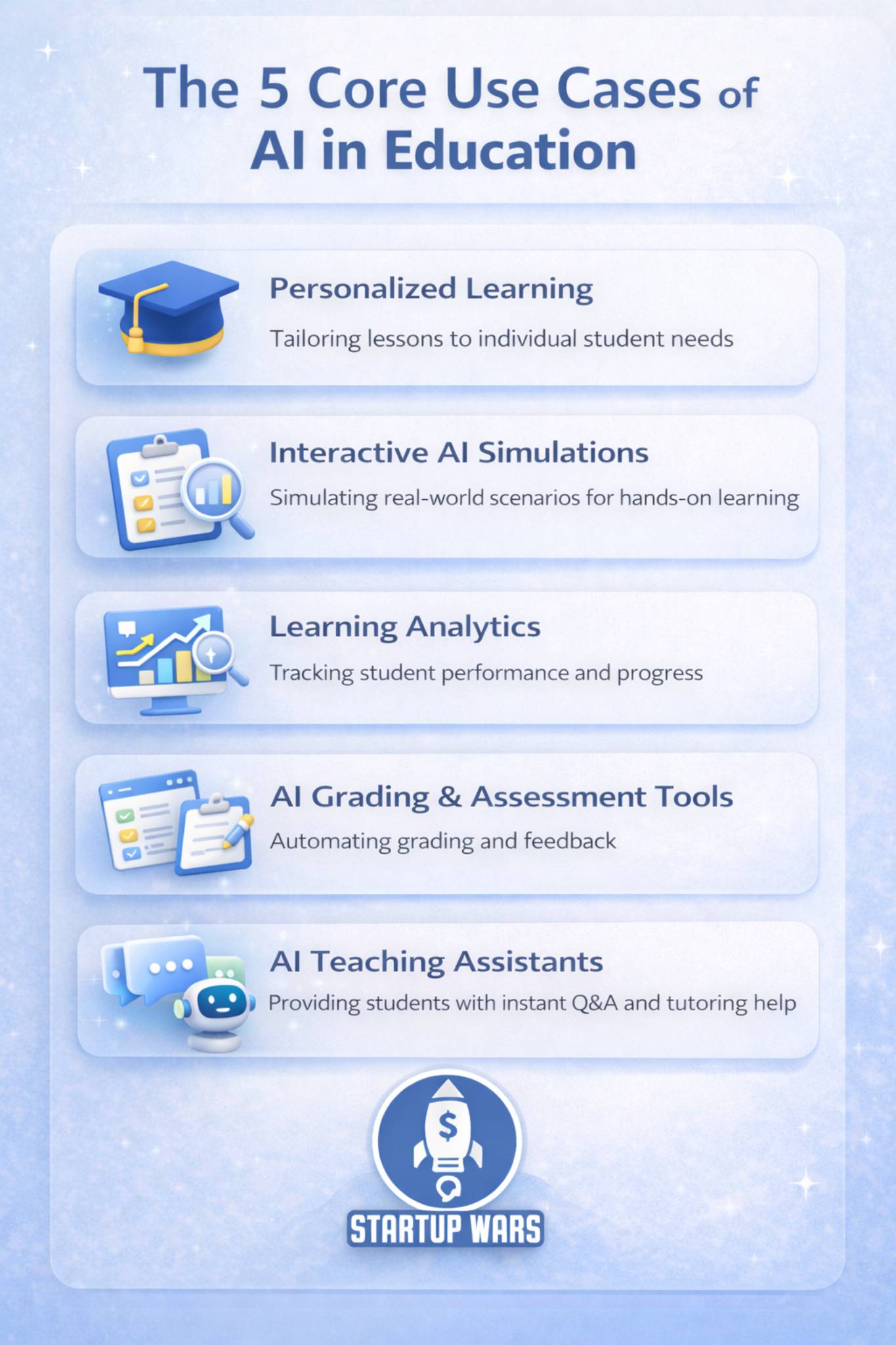
Traditional education often follows a one-size-fits-all approach.
AI changes that.
Adaptive learning platforms analyze student performance and adjust:
- lesson difficulty
- content pacing
- recommended exercises
This means struggling students receive extra support while advanced students can move faster.
The result is more efficient and personalized learning pathways.
One of the biggest challenges in teaching entrepreneurship, economics, and business is translating theory into real-world experience.
AI-powered simulations solve this problem.
Students can:
- build a startup
- allocate budgets
- respond to market changes
- make strategic decisions
Instead of memorizing concepts, students experience them.
This approach aligns with research from Edutopia showing that experiential learning dramatically improves retention and engagement.
Startup Wars allow students to run a virtual startup while interacting with Milton AI, a built-in assistant that encourages reflection on strategic decisions. Instead of simply providing answers, Milton guides students to evaluate their own choices, explore alternative strategies, and think like real entrepreneurs.
AI systems can also help educators understand their classrooms better.
These platforms analyze learning data and reveal insights such as:
- which topics students struggle with
- where engagement drops
- how learning patterns evolve across the semester
Educators can then adjust instruction in real time.
In other words, AI can turn teaching into a data-informed practice.
Ethical Considerations and Responsible AI Use
Of course, AI in education is not without concerns.
Responsible implementation requires addressing three major ethical issues.
Establishing clear classroom guidelines is essential when introducing AI tools into coursework. Educators looking for practical strategies can explore our guide on how educators can use AI ethically in the classroom, which outlines policies and best practices for responsible AI use.

One of the most common concerns educators have about AI is cheating.
Students may use AI tools to generate essays or complete assignments.
The solution is not banning AI entirely.
Instead, institutions should redesign assessments to focus on:
- applied knowledge
- critical thinking
- real-world problem solving
Assignments that require analysis and decision-making are much harder for AI to fake.
AI models are trained on large datasets that may contain bias.
If left unchecked, this bias could influence:
- grading recommendations
- learning suggestions
- predictive analytics
Institutions must evaluate AI tools carefully and ensure transparency in how algorithms make decisions.
AI systems often rely on student data to personalize learning.
Schools must ensure compliance with privacy regulations and protect sensitive information.
Responsible AI adoption requires:
- secure data management
- clear policies
transparency with students
The Future of AI in Higher Education
AI will not replace educators.
But it will transform the role of educators.
The future classroom will likely combine:
- human instruction
- AI-driven learning support
- interactive simulations
- real-time analytics
In this environment, educators become:
- mentors
- facilitators
- strategic learning designers
And students gain access to more engaging, practical learning experiences.
The universities that adopt these tools thoughtfully will likely lead the next generation of education.
Practical Next Steps for Educators
Bringing AI Into the Classroom: A Practical Next Step
Artificial intelligence will not replace educators.
But it will transform how students engage with learning.
The most effective classrooms of the future will combine:
AI learning assistants
experiential simulations
real-time learning analytics
collaborative problem solving
For educators teaching entrepreneurship, business strategy, or innovation, AI-powered simulation platforms like Startup Wars offer a practical way to introduce these experiences into the classroom today.
The result is a classroom where students don’t just learn business concepts, they practice thinking like entrepreneurs.
📅 Schedule a Free Demo to see how Startup Wars and Milton AI can transform entrepreneurship education into a hands-on learning experience.
Frequently Asked Questions
1. What is AI in education?
2. How are teachers using AI in the classroom?
3. What are the benefits of AI in education?
4. What is responsible AI use in education?
5. Can AI replace teachers?
Let's Empower The Next Generation Of Founders
Schedule a call with our team to explore how Startup Wars can fit into your classroom.