Let’s address the elephant in the lecture hall.
Your students are already using AI.
Not next semester.
Not next year.
Right now.
They’re using AI to brainstorm, summarize, code, calculate, design slides, and sometimes, yes, even draft assignments.
The real question isn’t whether AI belongs in higher education.
The real question is:
Are universities leading this transformation… or reacting to it?
If you’re a business professor or dean, this matters more than ever. Because the best AI tools for college students are reshaping not just how students study, but how they expect to learn.
Brace yourself… whiteboards alone won’t cut it anymore.
What Are the Best AI Tools for College Students?
The best AI tools for college students in 2026 are digital platforms that:
-
Improve productivity
-
Enhance research quality
-
Support writing and presentation skills
-
Automate repetitive tasks
-
Simulate real-world decision-making
But here’s the deeper shift:
AI tools are moving education from passive absorption → to active problem-solving.
Productivity gains are highest when AI is paired with structured, real-world tasks, not when it replaces thinking.
And that’s where most institutions are missing the mark.
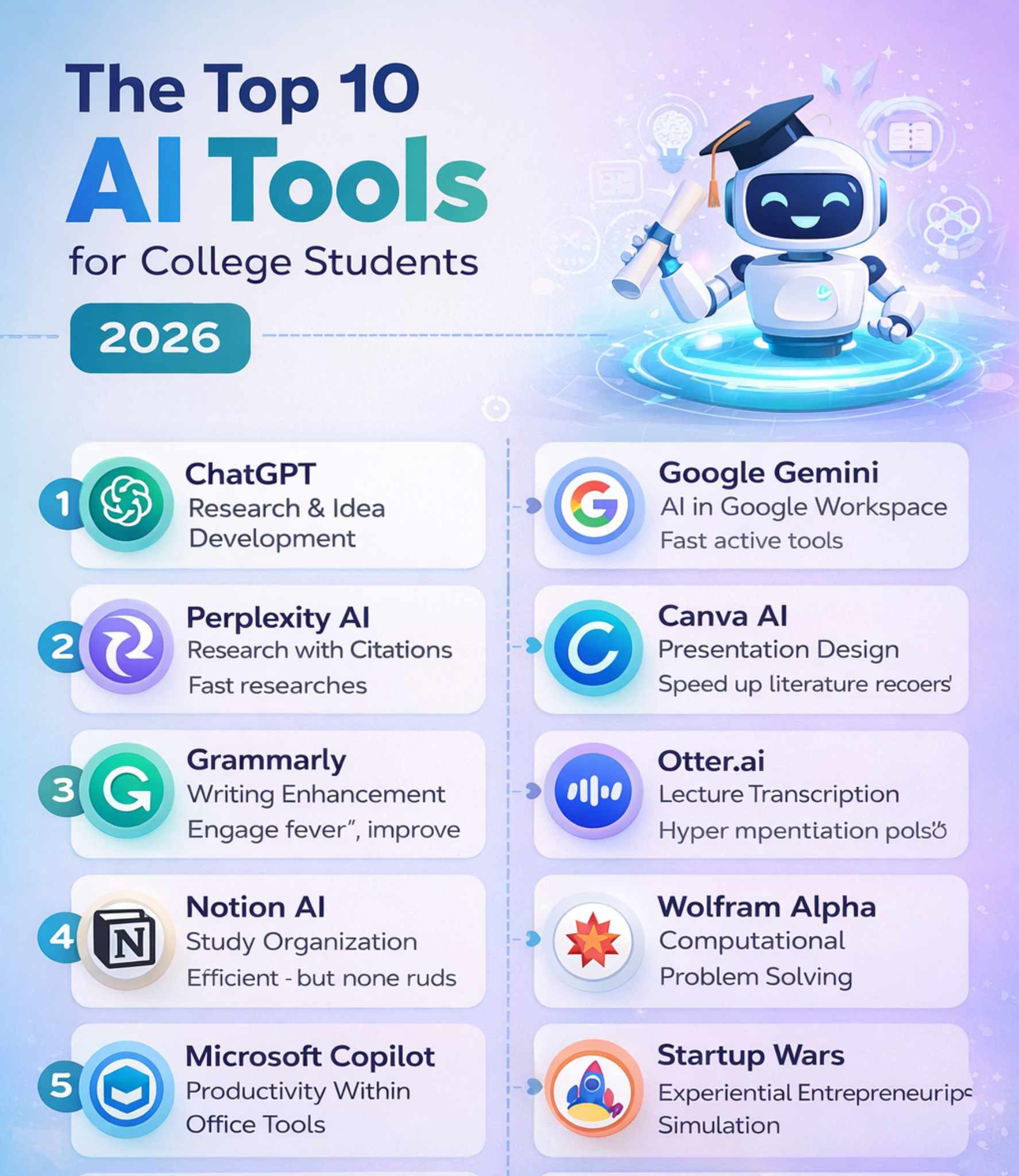
The 10 Best AI Tools for College Students (2026)
Below are the most impactful AI tools students are using, and what educators should understand about each.
1️⃣ ChatGPT – Research & Idea Development
Best for: Brainstorming, outlining, drafting.
Students use it to:
-
Generate essay frameworks
-
Break down complex theories
-
Practice case analysis
⚠️ Limitation: It provides answers, not lived business consequences.
2️⃣ Perplexity AI – Research with Citations
Best for: Fast academic research.
It:
-
Summarizes multiple sources
-
Provides citations
-
Speeds up literature reviews
Great tool, but still passive consumption.
3️⃣ Grammarly – Writing Enhancement
Best for: Polishing academic writing.
Improves:
-
Clarity
-
Tone
-
Grammar
-
Professional communication
Valuable, but doesn’t build strategic thinking.
4️⃣ Notion AI – Study Organization
Best for: Structuring notes and workflows.
Students use it to:
-
Summarize lectures
-
Create study dashboards
-
Organize projects
Efficient, but still internal work.
5️⃣ Microsoft Copilot – Productivity Within Office Tools
Embedded into Word, Excel, PowerPoint.
Helps:
-
Draft reports
-
Analyze data
-
Create slide decks
Powerful, but no entrepreneurial pressure simulation.
6️⃣ Google Gemini – AI in Google Workspace
Assists with:
-
Docs drafting
-
Spreadsheet insights
-
Research summarization
Again: productivity booster.
7️⃣ Canva AI – Presentation Design
Magic Design creates:
-
Slides
-
Infographics
-
Visual projects
Excellent for communication, not decision-making.
8️⃣ Otter.ai – Lecture Transcription
Converts speech into:
-
Searchable notes
-
Summaries
Helpful for review, not experiential learning.
9️⃣ Wolfram Alpha – Computational Problem Solving
Solves:
-
Math
-
Economics equations
-
Statistical models
Strong analytical assistant, limited real-world context.
🔟 Startup Wars – Experiential Entrepreneurship Simulation
Best for: Real-world business decision-making under pressure.
Unlike other AI tools that provide answers, Startup Wars places students inside a live, competitive startup simulation.
Students must:
-
Allocate limited budgets
-
Make marketing, product, HR, and financial decisions
-
Compete against other teams
-
Operate under time constraints
-
Experience consequences
This is not AI assisting an assignment.
This is AI-powered experiential learning.
And that difference changes everything.
What AI Tools Still Can’t Teach

Here’s the uncomfortable truth:
Most AI tools improve efficiency.
Very few improve judgment.
Business education isn’t about producing faster writers.
It’s about producing:
-
Better decision-makers
-
Risk assessors
-
Strategic thinkers
-
Resilient founders
Engagement and retention dramatically increase when students actively participate rather than passively consume content.
AI writing assistants cannot replicate:
-
Market uncertainty
-
Team conflict
-
Financial tradeoffs
-
Competitive pressure
Startup Wars can.
Because students don’t just analyze case studies, they live them.
The Mindset Shift for Business Schools
The best AI tools for college students are not replacements for professors.
They are multipliers.
But only if structured correctly.
Here’s the transformation model:
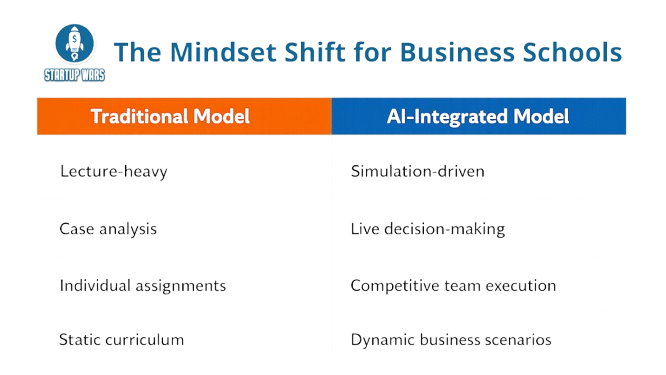
Universities that integrate experiential AI simulations are not “keeping up.”
They’re differentiating.
The Practical Step Forward
If your students are already using AI tools, the real leadership move isn’t banning them.
It’s designing around them.
The best AI tools for college students in 2026 improve productivity.
But Startup Wars improves:
-
Strategic thinking
-
Financial literacy
-
Cross-functional understanding
-
Entrepreneurial resilience
-
Classroom engagement
And most importantly, it makes business education unforgettable.
If you’re a professor, dean, or curriculum director asking:
How do we modernize our entrepreneurship curriculum without losing rigor? The answer isn’t another lecture slide.
It’s experiential simulation.
📅 Schedule a Free Demo
See how Startup Wars transforms passive classrooms into competitive, high-energy startup environments.
Frequently Asked Questions
1. What are the best AI tools for college students in 2026?
The best AI tools for college students include ChatGPT, Perplexity AI, Grammarly, Microsoft Copilot, Google Gemini, Notion AI, Canva AI, Wolfram Alpha, Otter.ai, and experiential platforms like Startup Wars for business simulation learning.
2. Are AI tools good for business students?
Yes. AI tools improve productivity, research, writing, and presentation skills. However, experiential AI simulations are more effective for building strategic and entrepreneurial decision-making skills.
3. How can professors integrate AI into the classroom?
Professors can integrate AI by: Encouraging structured research use Allowing AI-assisted drafting Incorporating AI-powered simulations Designing assignments that require judgment beyond AI outputs
4. What is experiential learning in business education?
Experiential learning involves students actively participating in real-world simulations, decision-making exercises, and competitive scenarios rather than passively listening to lectures.
5. Why should universities use business simulations like Startup Wars?
Business simulations improve engagement, critical thinking, financial understanding, and teamwork by placing students in realistic, high-pressure entrepreneurial environments.
Let's Empower The Next Generation Of Founders
Schedule a call with our team to explore how Startup Wars can fit into your classroom.
About the author
Andrea Martinez
Startup Wars marketing and content contributor
Andrea writes about entrepreneurship education, experiential learning, and the programs and product ideas shaping Startup Wars.