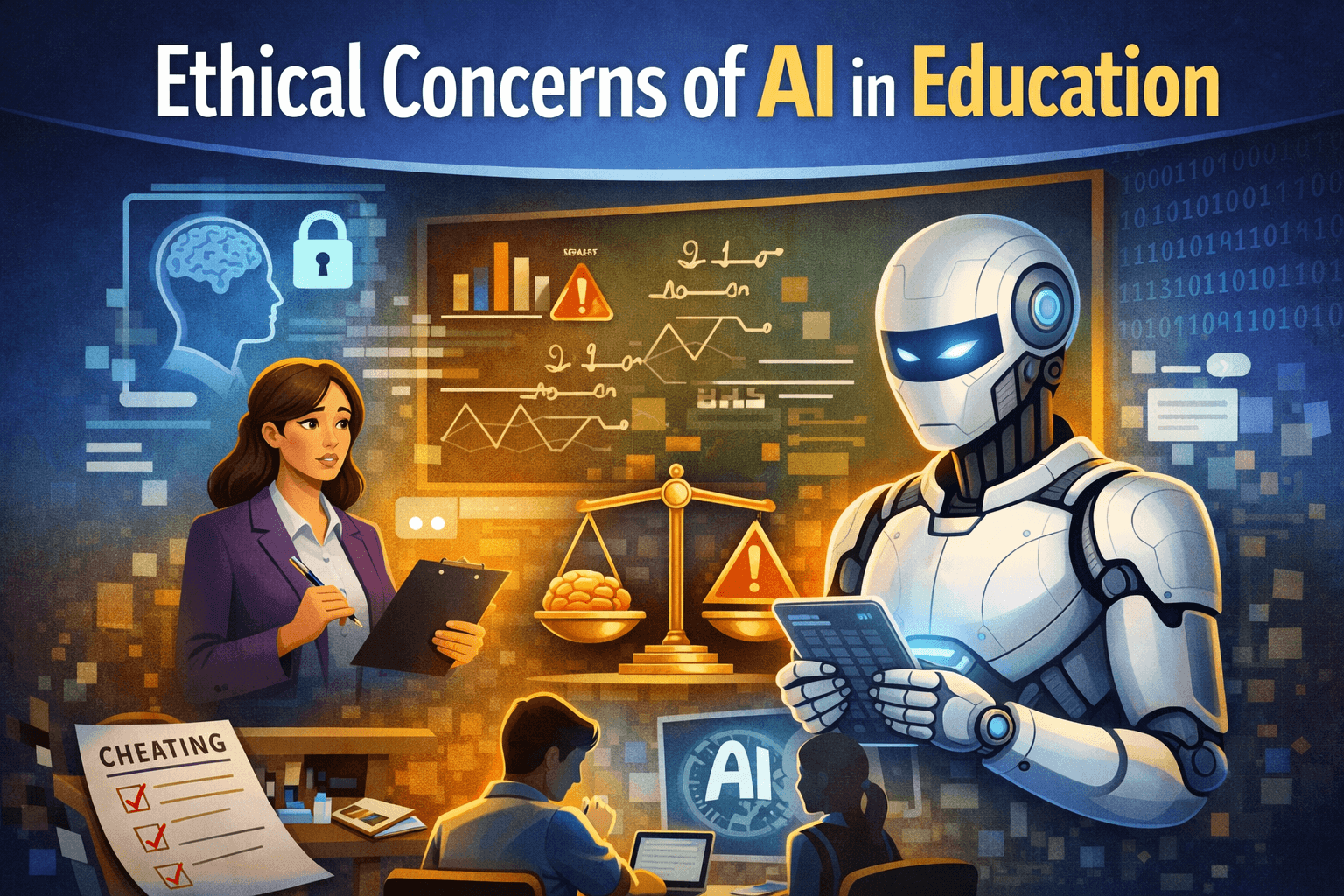
Artificial intelligence is rapidly transforming education.
AI tutors.
Automated grading.
Personalized learning platforms.
Even AI-generated lesson plans.
For many educators, it feels like we’ve stepped into the future overnight.
But along with opportunity comes a serious question:
Are we introducing AI into classrooms faster than we understand its ethical consequences?
Universities around the world are asking the same thing. And the truth is, AI itself isn’t the risk. Unethical implementation is.
For business professors, deans, and curriculum directors, understanding the ethical concerns of AI in education is no longer optional. It’s part of building responsible, future-ready classrooms.
Let’s break down the real risks, and the practical ways educators can address them.
Table of Contents
What Ethical Concerns Are Raised by AI in the Classroom?
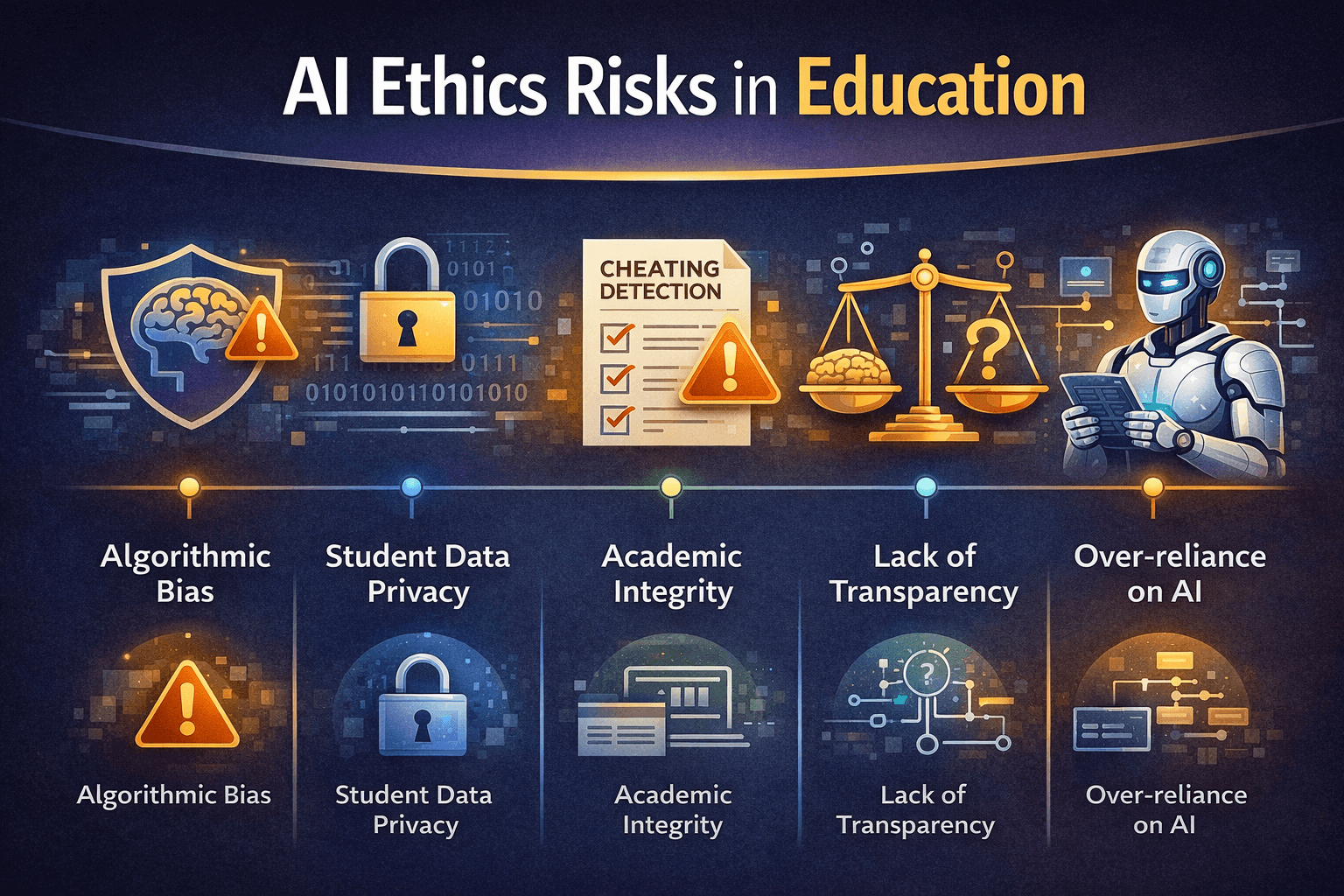
The main ethical concerns of AI in education typically fall into five categories:
- Algorithmic bias that may disadvantage certain student groups
- Student data privacy risks from AI platforms collecting sensitive information
- Academic integrity challenges such as AI-generated assignments
- Lack of transparency in how AI tools make decisions
- Over-dependence on automation that reduces critical thinking
Understanding these risks allows educators to design responsible AI policies instead of banning the technology outright.
And that’s important, because AI isn’t going away.
Why AI Ethics Matters for the Future of Higher Education
Education has always shaped society’s relationship with technology.
When calculators arrived, educators worried students would stop learning math.
When the internet arrived, professors worried about plagiarism.
Now the conversation has shifted to AI.
But there’s a deeper reason ethics matters.
Universities are training tomorrow’s entrepreneurs, leaders, and decision-makers.
If students learn to use AI irresponsibly today, they may build unethical AI systems tomorrow.
Teaching AI ethics isn’t just about preventing cheating.
It’s about shaping responsible innovators.
The 5 Biggest Ethical Concerns of AI in Education
1. Algorithmic Bias in AI Systems
AI models learn from historical data.
Unfortunately, historical data often contains biases related to race, gender, socioeconomic status, and geography.
In education, this can lead to:
- unfair grading recommendations
- biased admissions screening tools
- unequal learning recommendations
For example, some AI hiring tools have historically favored male applicants because the training data reflected male-dominated industries.
If similar bias appears in education tools, it could reinforce inequality instead of solving it.
What educators can do
- Evaluate AI tools for fairness
- Request transparency from vendors
- Avoid automated decision-making without human oversight
2. Student Data Privacy Risks
AI platforms often collect massive amounts of data, including:
- student performance metrics
- learning behavior patterns
- engagement analytics
- personal identifiers
While this data enables personalized learning, it also creates privacy concerns.
If poorly managed, student data could be:
- shared with third-party companies
- used to train commercial AI models
- exposed through security breaches
For universities, protecting student data isn’t just ethical, it’s also a legal responsibility under regulations like FERPA and GDPR.
What educators can do
- Choose platforms with strict data policies
- Avoid tools that store unnecessary student data
- Educate students about AI data risks
3. Academic Integrity and AI-Generated Work
Let’s address the elephant in the classroom.
Students using AI to generate essays, assignments, or even entire projects.
Many educators worry AI will destroy academic integrity.
But the reality is more nuanced.
Students aren’t just cheating, they’re experimenting with tools that will likely become standard in future workplaces.
The real challenge is re-designing assignments for the AI era.
Instead of banning AI entirely, educators can encourage responsible use:
- AI-assisted brainstorming
- AI-supported research exploration
- AI-generated idea validation
When used properly, AI can actually enhance creativity and entrepreneurship education.
4. Lack of Transparency in AI Decisions
Many AI systems operate as “black boxes.”
Educators may receive recommendations without understanding:
- how the algorithm works
- what data influenced the result
- why certain outputs were generated
This lack of transparency creates ethical concerns, especially when AI influences:
- grading decisions
- learning recommendations
- student evaluations
What educators can do
Prioritize explainable AI systems that allow educators to understand how recommendations are generated.
Transparency builds trust, both for instructors and students.
5. Over-Reliance on AI in Learning
AI tools can automate many aspects of education.
But automation comes with a hidden risk:
Students may rely on AI instead of developing essential skills such as:
- critical thinking
- problem solving
- creativity
- entrepreneurial decision-making
Ironically, these are the exact skills employers value most.
Education should use AI to enhance learning, not replace thinking.
A Practical Ethical AI Checklist for Educators
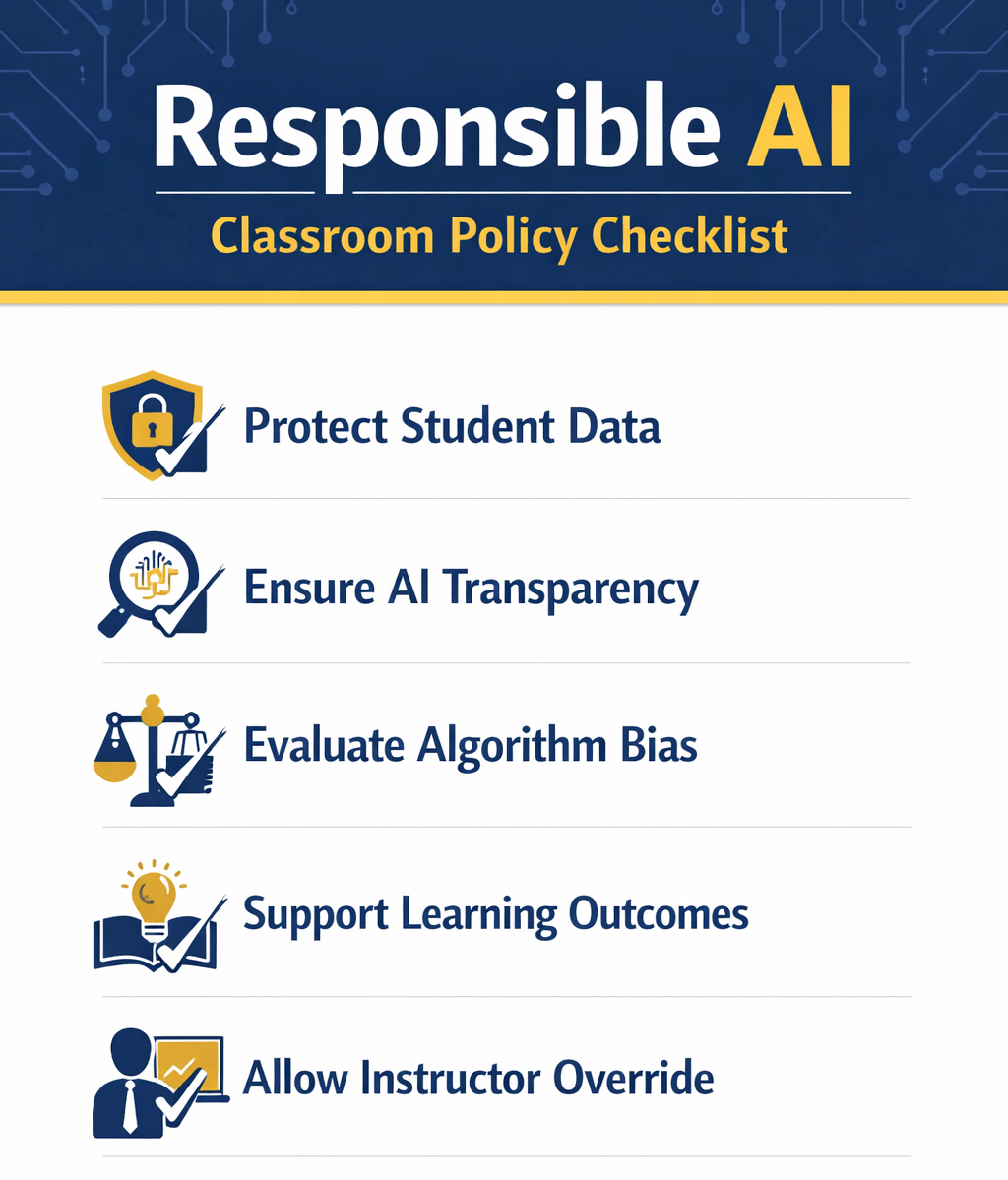
If your university is implementing AI tools, consider using this simple ethical checklist.
Responsible AI Classroom Policy Checklist
Before adopting any AI tool, ask:
✔ Does the system protect student data?
✔ Is the AI model transparent and explainable?
✔ Has the tool been evaluated for bias?
✔ Does it support learning outcomes rather than replace thinking?
✔ Can instructors override automated decisions?
These five questions alone can eliminate most ethical risks.
How Universities Can Use AI Responsibly
Instead of fearing AI, leading universities are focusing on AI literacy and responsible implementation.
That includes:
1. Teaching AI ethics in business programs
Students should understand both AI capabilities and risks.
2. Designing AI-resilient assignments
Assignments should emphasize:
- strategy
- decision-making
- creativity
- real-world application
3. Integrating experiential learning tools
Students learn ethical AI use best through hands-on experience solving real problems.
This is particularly important in entrepreneurship education.
The Opportunity: Ethical AI Can Improve Entrepreneurship Education
Here’s the paradox.
The same AI technology raising ethical concerns can also dramatically improve business education.
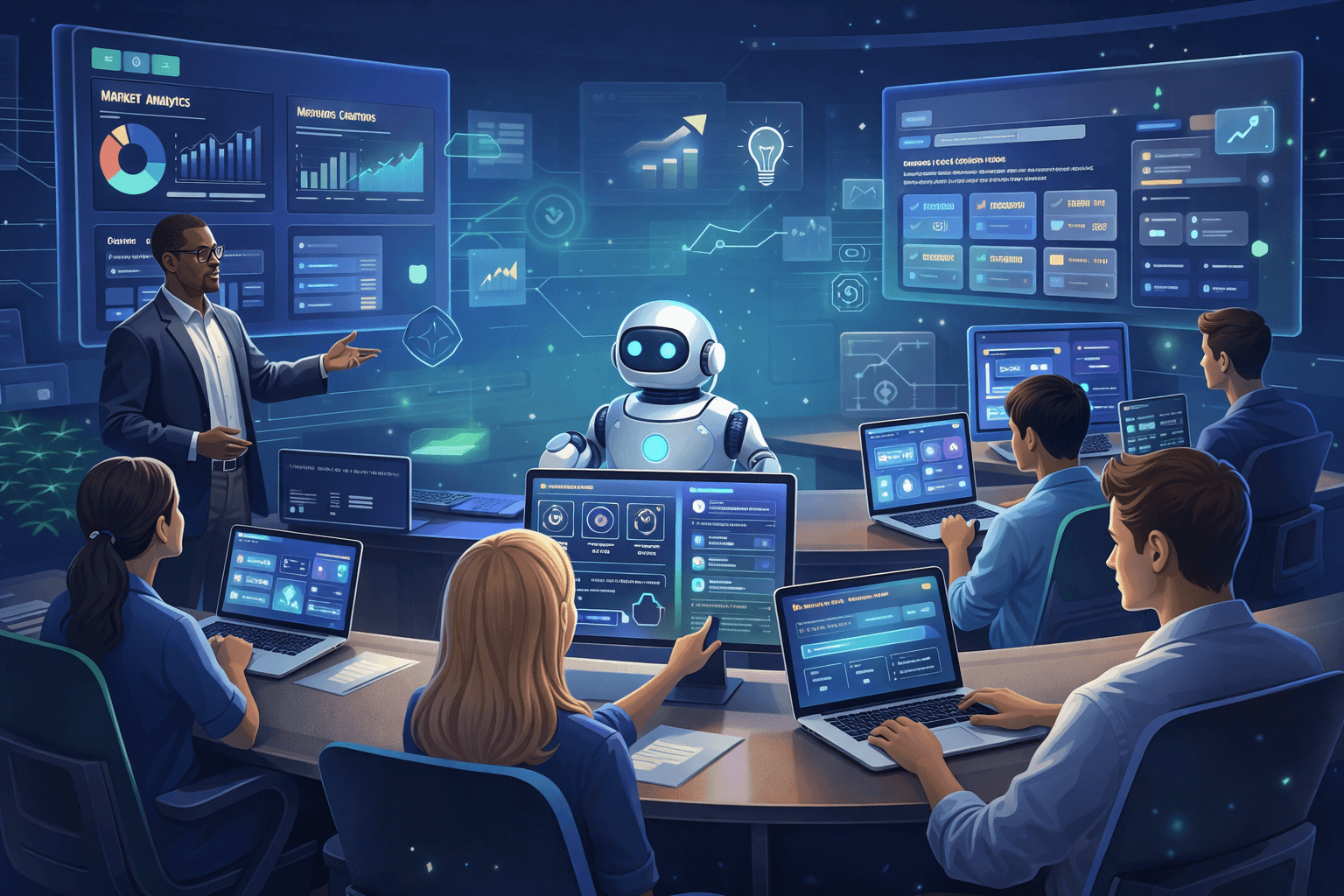
Entrepreneurship simulations, AI-assisted market analysis, and startup scenario modeling allow students to:
- test business ideas safely
- understand real market dynamics
- develop decision-making skills
Instead of passively listening to lectures, students experience real-world business challenges.
This is where modern teaching tools are making a difference.
Interactive platforms like startup simulations allow students to explore technology, innovation, and strategy in realistic environments, while still keeping instructors in control of the learning process.
When designed correctly, these tools balance innovation with ethical oversight.
The Real Question Isn’t “Should We Use AI?”
It’s “How should we use AI responsibly?”
The educators who answer that question today will shape the future of business education.
Universities that ignore AI risk falling behind.
But universities that adopt AI thoughtfully, with ethics, transparency, and experiential learning, will produce more capable entrepreneurs and leaders.
Final Thought for Educators
AI is not replacing educators.
But it is changing how students learn.
The opportunity now is to guide students toward responsible innovation, teaching them not just how to build technology, but how to build it ethically.
And sometimes the best way to do that is through experiential learning environments that simulate real-world decision making.
If you’re exploring new ways to bring ethical innovation into your entrepreneurship classroom:
📅 Schedule a Free Demo of Startup Wars and see how startup simulations help students develop critical thinking, strategy, and ethical decision-making in a safe learning environment.
Frequently Asked Questions
1. What ethical concerns are raised by AI in education?
2. How can schools use AI ethically?
3. Does AI increase cheating in schools?
4. Why is AI ethics important in education?
5. Should universities ban AI tools?
Let's Empower The Next Generation Of Founders
Schedule a call with our team to explore how Startup Wars can fit into your classroom.