How to Deal With Difficult Clients: Founder Lessons from Xavier Nazario
What First-Time Founders Should Do Before Launch
Every founder eventually faces a client decision that feels bigger than the contract itself.
Maybe the client pays well, but the relationship drains the team. Maybe the project looks impressive on paper, but the scope is unclear. Maybe the revenue is tempting, but the values do not align. That is when entrepreneurship stops being theoretical and turns into a real test of judgment.
In this episode of Founders Who Build, Xavier Nazario of Workforce Innovation Labs shares one of those moments. His company had taken on a major project, one of the largest six-figure contracts in its early years. But during a meeting, Xavier and his business partner looked around the room and realized they did not trust the stakeholders they were working with.
That moment forced a difficult question: should they stay for the revenue, or walk away to protect the company they were trying to build?
His answer became one of the strongest lessons from the episode: sometimes founders need to get off the wrong train so they are ready for the next one.
For students, early-stage founders, and entrepreneurship educators, Xavier’s story is a practical example of how to deal with difficult clients without losing your values, reputation, or long-term direction.
TL;DR: How to Deal With Difficult Clients Without Losing Your Founder Values
Dealing with difficult clients is one of the clearest tests of founder judgment.
In this episode of Founders Who Build, Xavier Nazario shares lessons from building Workforce Innovation Labs.
His company helps community colleges, nonprofits, and other organizations manage workforce development projects.
One major lesson came from a six-figure project that looked good on paper but felt wrong in practice.
Xavier and his business partner realized they did not trust the stakeholders in the room.
Walking away was hard because the project was one of their largest early contracts.
Still, they chose to protect the company’s values, reputation, and team energy.
Xavier’s takeaway was that founders sometimes need to leave the wrong opportunity to be ready for a better one.
Soon after, Workforce Innovation Labs received a larger project that better aligned with their values.
His advice is to trust your gut, but support that instinct with data, risk review, and financial clarity.
He also emphasized that founders only get one reputation, so short-term revenue is not always worth the long-term cost.
The episode shows why clear scopes of work help prevent difficult client relationships.
Xavier also shared the value of strong business partners, clear roles, and early standard operating procedures.
For growth, he highlighted LinkedIn and conferences as key channels for building trust and partnerships.
For founders, the main takeaway is simple: not every paying client is the right client.
For educators, Xavier’s story shows how students can learn client management, entrepreneurial mindset, and values-based decision-making.
Founders Who Build is a Startup Wars content series where students build entrepreneurship skills in a risk-free digital learning environment.
Watch the Founders Who Build Episode with Xavier Nazario
Prefer to watch instead of read? Watch the full conversation with Xavier Nazario, co-founder of Workforce Innovation Labs, on Founders Who Build.
Who Is Xavier Nazario?
Xavier Nazario is the co-founder of Workforce Innovation Labs, a virtual project management company that specializes in workforce development initiatives. The company works with community colleges, nonprofits, municipalities, and other organizations to bring workforce development ideas to life.
Their model is practical: when an organization has an idea but lacks the internal capacity to execute it, Workforce Innovation Labs builds the team, delivers the project, and then hands it back to the client so the work can continue sustainably.
That handoff mindset matters. Xavier explains that his company is not trying to stay inside a project forever. Instead, the goal is to help organizations build infrastructure, create internal capacity, and continue the work after Workforce Innovation Labs steps out.
That same values-driven approach shaped the way Xavier thinks about difficult clients.
How to Deal With Difficult Clients Without Sacrificing Your Values
The hardest part of dealing with difficult clients is that not every difficult client looks bad at the beginning.
Some are simply unclear. Some are disorganized. Some need more guidance. Some have real pressure from their own stakeholders. Those situations can often be managed with better communication and a tighter process.
But some client relationships create a deeper problem. They make the team question whether the work is aligned with the company’s mission. They create distrust. They make the founder feel like continuing the project would cost more than the contract is worth.
That was the situation Xavier described.
He and his business partner were in a meeting for a major project when they realized they did not trust the people in the room. The project was financially meaningful, especially for a young company, but the relationship felt wrong. Instead of pushing through for the revenue, they chose to walk away.
That decision was not easy. For any founder, giving up a large contract can feel risky, especially when payroll, cash flow, and growth are on the line. But Xavier’s takeaway was that values are not just words on a company document. They have to show up in real decisions.
If a client relationship forces a founder to compromise trust, transparency, or reputation, it may be time to step back.
Signs a Difficult Client May Not Be the Right Fit
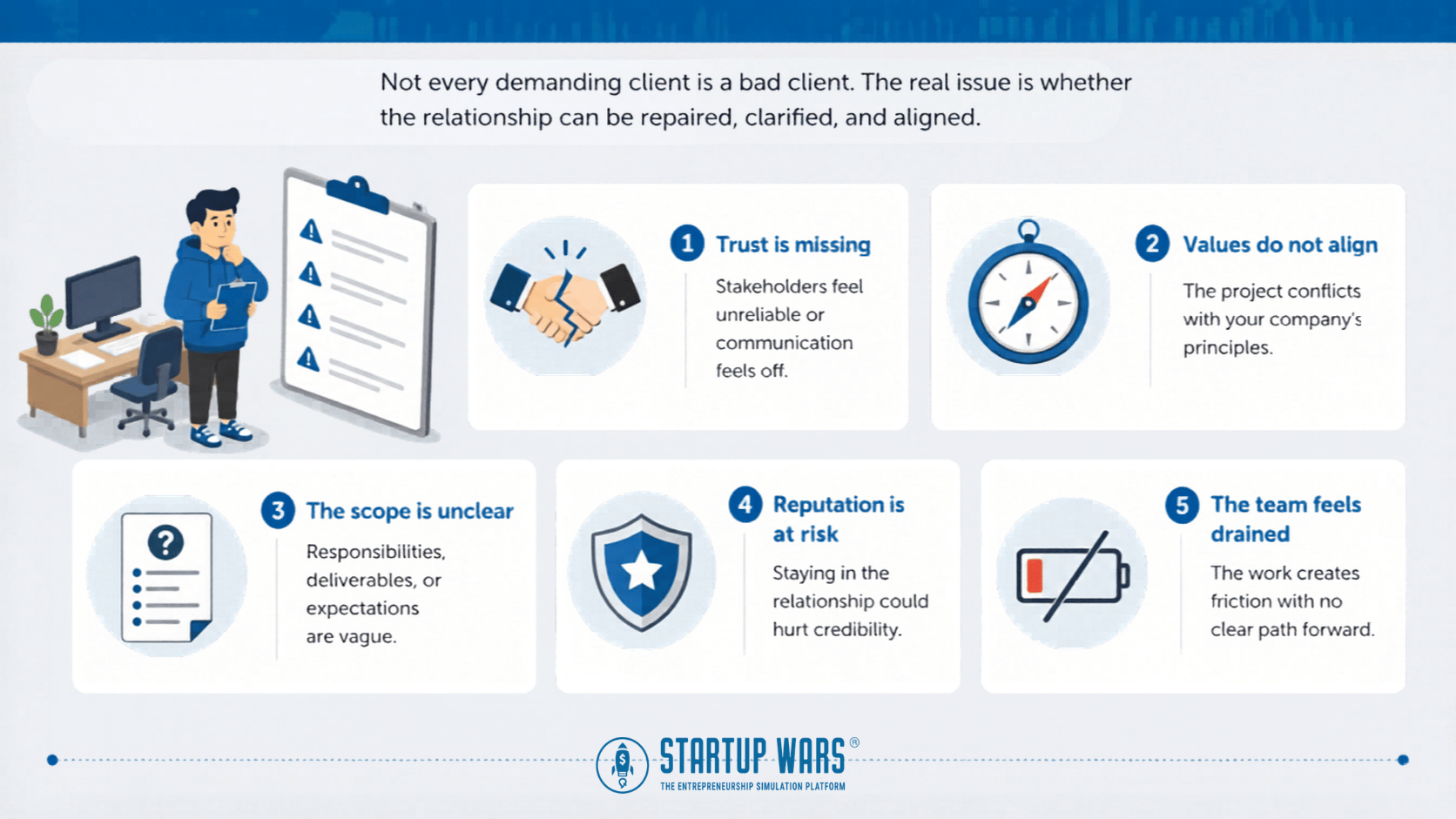
Founders do not need to fire every client who asks hard questions or creates extra work. Some of the best clients are demanding because they care about outcomes.
The real issue is whether the client relationship can be repaired and clarified.
Here are a few warning signs that a difficult client may not be the right fit:
1. You do not trust the stakeholders
Trust is the foundation of any serious client relationship. If the founder, team, or client cannot have honest conversations, the project becomes much harder to deliver.
Xavier described trust as one of the pillars of his company. Without trust and transparency, the relationship loses the foundation needed to solve problems together.
2. The project does not align with your values
A project can be profitable and still be wrong for the company. This is one of the most difficult lessons for early-stage founders because revenue can feel like validation.
But a misaligned project can drain energy, damage morale, and distract the company from better opportunities.
3. The scope of work is vague
Xavier points out that unclear scopes create difficult projects. If the scope of work does not clearly define what success looks like, the founder and client may end up with different expectations.
A vague scope can lead to endless revisions, unclear accountability, and frustration on both sides.
4. The client relationship puts your reputation at risk
Founders only get one reputation. If staying in a client relationship could damage the company’s credibility, future opportunities, or team culture, the short-term revenue may not be worth it.
5. The project drains the team without a clear path forward
Some projects are hard but meaningful. Others are hard because the structure is broken. If the team feels stuck in a project that cannot be fixed, leaders need to evaluate whether continuing is actually helping the business.
When Should a Founder Walk Away From a Client?
A founder should consider walking away from a client when the relationship threatens the company’s values, reputation, team health, or ability to deliver quality work.
That does not mean the decision should be emotional only. Xavier’s advice is to combine intuition with data. If your gut says something is wrong, look at the numbers, the risks, and the possible consequences. Then make a clear decision.
This is a useful decision-making framework for founders:
Ask what your gut is telling you
Founders often sense a problem before they can fully explain it. That instinct should not be ignored, but it should also be tested against facts.
Review the financial risk
Can the company afford to walk away? What would the decision mean for cash flow, payroll, delivery, and future sales? What is the cost of staying?
Evaluate the reputation risk
Would continuing the project create work you would not be proud to stand behind? Would it damage client trust, employee trust, or market credibility?
Revisit the scope of work
Is the project difficult because the client is misaligned, or because expectations were not clear enough? If the scope can be clarified, the relationship may still be repairable.
Decide whether the relationship can be reset
Before ending a client relationship, founders should ask whether a direct conversation could solve the problem. Sometimes a difficult client becomes a strong client after expectations are reset.
But if trust is gone, the relationship may already be past the point of repair.
What Xavier’s Story Teaches About Entrepreneurial Mindset
Xavier’s story is not just about client management. It is about entrepreneurial mindset.
Many people think entrepreneurship is only about launching ideas, finding customers, and growing revenue. Those things matter, but founders also need the judgment to say no, even when yes would be easier in the moment.
That is a trait students and future founders need to practice: deciding what kind of company they want to build before pressure tests that decision.
In Xavier’s case, walking away from the wrong project created space for a better one. Shortly after stepping away, his company received a call about a larger project that was more aligned with their values. That does not mean every hard decision is immediately rewarded, but it does show why founders need to make room for better-fit opportunities.
His train analogy captures it well: if you stay on the wrong train, you may miss the next one.
How Clear Scopes Help Prevent Difficult Client Relationships
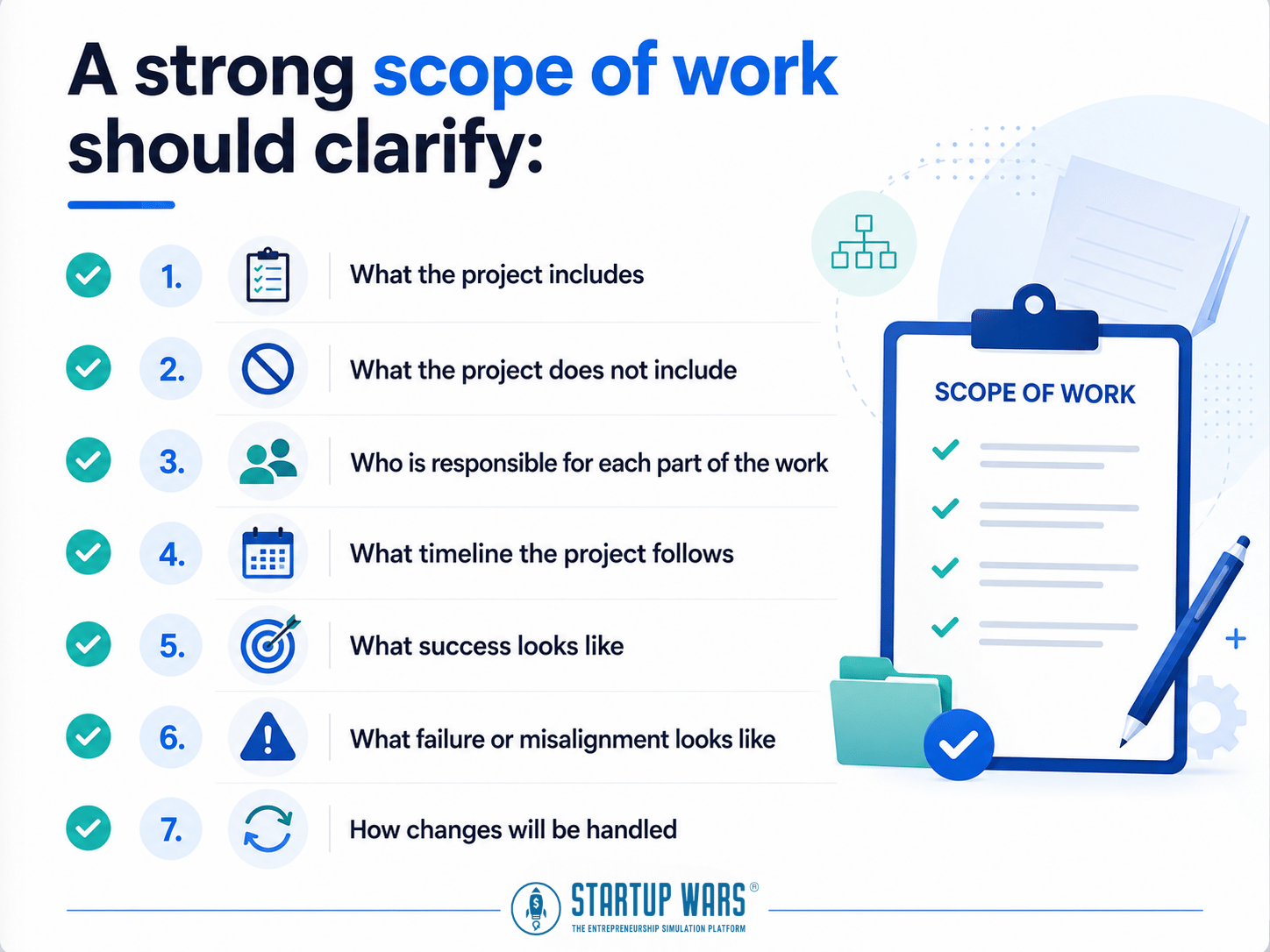
One of the most practical takeaways from the episode is the importance of a clear scope of work.
For service-based founders, consultants, agencies, and project managers, many difficult client relationships start with unclear expectations. The client thinks one thing is included. The team thinks something else was agreed on. No one has a shared definition of success.
A strong scope of work should clarify:
How changes will be handled
Xavier explains that the clearer the vision, scope, and value are from the beginning, the easier it is to know whether the project is on track.
That lesson is especially important for young entrepreneurs. A signed contract is not automatically a healthy business relationship. The details matter.
Why Difficult Client Decisions Matter in Entrepreneurship Education
Entrepreneurship is not only about having a good idea. It is about learning how to make decisions under pressure.
Should you take the client even if the fit is questionable? Should you discount your services to win early traction? Should you walk away from revenue to protect the brand? Should you hire quickly or wait for the right person? Should you keep doing everything yourself or build systems?
These are the kinds of tradeoffs students rarely learn from a lecture alone.
That is where business simulations can help. Startup Wars gives students a risk-free environment to practice business decision-making before they face those tradeoffs in the real world. Through simulated ventures, students can experiment with strategy, marketing, supply management, customer decisions, and growth challenges without putting a real company at risk.
To learn more, read how business simulations help students practice startup decision-making.
Xavier’s episode gives educators a real-world example they can bring into the classroom. His story helps students understand that entrepreneurship is not just about chasing revenue. It is also about protecting trust, defining values, and building a company that can survive hard choices.
More Founder Lessons to Learn
While the client story is the strongest evergreen lesson, Xavier shared several other insights that are useful for future founders.
+ Build with the right partner
Xavier emphasized the value of having a business partner whose strengths, work ethic, and values complement your own. Entrepreneurship can be lonely, and having the right person beside you can make the hard decisions easier to carry.
+ Price around value, not just labor
Xavier explained that his company prices its work by comparing the cost of hiring one internal coordinator with the value of bringing in a full project management team. This helps clients understand the practical business case for the service.
+ Use relationships to build opportunities
Xavier also shared how conferences, LinkedIn, and in-person conversations help build trust in his industry. For his company, conferences are not only about attending sessions. They are about meeting people, learning what problems they have, and starting partnership conversations.
Final Takeaway: Difficult Clients Test What Kind of Founder You Are
Learning how to deal with difficult clients is part of becoming a stronger founder.
Some clients need better communication. Some need clearer expectations. Some need a reset. And some need to be released so the company can protect its values and move toward better opportunities.
Xavier Nazario’s story is a reminder that founders do not only build products, services, or contracts. They build trust. They build reputations. They build teams that watch how leadership responds when money and values are in conflict.
For students and future founders, that may be the most important lesson of all.
Revenue matters. But the right revenue matters more.
Startup Wars helps students practice these kinds of business decisions in a risk-free digital learning environment. Through entrepreneurship simulations, students can test strategies, solve problems, and build the judgment they will need when real-world decisions get complicated.
Explore Startup Wars to help students build entrepreneurial skills before they launch their first real venture.