
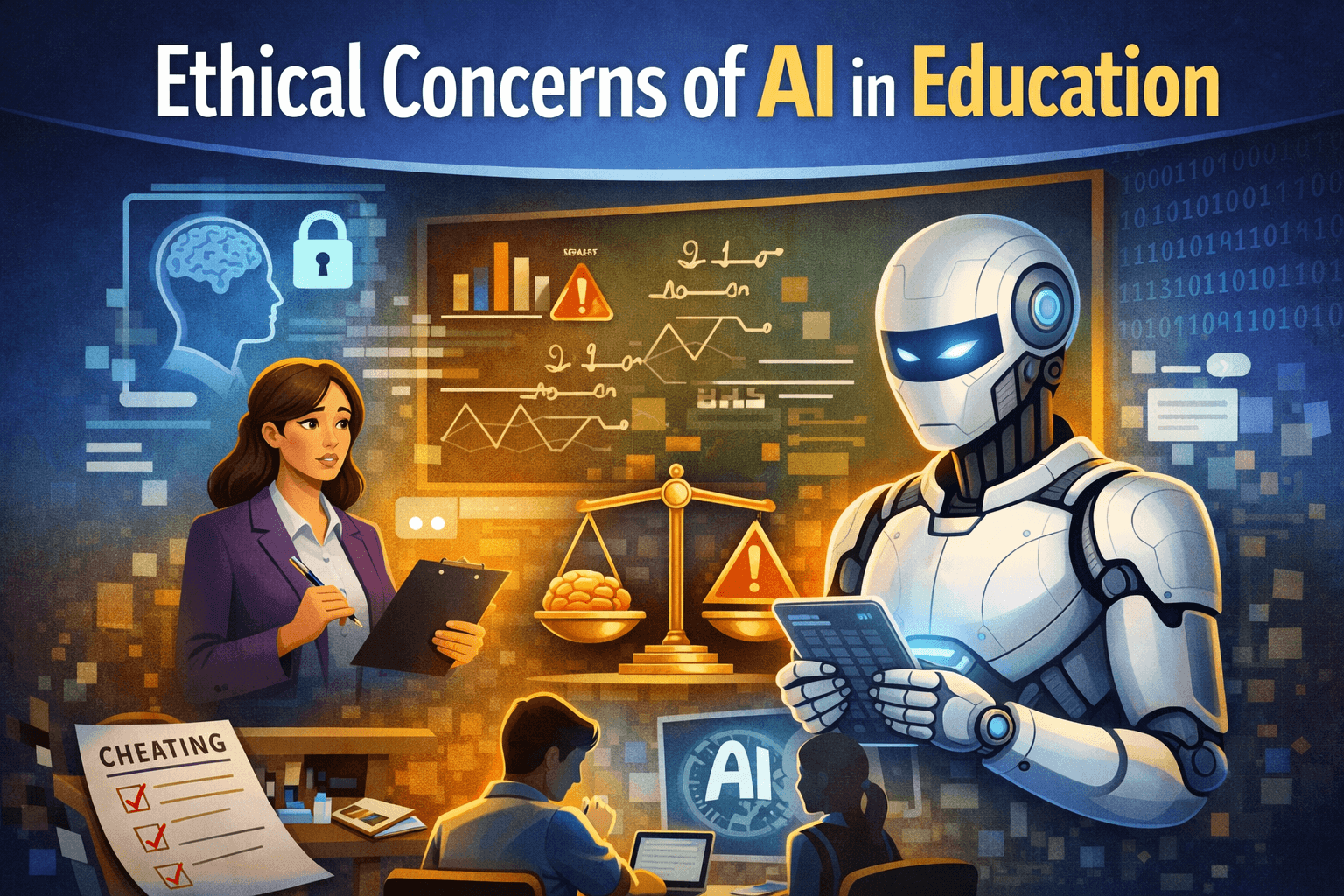
AI can support teaching and learning, but it can also create new risks. The risks are not solved by a short disclosure or a vendor promise. Educators need to connect each use to a learning goal, review the data involved, and keep accountable people in control.
Six ethical concerns educators should examine
1. Bias and uneven impact
AI systems learn from data and design choices that may not represent every learner fairly. Output may reflect stereotypes, miss cultural context, or perform differently across language and disability groups.
Educators should test realistic examples, invite feedback from affected users, and avoid using AI as the sole basis for grades, discipline, admissions, or support decisions.
2. Student privacy
Prompts can contain personal or protected information. Some tools may store inputs or use them to improve a model. Students may also feel pressure to accept terms they do not understand.
Use institution-approved systems. Collect only what is needed. Explain what data enters the tool, who can access it, how long it is retained, and how users can seek help. Never place confidential student or business data into an unapproved service.
3. Academic integrity
AI can produce text, code, images, and answers that hide whether a student has practiced the intended skill. A broad ban may be hard to apply, while unrestricted use can weaken assessment.
Set rules for each assignment. State the allowed steps, independent steps, disclosure method, and evidence students must provide. Use process artifacts, in-class work, oral explanation, and reflection when authorship matters.
Automated AI detectors should not be treated as proof. Follow the institution’s normal review process and consider direct evidence.
4. Accuracy and invented information
Confident language can make a false answer look reliable. Generated sources may be irrelevant or nonexistent. Calculations and summaries can also be wrong.
Require verification against course materials and credible sources. Grade the quality of the checking, not only the final presentation.
5. Transparency and accountability
Students and faculty should know when AI is involved and what role it plays. If an output affects a person, someone must be responsible for reviewing it and responding to concerns.
Do not describe a system as neutral or objective. Document its purpose, limits, data flow, review process, and alternative path.
6. Over-reliance and loss of practice
Convenience can remove productive struggle. If AI performs every early step, students may lose practice forming a question, building an argument, or checking a result.
Protect the parts of the process that match the learning goal. AI can support practice, but it should not replace the thinking students need to develop.
A responsible AI review for faculty
Before using a tool, ask:
- What educational outcome does this use support?
- What evidence of student learning will remain visible?
- What data will the tool receive?
- Is the tool approved by the institution?
- What accessibility support is documented and tested?
- How could bias or error affect a learner?
- Who reviews the output?
- Can a student use an equivalent alternative?
- How will concerns or mistakes be corrected?
- What result would cause us to stop the pilot?
If these questions do not have clear answers, pause the adoption.
Design AI-resilient business assignments
Business education is well suited to tasks that require context and judgment. Ask students to make a decision, state assumptions, use evidence, consider tradeoffs, and revise after feedback.
For example, students can compare an AI marketing recommendation with a specific customer profile and budget. They can identify what the output assumes, test it against course concepts, and write a better plan. The assessment measures verification and business reasoning.
A business simulation adds a sequence of decisions and outcomes. In Startup Wars, students run a virtual company and make connected choices across business functions. Faculty can ask students to explain why they acted, what happened, and what they would change. AI may support questions or critique if course rules allow, but the learner remains responsible for the decision.
Use a simple ethical AI policy
A useful policy includes:
- approved and restricted uses;
- disclosure requirements;
- source and fact-checking expectations;
- privacy and confidential-data rules;
- accessibility and alternative paths;
- consequences under existing integrity procedures; and
- a contact for questions.
Review the policy as tools and institutional guidance change. Walk through examples before a graded task.
Keep ethics tied to teaching
Ethical review should improve the learning design. Clearer rules help students understand the task. Better evidence makes grading more defensible. Privacy limits encourage faculty to choose tools with care. Accessibility review creates a fairer path to participation.
The ethical AI policy and rubric guide offers an adaptable structure. The Startup Wars FAQ and evidence center provide product information and evidence notes. Institutions with specific questions can contact Startup Wars.
About the author
Startup Wars Editorial Team
Entrepreneurship education contributors
The Startup Wars editorial team shares practical guidance on experiential learning, business education, and helping learners build real-world skills.