Table of Contents
A professor just finished explaining the business model canvas. The slides were clear. The examples were relevant. But when she looks up, she sees the same familiar scene. Students are scrolling on their phones. Some are typing, but probably not taking notes. A few are just staring into space.
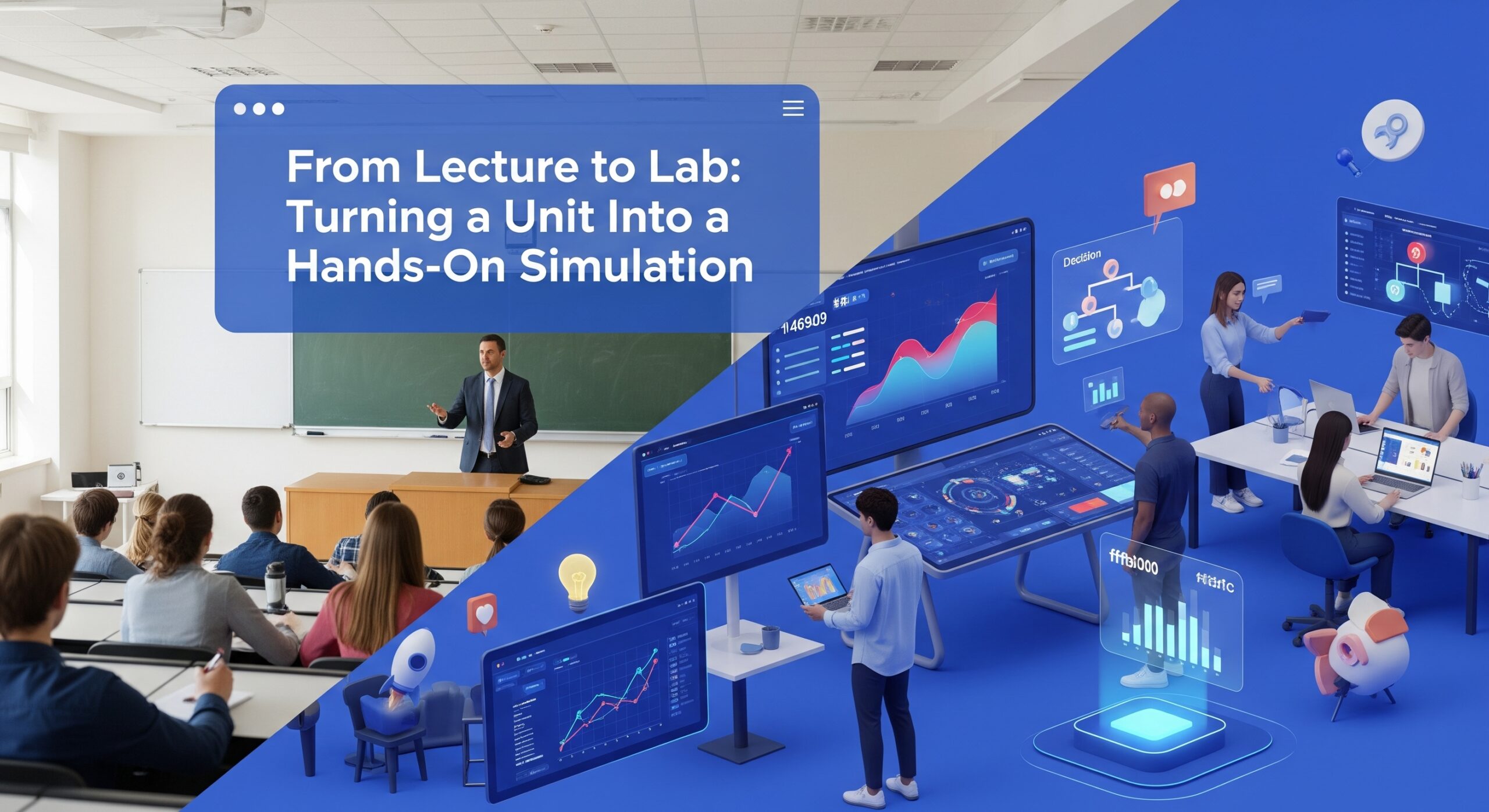
This is a common problem in business classrooms. Lectures don’t create real engagement. Students learn about entrepreneurship, but they don’t experience it. They remain passive observers, waiting for class to end so they can move on to something more engaging.
There is a better way. Classrooms can become startup labs. This article shows how a hands-on entrepreneurship simulation can change teaching. It explains why traditional methods often fail, how experiential learning works, and provides a practical path to implement this in any course.
Why Traditional Lectures Fail for Entrepreneurship Education

The Passive Learning Problem
Lectures create one-way communication. The professor talks. Students listen. Or, more often, they just hear. Information moves in one direction, from lecture notes to student notebooks, with little processing in between.
The student experience is passive. They become spectators in their own learning. They might take notes, but they’re not asked to actually use the information. They’re not solving problems or making decisions. This leads to disengagement that’s visible throughout the classroom. The lowered heads. The distracted screens. The lack of questions when a topic wraps up. This is a core challenge that modern teaching tools aim to solve.
The Gap Between Theory and Practice
Case studies are an improvement over pure lecture. But they’re still pretty abstract. Students analyze what another company did. They’re critics, not creators. This is like learning to drive by watching a video of someone else driving. It’s informative, sure, but it’s not the same as actually getting behind the wheel.
Students struggle to apply concepts to real situations. They can describe a pricing strategy in theory but can’t set a price for their own product. They lack the emotional connection that comes from ownership. There’s no risk in being wrong about a case study. There’s no real reward for being right. The material stays as theory, separate from practice, floating in academic space.
The Educator's Challenge
This is frustrating for educators. They see the potential in their students. They know students are capable of more than memorizing terms and regurgitating them on exams. But traditional methods limit what can be assessed. Exams test memory, not understanding. Assignments can feel like hoops to jump through rather than genuine learning experiences.
Educators know their students need to build resilience and decision-making skills. A lecture can’t teach that. This leads to a search for better tools. They need a way to make learning active, not passive. They need a method that bridges the gap between the textbook and the real world of business.
The Power of Experiential Learning

What is Experiential Learning?
Experiential learning is straightforward. It means learning through direct experience. Students don’t just receive information. They use it. They apply it to solve a problem or create something tangible.
This is fundamentally different from passive learning. Passive learning is like being told how an engine works. Hands-on learning is being given the tools to take one apart and put it back together. Research from groups like ASECU shows that students in active learning environments perform better. They understand concepts more deeply and retain knowledge longer.
Why Business Simulation Games Work Better
Business simulation games create a safe environment for failure. In a simulation, a failed product launch is a learning moment. It’s not a financial disaster. Students can take risks and see the consequences without real-world costs. This freedom to fail is actually what makes the learning stick.
This process is driven by healthy competition. A live leaderboard shows teams their standing. This motivates students in ways that traditional grading can’t quite match. They become invested in their company’s success. They want to improve their strategy. This method is highly effective for combatting student fatigue by making learning dynamic.
They also get immediate feedback from the simulation software. If a marketing campaign fails, they see the results right away. This direct link between action and outcome reinforces learning better than waiting two weeks for a graded paper.
What Happens When You Switch to Simulation-Based Learning
The change in the classroom is visible and immediate. The quiet lecture hall becomes a busy workshop. Students aren’t just listening anymore. They’re talking. They debate business strategies with their teammates. They ask specific questions because they actually need answers to move forward.
The mindset shifts completely. Students stop thinking, “What do I need to remember for the test?” They start thinking, “What does my startup need to do to succeed?” They become active participants in their own education. They’re building something, and that makes all the difference. This fosters a true entrepreneurship mindset.
How to Build a Hands-On Entrepreneurship Simulation Unit

Getting Started: The Setup Phase
The setup is straightforward. It should take one class session.
First, form student teams. Keep them small, with three to five members. Each student takes a role like CEO, Marketing Lead, or Finance Lead. This creates clear responsibility and accountability within the group.
Next, teams choose a startup concept. It should be a tech-oriented product or service. This keeps the simulation focused and relevant. They don’t need a complex business plan at this stage. A simple idea is enough to start building.
Finally, the instructor sets the initial parameters. In the simulation software platform, they define the starting budget and market conditions. This creates a level playing field. The rules are the same for everyone. For a more structured approach, instructors can follow a 2-week business curriculum sprint.
The Simulation Workflow
The simulation runs in weekly cycles. This mirrors real business planning timelines.
Each week, teams log in to their dashboard. They make key decisions about where to allocate their budget, areas like product development or advertising. They set their product’s price based on market data and competitor analysis. They decide which new features to prioritize.
They must manage their resources carefully. The platform shows their cash balance and burn rate in real time. They see how their choices affect their finances. If they spend too much without generating revenue, they run out of money. Game over.
Random market events also occur throughout the simulation. A new competitor might enter the market. A product bug could be discovered. These events force teams to adapt quickly. They learn to handle unexpected challenges, just like real small businesses do every day.
Integration with Your Existing Curriculum
Instructors don’t need to rebuild their entire course. A business simulation can replace specific assignments strategically.
Instead of a lecture on pricing, students test different pricing strategies in the sim. Instead of a written case study analysis, they make strategic decisions for their own company and see the results. The simulation becomes the core application of theoretical concepts.
Run the simulation for four to six weeks. This is long enough for meaningful cycles to play out and for teams to learn from their mistakes. Instructors can dedicate a portion of each class to team meetings and strategy sessions.
The balance is simple but effective. Teach the concept in class. Then, students apply it immediately in the simulator. This connects theory and practice directly. For a deeper dive into the technical side, explore the role of AI-powered business simulations in modern curricula.
Comparison Table: Traditional vs. Simulation-Based Teaching
Traditional Approach | Simulation Approach | Student Outcome |
Lecture on pricing | Test different prices in the simulation | Understands price elasticity through experience |
Case study analysis | Make strategic decisions for their own company | Develops a personal stake in the outcomes |
Written exam on finance | Manage a virtual budget and burn rate | Applies financial knowledge in a realistic context |
Theory of product development | Decide which features to build each week | Learns to prioritize based on resources and strategy |
Measuring Learning Outcomes with a Business Simulator

Tangible Skills Students Develop
Students build specific, practical skills through the business simulation.
They develop financial literacy by managing a budget over time. They see how hiring, marketing, and development costs affect their cash flow week by week. This makes financial statements real instead of abstract numbers on a page.
They learn data analysis by reviewing performance metrics. The dashboard shows them customer growth and revenue trends. They must interpret this data to make better decisions, developing analytical skills that transfer to any business role.
They practice strategic thinking in a competitive environment. Each choice, from pricing to feature development, affects their market position. They learn to think several steps ahead and anticipate competitor moves. These are the essential skills that prepare students for the future.
Assessment and Grading
Grading is based on multiple factors, not just final profit numbers.
Instructors can evaluate simulation performance objectively. The platform provides a final score based on key metrics like market share and financial health. This measures their results and decision quality.
Incorporate a reflection paper. This is crucial for deeper learning. Students explain their strategy, their decisions, and what they learned from their failures. This assesses their understanding beyond the numbers.
Use peer evaluations as well. Teammates rate each other on contribution and collaboration. This ensures individual accountability within the group and rewards strong team players.
Long-Term Benefits of Experiential Learning
The benefits extend well beyond the final grade.
This experience prepares students for their careers in tangible ways. They can discuss a real business they built in job interviews. They have practiced decision-making and teamwork under pressure. This directly supports preparing students for real-world interviews.
Student feedback typically highlights this shift. They report that the simulation was challenging but valuable. They felt they were learning something applicable to their future careers, not just studying for a test.
Most importantly, they retain the concepts long after the course ends. The lessons from running their own company stick with them far longer than information memorized for an exam. They learn by doing, and they remember what they did.
Final Word

Lectures have their place in business education. But for teaching entrepreneurship, they’re not enough on their own. Students need to practice, not just listen and take notes.
A business simulation game provides this practice. It turns classrooms into dynamic labs. Students engage with the material actively. They learn from their mistakes in a safe space. They develop real skills they can use in their careers.
This approach is practical and doesn’t require curriculum overhaul. It fits into existing course structures. It gives instructors a better way to assess true understanding. Before choosing a tool, it’s wise to review key questions to ask before choosing a business simulation.
Instructors can see how it works firsthand. Schedule a Free Demo. The platform demonstration shows how it fits into different syllabi. It’s the first step toward a more effective classroom.
📅 Schedule a Free Demo and see how Startup Wars can help you lead beyond the classroom today.
Frequently Asked Questions
What are the benefits of using a business simulation?
Why do students have better performance with interactive learning?
How do you implement a business simulation in an existing course?
What are the measurable learning outcomes from business simulations?
What is the difference between a business simulation and a case study?
People Also Searched For:
-
The Real Reasons Startups Fail - What 2 Startups & 70+ Startup Investments Teach You About Success
-
Most Founders Build Too Fast and That’s Why Startups Fail
-
ChatGPT 5 Release: What Educators and Students Should Know
-
Case Study in Education vs Simulation: Which Is Better for Teaching Entrepreneurship?
-
How to Use Business Simulations in the Classroom