Walk into many university classrooms today and you’ll see the same scene:
A professor presenting slides. Students quietly taking notes. A few glancing at laptops… or their phones.
Now compare that with a classroom where students are competing to launch startups, testing pricing strategies, negotiating partnerships, and watching their decisions affect real outcomes in real time.
That second classroom is what a gamification course looks like.
And in 2026, it’s quickly becoming one of the most effective teaching methods in higher education.
Universities worldwide are realizing something important:
Students don’t just want to learn concepts.
They want to experience them.
Gamified learning transforms passive lectures into interactive learning environments where students learn by doing.
Let’s break down what a gamification course actually is, and why it’s reshaping how universities teach business, entrepreneurship, and innovation.
Table of Contents
What Is a Gamification Course?
A gamification course is a class that integrates game mechanics, such as points, competition, levels, and challenges, into the learning process to increase student engagement and improve knowledge retention.
Instead of relying only on lectures or case studies, gamified courses allow students to:
- Make strategic decisions
- Compete or collaborate with peers
- Receive immediate feedback
- Learn through simulated real-world outcomes
The goal isn’t entertainment.
The goal is deep learning through experience.
In a gamified course, students are not passive listeners.
They become active participants inside the learning process.
Why Traditional Teaching Methods Are Losing Student Attention
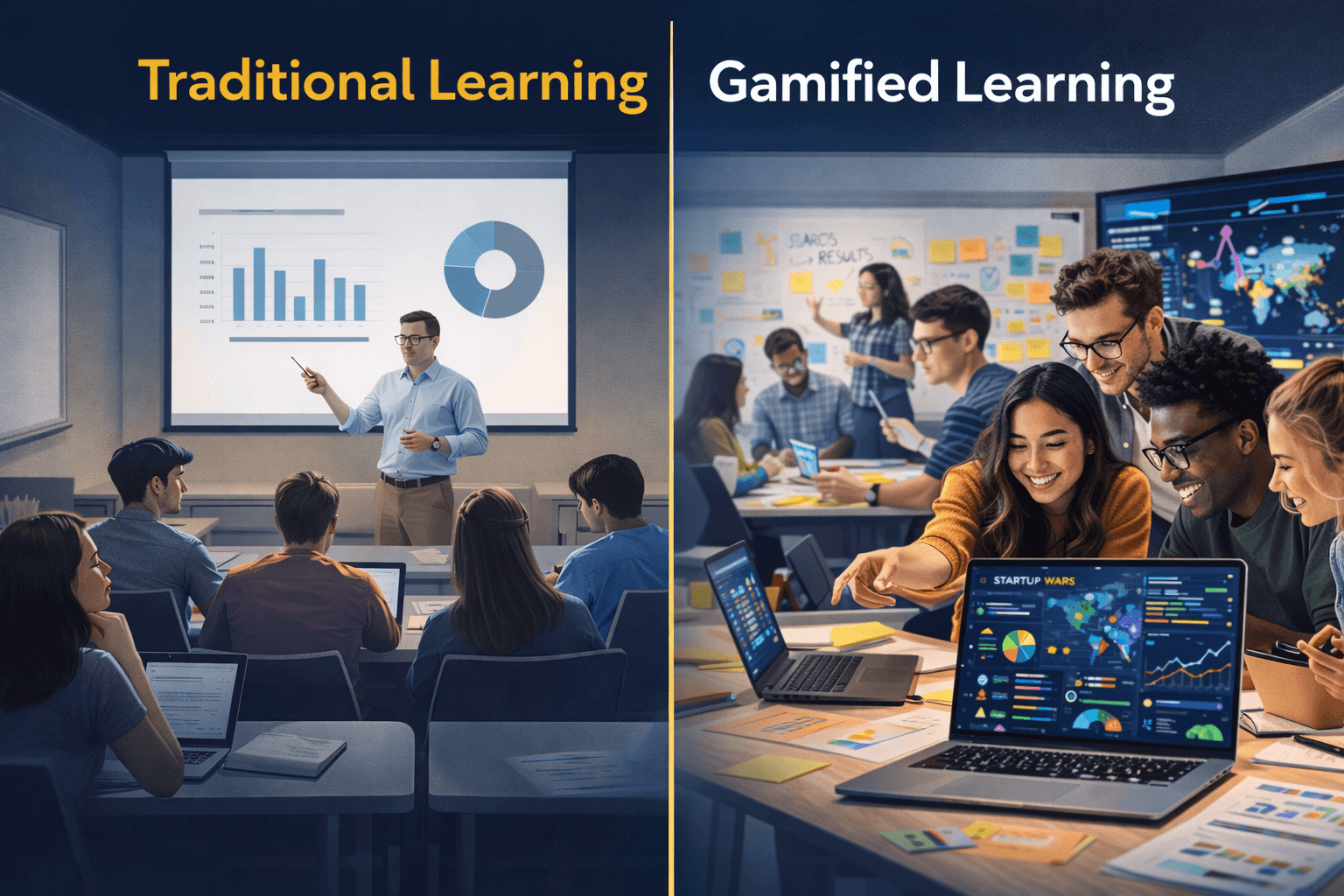
Higher education is facing a quiet but growing challenge: student disengagement.
Research from Edutopia and McKinsey shows that experiential learning dramatically increases knowledge retention compared with traditional lecture formats.
Why?
Because passive learning struggles to compete with the interactive environments students experience everywhere else.
Today’s students are used to:
- interactive technology
- real-time feedback
- decision-based environments
- collaborative platforms
So when education relies exclusively on slides and lectures, engagement drops.
Gamification closes that gap by making learning participatory rather than observational.
Instead of studying entrepreneurship theory, students build and test companies inside simulated markets.
And that’s a huge shift.
How a Gamification Course Works
A well-designed gamification course blends learning science, game design, and real-world problem solving.
Here’s how it typically works.
Game-Based Challenges
Students are given missions or challenges that mirror real-world scenarios.
Examples include:
- launching a startup product
- allocating marketing budgets
- designing pricing strategies
- analyzing competitor behavior
Every decision produces a result.
Students immediately see the impact of their choices.
Experiential Learning Framework
Gamified courses often follow the experiential learning cycle:
- Experience
- Reflection
- Conceptualization
- Application
Students don’t just hear a concept.
They test it, observe the results, and adjust strategy.
That process dramatically improves retention.
Real-Time Feedback
One of the most powerful elements of gamified learning is instant feedback.
Instead of waiting weeks for exam results, students immediately see:
- profits or losses
- market share changes
- customer demand shifts
- competitive reactions
Learning becomes dynamic and adaptive.
7 Game Mechanics That Dramatically Improve Student Engagement
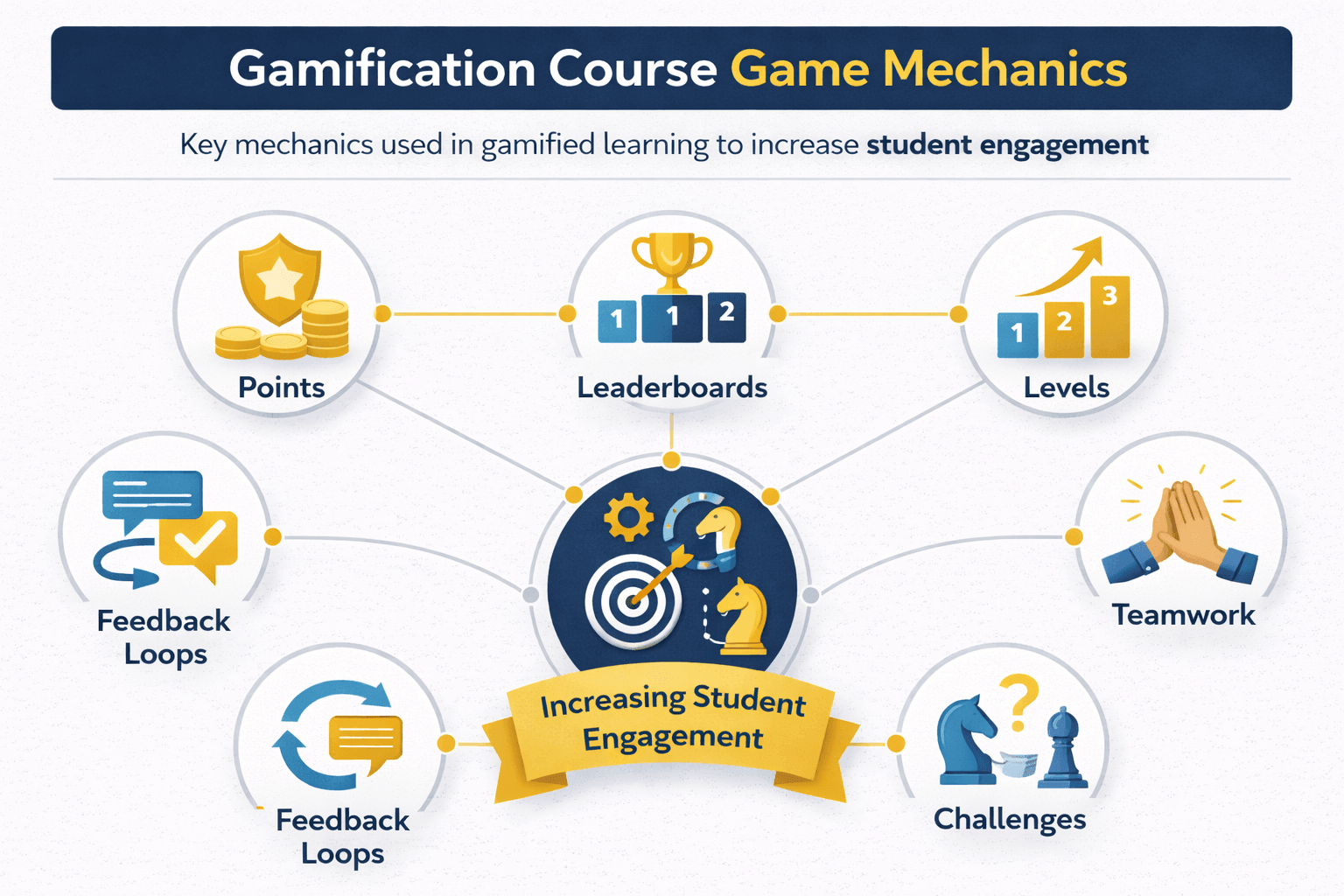
Certain game mechanics consistently increase participation and motivation.
Here are seven that work especially well in higher education.
1. Points and Scoring Systems
Students earn points based on decisions, outcomes, or milestones.
This creates clear progress indicators.
2. Leaderboards
Friendly competition motivates students to improve performance.
Leaderboards also encourage peer discussion around strategy.
3. Levels and Progression
Students unlock new stages of complexity as they advance.
This keeps learning challenging but manageable.
4. Scenario-Based Challenges
Students face real-world problems that require strategic thinking.
For example:
- entering new markets
- adjusting supply chains
- responding to competitor actions
5. Immediate Feedback Loops
Fast feedback accelerates learning and allows students to iterate quickly.
6. Collaborative Teams
Gamified learning often involves teams that simulate real organizations.
Students practice leadership, negotiation, and communication.
7. Narrative and Storytelling
Some gamified courses build a storyline, like launching a startup or growing a company.
This narrative structure increases emotional engagement.
Examples of Gamification Courses in Higher Education
Gamification isn’t limited to one subject.
It’s now used across disciplines.
Common examples include:
Entrepreneurship Simulations
Students create and run virtual startups, making decisions on marketing, pricing, hiring, and funding.
Business Strategy Games
Teams compete to grow companies in simulated markets.
Economics Simulations
Students experience supply and demand dynamics by participating in live market environments.
Innovation Labs
Students prototype ideas, pitch products, and iterate based on feedback.
These formats transform classrooms into experiential laboratories.
Why Gamification Matters Even More in 2026
The demand for skills-based learning is accelerating.
Employers increasingly prioritize graduates who can:
- make strategic decisions
- adapt quickly
- collaborate effectively
- think entrepreneurially
Traditional exams measure knowledge.
But gamified learning measures decision-making ability.
That’s a major advantage.
In fact, experiential learning models are rapidly expanding in entrepreneurship programs worldwide.
Universities that adopt gamified learning gain three key advantages:
- Higher student engagement
- Stronger practical skill development
- Differentiated academic programs
And in competitive education markets, differentiation matters.
How Universities Can Introduce Gamification Without Rebuilding Their Curriculum
Many educators assume gamification requires rebuilding entire courses.
It doesn’t.
In most cases, universities introduce gamified learning through simulation platforms or experiential learning tools integrated into existing classes.
For example, professors can:
- add a startup simulation to an entrepreneurship course
- introduce market simulations in strategy classes
- run innovation challenges inside capstone programs
This allows educators to enhance engagement without rewriting their entire curriculum.
Why Entrepreneurship Simulations Are the Next Evolution of Gamified Courses

One of the most powerful forms of gamified learning is entrepreneurship simulation.
Instead of studying startups through case studies, students actually:
- launch virtual companies
- test product-market fit
- compete against classmates
- adjust strategy in real time
Platforms like Startup Wars turn classrooms into startup ecosystems where students learn entrepreneurship by doing.
Students experience:
- the pressure of decision-making
- the impact of competition
- the complexity of building a company
And that’s something textbooks simply can’t replicate.
The Future of Business Education Is Experiential
Higher education is entering a new era.
Students expect learning that is:
- interactive
- applied
- collaborative
- engaging
Gamification isn’t just a teaching trend.
It’s part of a broader shift toward experiential education.
For business schools especially, this shift is critical.
After all, entrepreneurship can’t truly be understood through theory alone.
It has to be experienced.
Ready to Bring Gamified Learning to Your Classroom?
If you’re a professor, curriculum director, or business school leader looking to make entrepreneurship education more engaging, experiential simulations can transform the way students learn.
Startup Wars helps universities turn classrooms into startup laboratories where students build companies, test strategies, and learn through real decision-making.
📅 Schedule a Free Demo and see how gamified entrepreneurship simulations can bring your course to life.
Frequently Asked Questions
1. What is a gamification course?
2. How does gamification improve student engagement?
3. What game mechanics improve learning outcomes?
4. Are gamification courses effective in higher education?
5. What subjects work best for gamified learning?
Let's Empower The Next Generation Of Founders
Schedule a call with our team to explore how Startup Wars can fit into your classroom.