Good games about entrepreneurship should do more than make business class feel a little less like business class.
They should make students choose.
Do we spend more on marketing or save the cash? Raise the price or chase volume? Hire now or stretch the existing team? Stick with the idea or admit the customer feedback is telling us to pivot?
Those are the moments when entrepreneurship stops being a vocabulary lesson and starts becoming practice.
The best entrepreneurship games and classroom activities give students a decision, some kind of constraint, and enough information to defend a strategy. They do not all need software, elaborate materials, or an entire class period either. Some of the most useful activities can start with a whiteboard, a fictional $100 budget, and one uncomfortable tradeoff.
Here are 15 you can try.
First: What Makes an Entrepreneurship Activity Worth Doing?
Before choosing an activity because it looks fun, give it a quick decision-practice test.
Ask four questions:
- Is there a real choice? Students should have more than one reasonable option.
- Is there a constraint? Money, time, people, inventory, information, or another limited resource makes the decision meaningful.
- Does the choice create a consequence? Something should change because of what students decided.
- Can students explain what they would do next? Reflection turns an outcome into a lesson.
That last step matters.
A pitch competition can be entertaining. A pricing game can get competitive. But the real teaching opportunity often comes after the result, when you ask, "Why did you choose that?" and "Would you make the same decision again?"
Programs such as JA Titan and Wharton's Entrepreneurship Game use this broader pattern by connecting decisions to outcomes and subsequent strategy rather than treating each choice as an isolated question. (Junior Achievement USA)
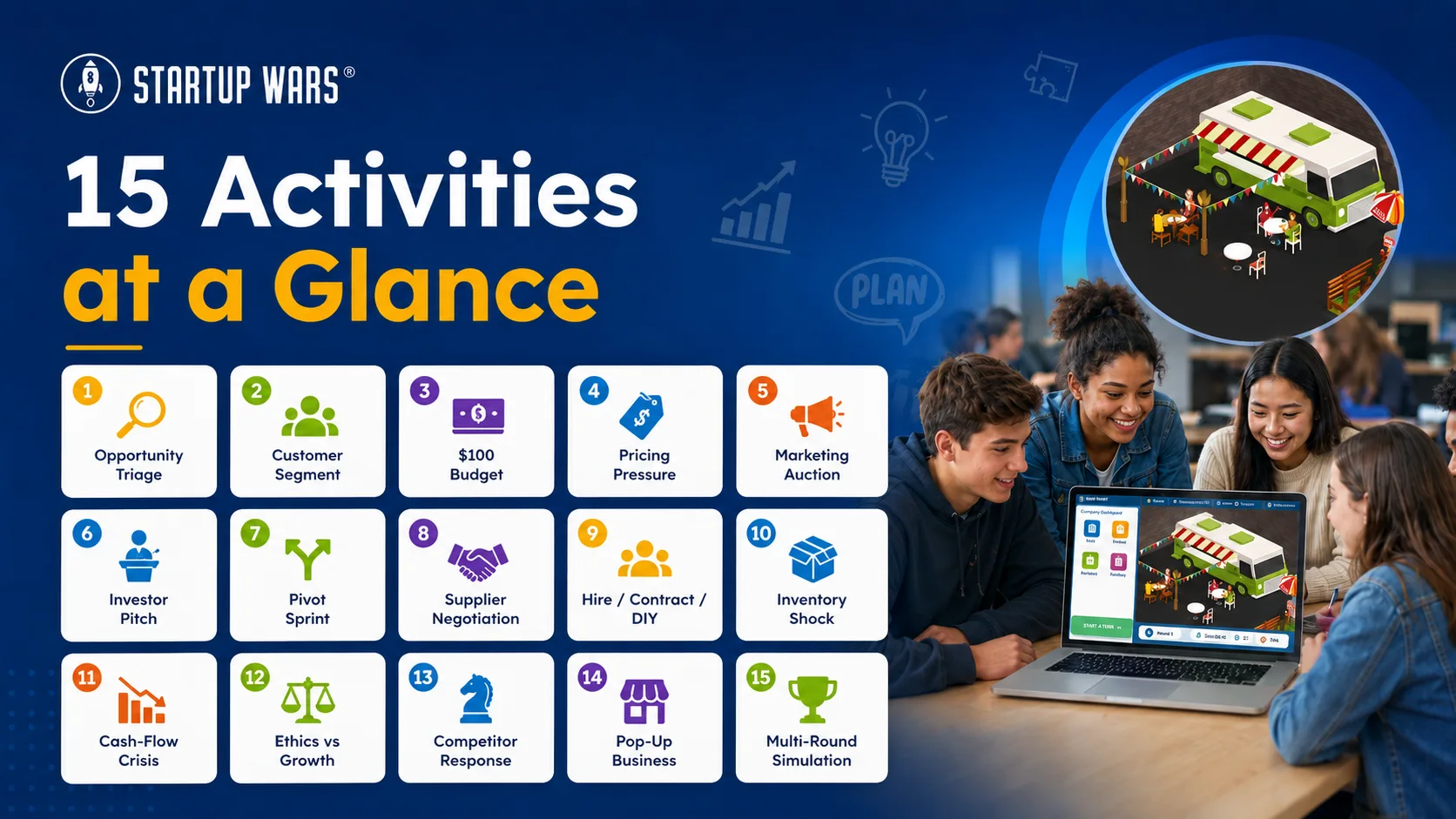
15 Entrepreneurship Games and Activities for Students
| Activity | Main decision students practice | Time |
|---|---|---|
| Opportunity Triage | Which problem is worth solving? | 20–30 min |
| Customer Segment Showdown | Which customer should we target? | 20–30 min |
| $100 Startup Budget | Where should limited money go? | 30 min |
| Pricing Under Pressure | What should we charge? | 30 min |
| Marketing Channel Auction | Where should we advertise? | 30–45 min |
| Investor Token Pitch | Which ideas deserve investment? | 30–45 min |
| Feedback-to-Pivot Sprint | When should a business change direction? | 30–45 min |
| Supplier Negotiation | Which terms matter most? | 30–45 min |
| Hire, Contract, or DIY | How should we add capacity? | 30 min |
| Inventory Shock | How much inventory should we carry? | 30–45 min |
| Cash-Flow Crisis | What gets protected when cash gets tight? | 30–45 min |
| Ethics vs. Growth | When should a business say no? | 20–30 min |
| Competitor Response Game | How should a company react to competition? | 30 min |
| Pop-Up Business Sprint | How do several decisions work together? | 1–3 classes |
| Multi-Round Business Simulation | How do today's choices affect tomorrow's options? | Multiple sessions |
1. Opportunity Triage
Give teams four or five problems that could become business opportunities. Do not ask them to invent a solution immediately.
Instead, give them limited information about each problem: how often it occurs, who experiences it, what people currently do about it, and perhaps how much they might pay to solve it.
Then force the choice:
You can investigate only one. Which one gets your time?
Students have to distinguish an interesting idea from an opportunity worth pursuing.
Debrief: What evidence mattered most in your choice, and what information would you want before investing real money?
2. Customer Segment Showdown
Give every team the same product but three very different potential customers.
A meal-prep service might target busy parents, college students, or fitness enthusiasts. A tutoring app might serve struggling students, advanced learners, or parents.
Teams can choose only one segment.
Then ask them to adapt the price, message, sales channel, and most important product feature for that customer.
The lesson is simple but important: "everyone" is rarely a useful target market.
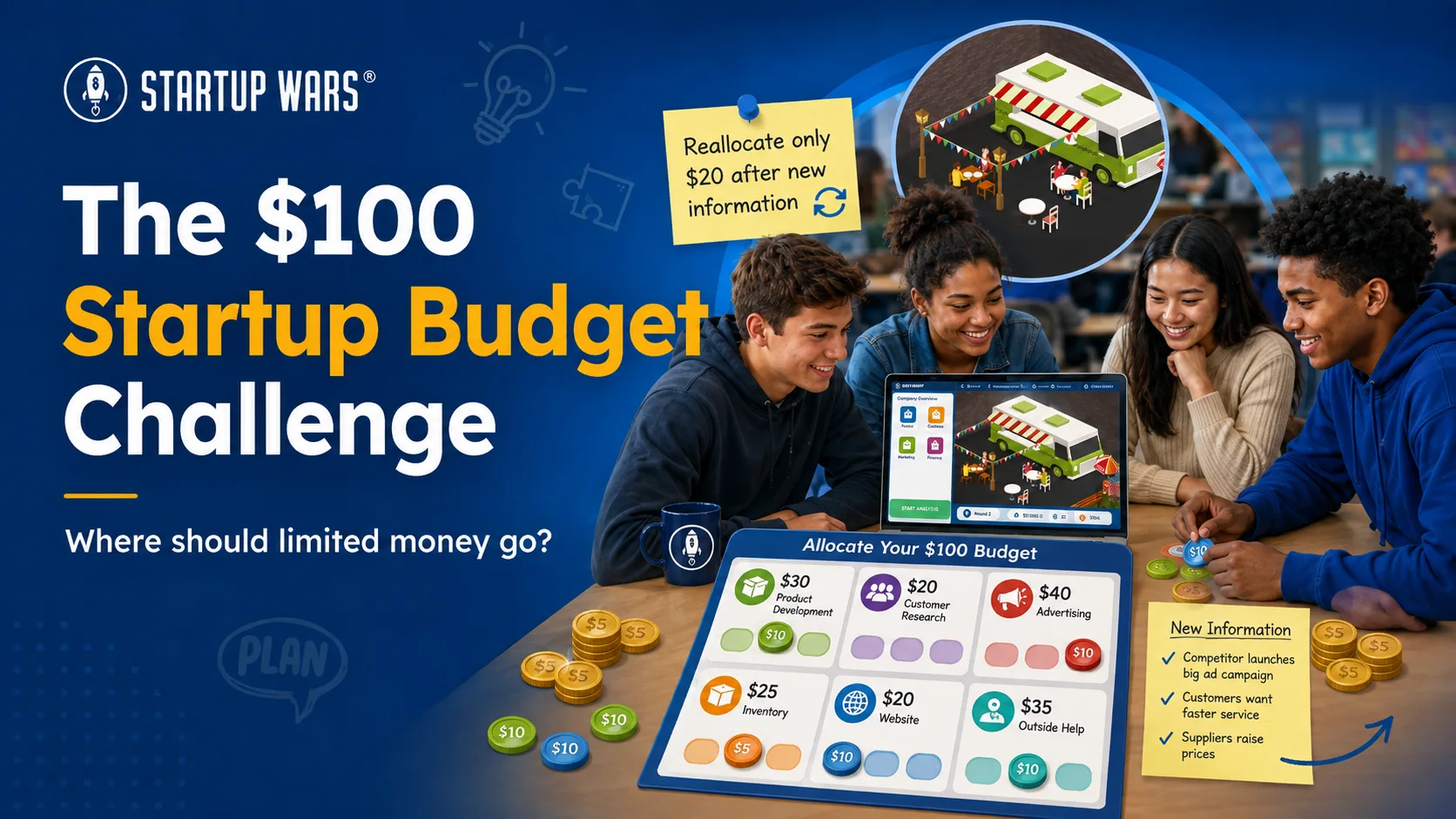
3. The $100 Startup Budget Challenge
Give teams a fictional $100 startup budget and a menu of possible expenses.
For example:
- $30 for product development
- $20 for customer research
- $40 for advertising
- $25 for inventory
- $20 for a website
- $35 for outside help
They cannot buy everything.
That turns budgeting into a strategy exercise rather than an arithmetic exercise.
After everyone commits, introduce one new piece of information — perhaps demand is lower than expected or a competitor has appeared — and let teams reallocate only $20.
Now the interesting question becomes: what are you willing to give up?
4. Pricing Under Pressure
Give students the same product, its unit cost, three possible price points, and some basic customer-demand information.
Then let each team select a price.
Once they commit, reveal a change:
- a competitor lowers its price,
- material costs increase,
- demand spikes,
- or customers suddenly value a premium feature more.
Students decide whether to stay put or change the price.
This is much more useful than asking students to memorize pricing terminology because it turns price into a tradeoff among margin, volume, positioning, and customer behavior.
5. Marketing Channel Auction
Give each team a limited marketing budget and auction access to fictional channels such as social media, search ads, a local event, email, influencers, or a school sponsorship.
The catch: every channel should have a different audience profile.
Students aren't trying to buy the most advertising. They're trying to buy the right attention for their customer.
After the auction, ask teams to explain why their media mix makes sense.
You can make a second round more interesting by revealing performance data and asking whether they would move the next $100 somewhere else.
6. Investor Token Pitch
Most pitch exercises focus on the presenter. Turn the audience into decision-makers too.
Give every student five fictional investment tokens.
After hearing several one-minute pitches, students must decide where to invest them. They cannot invest in every company.
The pitching teams practice communication and value propositions. The "investors" practice evaluating opportunities.
Then reveal the investment totals and ask investors what made one idea feel more credible than another.
This makes the class think about both sides of the table.
7. The Feedback-to-Pivot Sprint
Have teams develop a simple business idea and make three initial choices:
- target customer,
- core feature,
- price.
Then hand each team a set of customer feedback.
Maybe customers like the idea but think it is too expensive. Perhaps they're willing to pay, but the feature the team thought mattered most turns out to be irrelevant.
Teams must choose:
Stay the course, make a small adjustment, or pivot significantly?
Centier uses a similar pivot exercise built around adapting a business concept to customer and mentor feedback. (Centier Bank)
The most useful part is asking students to defend why the feedback was strong enough — or not strong enough — to justify changing direction.
8. Supplier Negotiation
Pair student teams as businesses and suppliers.
Give each side private goals.
The buyer wants a low price, fast delivery, and flexible payment terms. The supplier wants margin, predictable orders, and favorable terms.
Neither side can get everything.
Give them five minutes to negotiate an agreement.
Then compare deals across the room.
Students quickly discover that the "best" agreement is rarely determined by price alone.
9. Hire, Contract, or Do It Yourself?
A fictional startup has more work than its founders can handle.
Give students three options:
- hire an employee,
- use a contractor,
- or keep the work in-house.
Each has different costs, speed, skills, and risks.
Students choose one.
Then introduce a second condition: demand rises faster than expected, or revenue comes in below forecast.
Do they make the same staffing decision?
This entrepreneurial activity helps students see hiring as a resource-allocation decision, not merely an HR definition.
10. Inventory Shock
Tell teams they sell a physical product and must order inventory before knowing final demand.
They can order conservatively and risk running out, or order aggressively and risk tying up cash in unsold products.
Let teams commit.
Then reveal demand.
Do another round with a little more information.
By the third round, students will start asking better questions about forecasting, cash flow, margins, and uncertainty — which is exactly the point.
11. Cash-Flow Crisis
Give students a profitable-looking company with a problem: it does not have enough cash to cover the next month.
Teams receive a list of possible responses:
- delay a purchase,
- reduce marketing,
- negotiate payment terms,
- borrow money,
- raise prices,
- cut staffing costs,
- or seek additional investment.
They can choose only two.
There is no universally correct answer. Students have to balance short-term survival against the things the company needs to keep growing.
12. Ethics vs. Growth
Not every entrepreneurial decision should be about maximizing profit.
Give students a scenario where the most profitable option creates an ethical question.
For example, a supplier offers a much lower price but has questionable labor practices. A customer-data strategy could increase sales but requires collecting information users may not expect.
Teams choose a path and defend it.
Then ask the other groups to challenge their reasoning.
The goal isn't to manufacture a single "correct" ethical answer. It is to make students recognize that business decisions can affect customers, employees, communities, and reputation at the same time.
13. Competitor Response Game
Give teams a healthy fictional business.
Then announce that a competitor has:
- cut prices,
- introduced a new feature,
- entered their neighborhood,
- copied their offer,
- or launched a major advertising campaign.
Students get five minutes and a fixed budget to respond.
Do they lower prices? Improve the product? Change audiences? Increase marketing? Ignore the competitor entirely?
The last option is important. Entrepreneurship isn't only about reacting faster. Sometimes the strategic decision is deciding not to react.
14. The Pop-Up Business Sprint
If you have more time, connect several decisions.
Students build a tiny pop-up business over one to three classes.
They must decide:
- what to sell,
- who the customer is,
- what to charge,
- how much to spend,
- how to promote it,
- and who handles each role.
Junior Achievement's Company Program Pop-Up uses a related model in which students establish and operate a small venture while working through product, price, place, promotion, responsibilities, and business operations. (Junior Achievement USA)
The important shift here is continuity. Pricing can affect demand. Marketing can affect sales. Spending too much early leaves less money later.
Students begin seeing a business as a system rather than a collection of vocabulary words.
15. Run a Multi-Round Business Simulation
This is where entrepreneurship games can move from isolated skill practice to connected decision-making.
Instead of resetting after every classroom exercise, students operate the same business over multiple rounds.
A pricing decision affects revenue. Revenue influences cash. Cash affects hiring. Hiring changes capacity. Marketing affects demand. And the consequences from one round shape the choices available in the next.
That decision → outcome → next decision pattern is also central to established high-school business simulations such as JA Titan and Wharton's Entrepreneurship Game. (Junior Achievement USA)
Startup Wars takes a similar entrepreneurship-first approach: students operate industry-themed startups and make decisions around areas such as pricing, marketing, inventory, budgeting, hiring, operations, and growth in a risk-free environment. (Startup Wars)
The simulation does not need to replace smaller activities. It can be where those individual lessons finally collide.
Entrepreneurship Activities vs. Business Simulations: When Should You Use Each?
There's no need to declare a winner.
A short activity is often the better teaching tool when you want students to focus closely on one decision.
A simulation becomes more useful when you want students to experience how decisions interact over time.
| Use a classroom activity when… | Use a simulation when… |
|---|---|
| You want to isolate one skill | You want several business functions to interact |
| You have 20–45 minutes | You have multiple sessions |
| Students are learning a new concept | Students are ready to apply several concepts |
| The activity can reset afterward | Earlier decisions should affect later options |
| Your priority is discussion | Your priority is sustained decision-making |
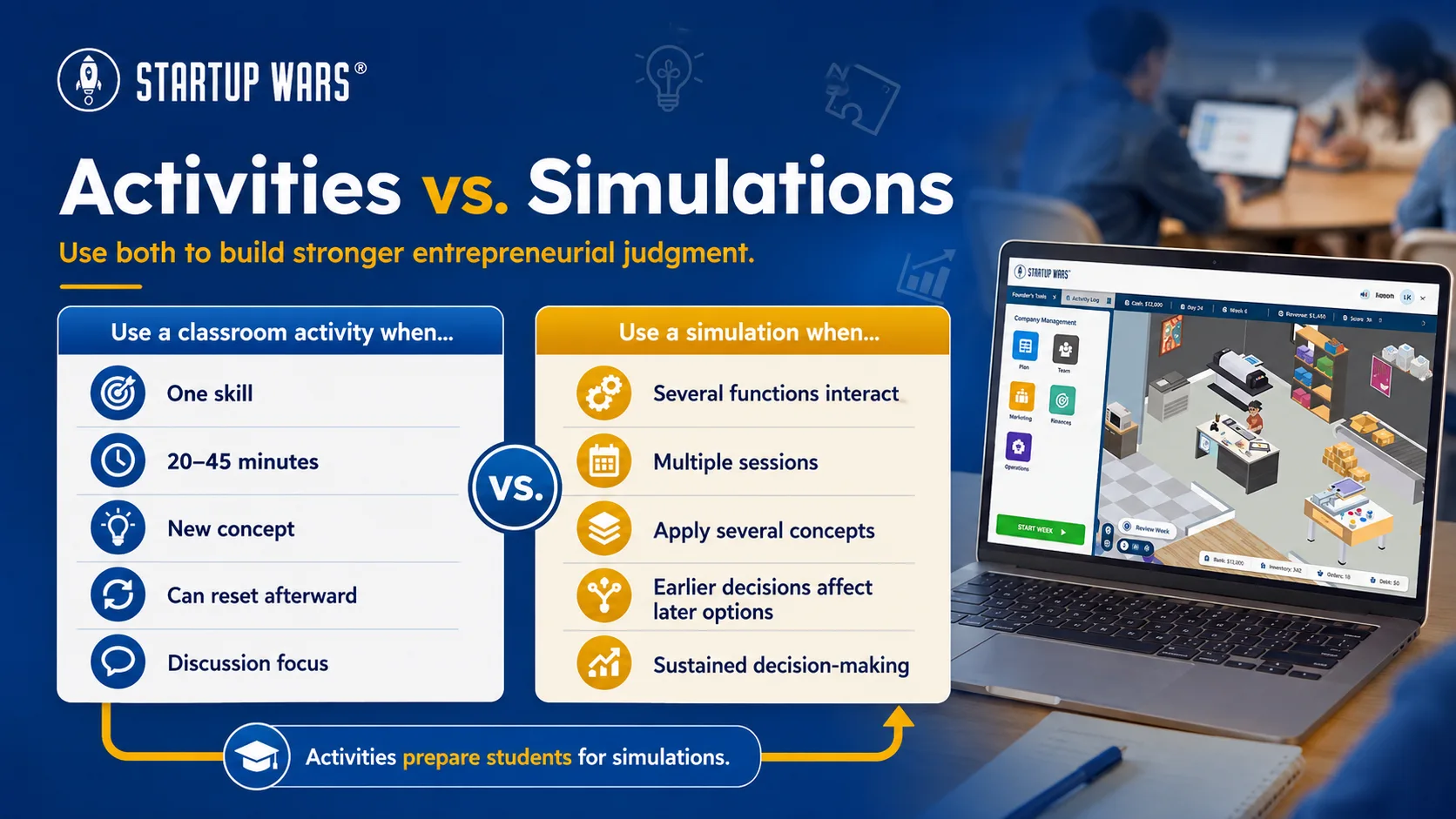
One does not eliminate the other.
A pricing activity can prepare students for a pricing decision inside a simulation. A pitch exercise can prepare them for a competition. A simulation can then show what happens after the pitch deck ends and the business actually has to operate.
A Simple Debrief That Works With Almost Any Entrepreneurship Game
The activity is not finished when someone wins.
Before students move on, ask them to answer four short questions:
- What did you decide?
- What information influenced you most?
- What did you give up by making that choice?
- What would you do differently if you had another round?
Those four questions move the conversation away from "Did we win?" and toward "Was our reasoning good?"
That's much closer to the judgment entrepreneurs actually need.
The Goal Isn't More Games. It's More Decisions.
There are plenty of fun activities for entrepreneurship classes.
The better question is what students are being asked to practice.
Are they simply completing a worksheet with a business theme? Or are they choosing between imperfect options, working with limited resources, seeing consequences, and adjusting their next move?
You can start small.
Run the $100 budget challenge tomorrow. Try a pricing scenario next week. Use a customer-feedback pivot after that.
Then, when students are ready, connect those skills in a longer experience where decisions stop living in isolation.
That's when entrepreneurship starts to feel a little less like something students are studying and a little more like something they're learning how to do.
Ready to connect individual business decisions into a full startup experience? Explore Startup Wars business simulations for high school and CTE classrooms.
Frequently Asked Questions
What are some good games about entrepreneurship for students?
Good games about entrepreneurship include pricing challenges, startup budget exercises, marketing auctions, pitch competitions, customer-feedback pivots, inventory games, negotiation exercises, cash-flow challenges and multi-round business simulations. The strongest activities require students to make a business decision and explain the reasoning behind it.
What are the best entrepreneurship activities for high school students?
High-school students can practice entrepreneurship through activities involving customer selection, budgeting, pricing, marketing, hiring, pitching, inventory, negotiation and competitive strategy. Choose activities with clear constraints and tradeoffs rather than exercises where students simply repeat definitions.
How can I make entrepreneurship activities more realistic?
Add limited resources, incomplete information and consequences. For example, give students a fixed marketing budget instead of asking them to create an unlimited campaign, or reveal new customer feedback after they have already committed to a business idea.
What is the difference between entrepreneurship activities and business simulations?
An entrepreneurship activity usually isolates one concept or decision for a short lesson. A business simulation connects multiple decisions over time, allowing an earlier choice in areas such as pricing, marketing or hiring to affect what happens later.
Can entrepreneurship games be used for assessment?
Yes. Instead of grading only whether students "won," instructors can assess their reasoning. Ask students to document the decision they made, evidence they used, tradeoffs they considered, outcome they observed, and what they would change in another round.
About the author
Andrea Martinez
Startup Wars marketing and content contributor
Andrea writes about entrepreneurship education, experiential learning, and the programs and product ideas shaping Startup Wars.