
An introduction to business course has an unfortunate superpower: it can turn the entire economy into a vocabulary test.
Students learn what marketing, finance, management, operations, and human resources mean. Then you give them a messy business problem, and suddenly the definitions stop volunteering for duty.
Should the company raise prices, hire another employee, cut inventory, or spend more on promotion? Which answer is "right" when every choice creates a new tradeoff?
That is the real work of business.
An introduction to business course should give students a clear map of how organizations create value, compete, manage people, use money, serve customers, and respond to change. In 2026, however, knowing the map is not enough. Students also need structured opportunities to make decisions, see consequences, explain their reasoning, and try again.
Textbooks still matter. Cases still matter. Lectures still matter. The opportunity is to connect them to something students can do.
What Is an Introduction to Business Course?
An introduction to business course is a broad survey of how businesses operate and how their major functions work together. It typically introduces entrepreneurship, ownership, management, leadership, human resources, marketing, operations, accounting, finance, ethics, technology, and the wider economic environment.
That scope explains why the current search results are dominated by textbooks and full courses. OpenStax's Introduction to Business 2e, released in April 2026, is designed around the scope of a foundational business course and covers areas including decision-making, ethics, management, leadership, production, marketing, finance, entrepreneurship, global business, and managing change. (OpenStax)
The Open University takes a similarly broad approach. Its B100 module uses seven blocks to introduce business functions, human resources, financial information, marketing, economics, ethics, and globalization through readings, international case studies, and interactive online activities. (Open University)
Those resources do an excellent job of answering:
What should an introductory business course cover?
The next question is more practical:
What should students be able to do with what they learn?
A student who finishes Business 101 should not merely recognize the parts of a company. They should be able to look at a business situation, identify the important information, make a reasonable decision, and explain the tradeoffs.
The Business Fundamentals Students Should Practice
| Business fundamental | Students should understand | Students should practice |
|---|---|---|
| Value creation and ownership | Problems, customers, business models, and common ownership structures | Define a customer problem, choose a model, and explain how the business creates value |
| Marketing | Segmentation, positioning, pricing, promotion, and customer research | Choose a target market, test a message, and defend a pricing decision |
| Finance and accounting | Revenue, costs, profit, cash flow, budgets, and financial reports | Read basic financial information, allocate limited funds, and forecast consequences |
| Operations | Capacity, inventory, quality, suppliers, fulfillment, and process design | Balance demand with resources and respond to an operational disruption |
| People and management | Hiring, motivation, workload, leadership, and organizational structure | Build a staffing plan, assign work, and respond to a people-management problem |
| Strategy | Goals, competition, tradeoffs, risk, and adaptation | Set priorities, compare options, and revise a plan when conditions change |
| Ethics and the business environment | Stakeholders, regulation, sustainability, technology, and global forces | Evaluate a decision from several stakeholder perspectives and justify a responsible response |
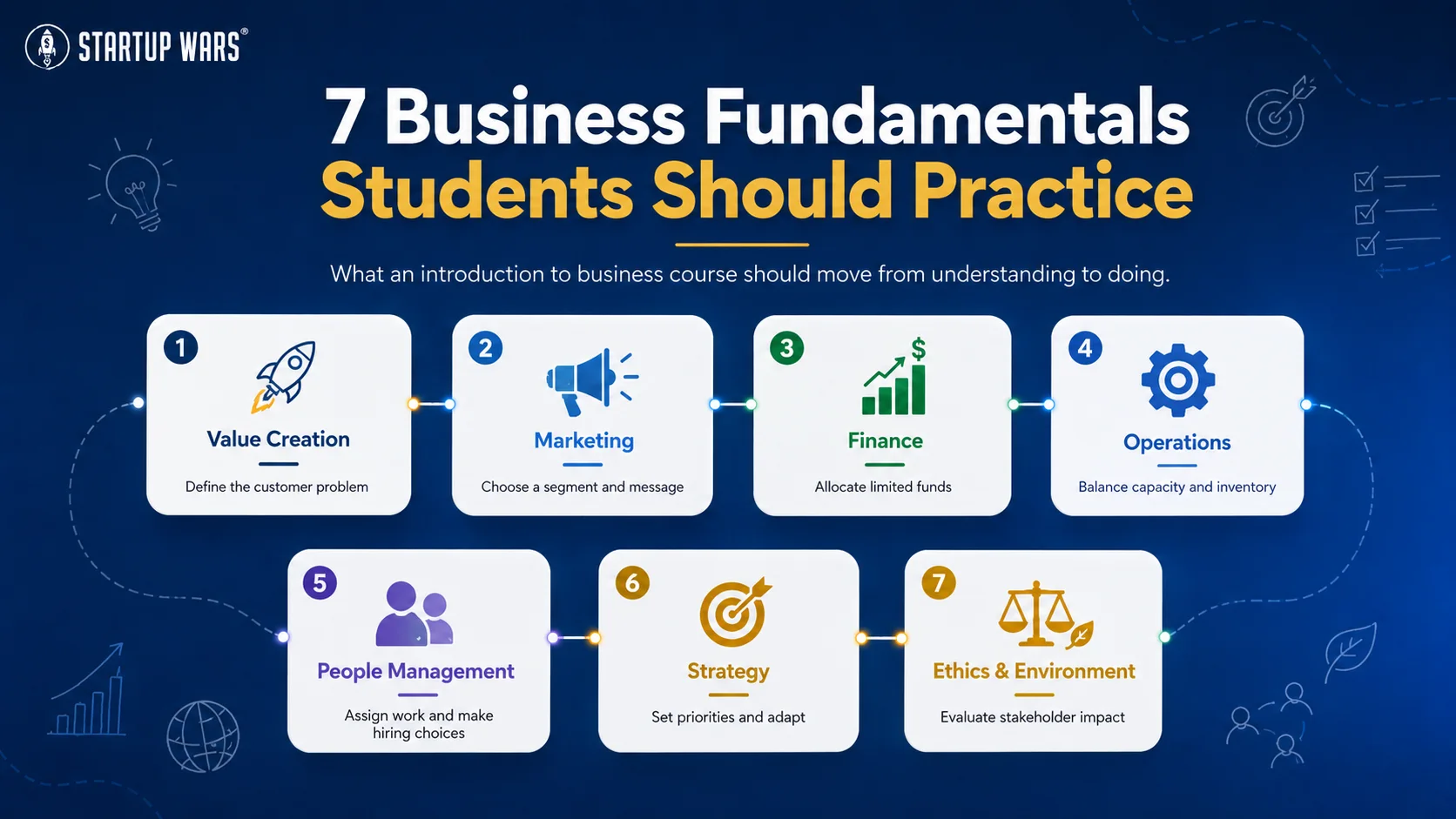
This list is not a replacement for a complete business fundamentals curriculum. It is a bridge between course content and student performance.
A Practical Framework: Business Fundamentals in Motion
At Startup Wars, we use a simple editorial framework when thinking about applied business learning:
Understand → Decide → Observe → Explain → Transfer
This is not a formal research model. It is a practical way to check whether a lesson moves beyond coverage.
Understand
Students learn the concept, vocabulary, and basic framework.
Decide
They use that knowledge to make a choice under realistic constraints.
Observe
They receive data, feedback, peer response, or a simulated outcome.
Explain
They describe why they chose that path and what the result revealed.
Transfer
They apply the lesson to a new situation, later round, case, or project.
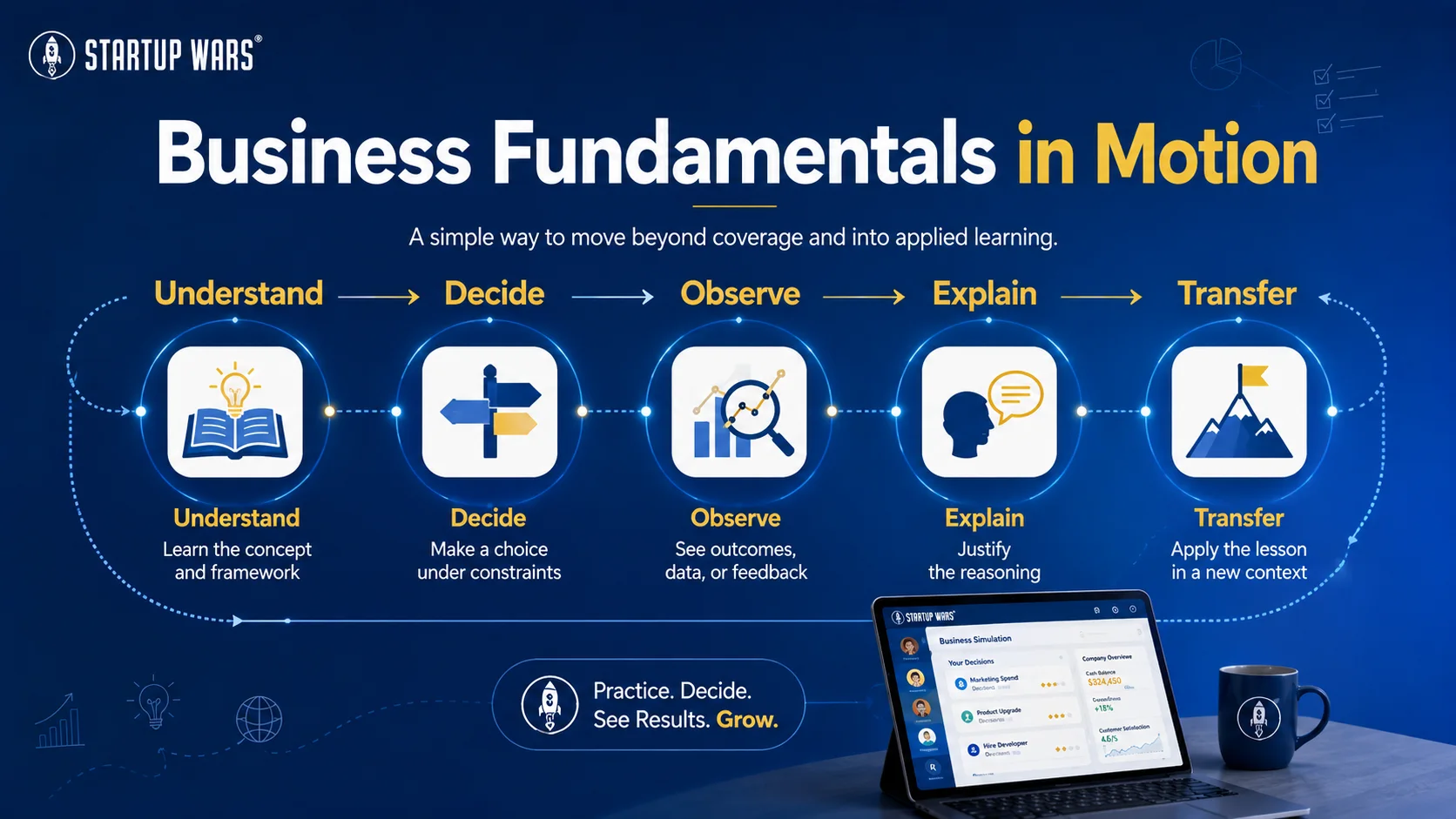
A lecture may handle the first step beautifully. A quiz can confirm basic understanding. The later steps reveal whether students can actually use the concept.
1. Value Creation, Entrepreneurship, and Business Ownership
Students should begin with a deceptively simple question:
Why does this business deserve to exist?
That means identifying a customer problem, defining the value offered, and understanding how the organization will deliver and capture that value. Business ownership belongs here too, but it should not become a parade of legal definitions with no context.
Ask students to compare a sole proprietorship, partnership, limited liability company, and corporation for a specific founder. The useful question is not only, "What are the four structures?" It is:
Which structure fits this business, its risk, its funding needs, and its growth plan?
In a makers-market scenario, for example, a student might begin with one handmade product and limited weekend availability. That creates a more meaningful discussion about scale, ownership, costs, and risk than asking for definitions alone.
2. Marketing and Customer Decisions
Marketing is often introduced as a tidy set of terms. Actual marketing is less tidy and much more interesting.
Students should know how segmentation, positioning, product choices, pricing, promotion, and customer research fit together. Then they should have to choose.
Which customer segment matters most? What message will reach that customer? Is a lower price likely to increase demand enough to justify the lost margin?
A T-shirt business can make those questions concrete. Students may need to choose designs, estimate demand, set prices, and decide whether a promotion is worth the cost.
A mobile app business raises a different version of the same problem: how do you attract users when attention is limited and acquisition is not free?
The goal is not to produce miniature marketing directors in one semester. It is to help students see that marketing decisions affect finance, operations, and strategy almost immediately.
3. Finance, Accounting, and the Difference Between Cash and Confidence
Every introduction to business course should help students become less intimidated by financial information.
They do not need to leave as accountants. They should be able to:
- Distinguish revenue from profit.
- Understand why cash flow matters.
- Recognize major cost categories.
- Interpret a basic profit-and-loss statement.
- Explain how a decision changes the numbers.
Give students a fixed budget and three attractive choices. They may want more inventory, another employee, and a larger marketing push.
Unfortunately, the spreadsheet has declined to fund all three.
That moment is useful. It turns budgeting into prioritization.
In a food-truck scenario, too much perishable inventory can become waste. Too little can mean missed sales. In a mobile app scenario, hiring faster can increase capacity while shortening the company's financial runway.
Students should experience the mildly rude fact that a good idea can still be a bad financial decision at the wrong time.
4. Operations, Inventory, and Keeping the Promise
Operations is where the customer promise meets reality.
Students should understand:
- Capacity.
- Process design.
- Inventory.
- Suppliers.
- Quality.
- Fulfillment.
- Scheduling.
- Bottlenecks.
More importantly, they should see how operating choices create consequences elsewhere.
A food-truck business may need to prepare for an event without knowing exact demand. A T-shirt company must balance materials, orders, fulfillment, and staffing. A vertical farm must make choices about crops, specialized equipment, limited resources, and distribution.
These are not simply "operations examples." They are opportunities to ask students:
- What would you measure?
- What is most likely to fail?
- Which risk deserves attention first?
- What would you change when the original plan stops cooperating?
5. People, Management, and Leadership
Businesses do not run on charts alone. Eventually, another human being appears and complicates the model.
An intro to business management unit should help students understand hiring, motivation, workload, performance, communication, organizational structure, and leadership.
Students should practice deciding:
- What work needs to be done.
- Who should do it.
- How workloads should be divided.
- What the business can afford.
- How a manager responds when performance changes.
The T-shirt simulation provides one useful tradeoff: hiring interns versus employees. The cheaper option may create a different workload, reliability, or management problem.
The lesson is not that one staffing model is always better. The lesson is that a people decision has financial and operational effects.
Leadership also becomes more credible when students must own a choice. It is easy to recommend "better communication" from a safe distance. It is harder to explain what should be communicated, to whom, by when, and with what consequence if the plan fails.
6. Strategy, Competition, and the Art of Not Doing Everything
Strategy is not a list of goals with ambitious verbs. It is a set of choices about where to compete, how to create value, what to prioritize, and what not to do.
Students should practice comparing options under constraints:
- Pursue growth or protect cash?
- Compete on price or differentiation?
- Expand the product line or improve one offer?
- Enter a new market or strengthen the current one?
- Hire now or wait for more evidence?
A strong business fundamentals course lets students revisit those choices when conditions change.
A competitor enters. Demand shifts. Costs increase. The original strategy may no longer fit.
This is where repeated rounds, cases, or simulations become valuable. Students can see whether they are adapting because the evidence changed or merely changing direction because the first result felt uncomfortable.
7. Ethics, Technology, and the Business Environment
Business decisions are shaped by customers, employees, regulators, communities, economic conditions, technology, and global events.
Ethics should therefore appear throughout the introduction to business course, not wait politely in one isolated chapter.
Ask students to evaluate:
- Who benefits?
- Who carries the risk?
- What information is missing?
- What does the organization owe its stakeholders?
- Which consequences are easy to overlook?
A cheaper supplier may improve margin while introducing labor or environmental concerns. Customer data may improve marketing while creating privacy questions. An AI-generated recommendation may sound efficient while hiding weak assumptions.
AACSB's 2026 Global Standards organize business-education quality around curriculum, assurance of learning, learner progression, teaching effectiveness, and impact. They also emphasize relevance, innovation, ethical judgment, learner-centricity, and preparing future-ready leaders. The standards do not prescribe one classroom method, but they reinforce the need for business education to produce more than content exposure.
Students should leave with a habit of asking both:
Can we do this?
and:
Should we do this?
Preferably before the legal department discovers the plan in a group chat.
How Should an Introduction to Business Course Be Designed?
A practical introduction to business course does not need to abandon a textbook or become one semester-long game.
It needs a rhythm that connects knowledge with action.
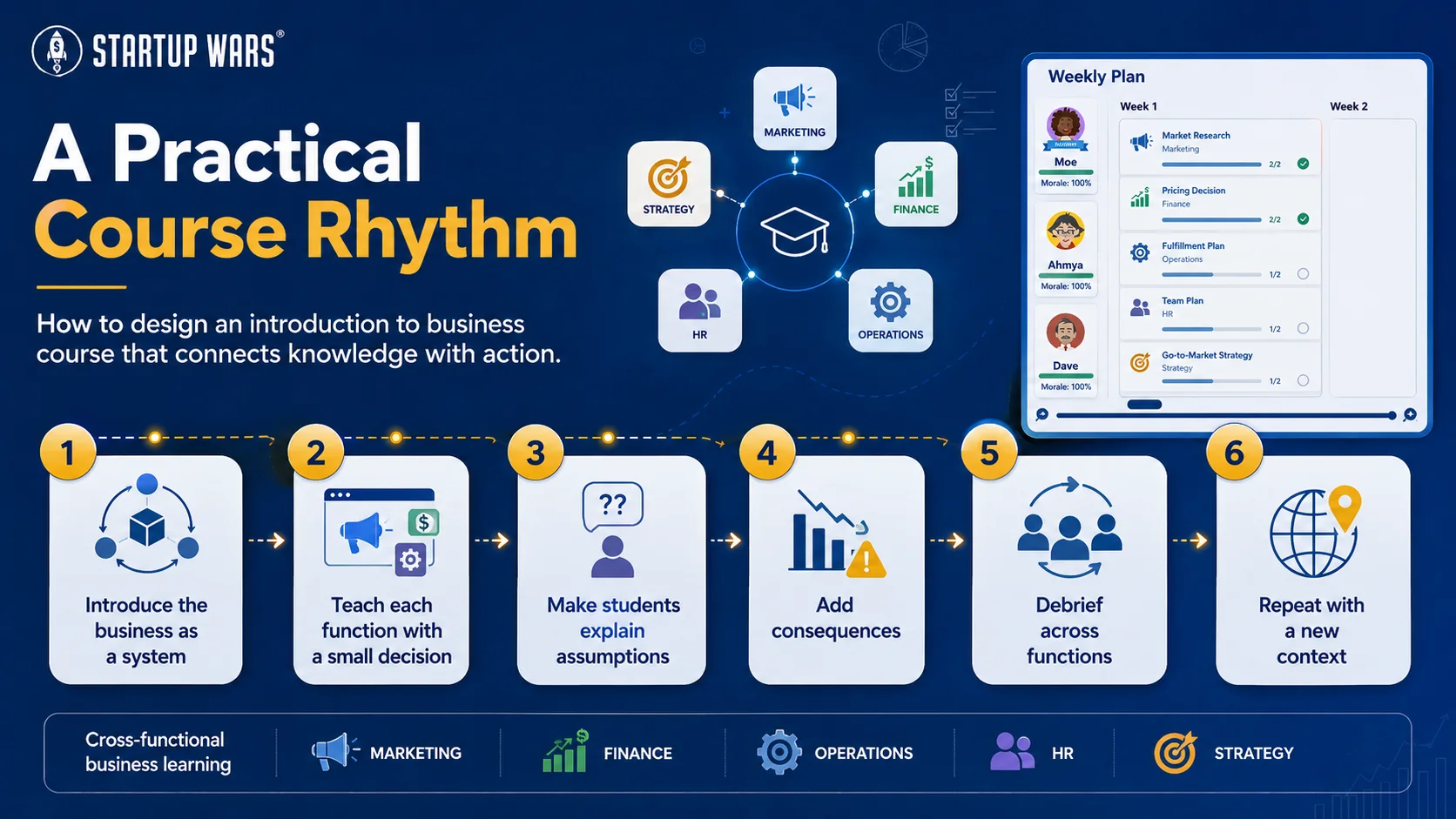
Whether an instructor uses an open textbook, commercial introduction to business courseware, or a custom business fundamentals curriculum, a useful sequence looks like this:
1. Introduce the business as a system
Show how customers, value creation, people, money, operations, and the external environment connect. Students need the whole map before diving deeply into one function.
2. Teach each function with a small decision
Pair marketing with a segmentation or pricing choice. Pair finance with a budget allocation. Pair human resources with a hiring decision. Pair operations with an inventory or capacity problem.
3. Make students explain their assumptions
Require a short rationale before revealing more information. This lets instructors assess thinking, not only the final answer.
4. Add consequences
Use case developments, new data, peer feedback, or a simulation outcome. Students should see that business decisions change what happens next.
5. Debrief across functions
Ask how the marketing decision affected operations, how the staffing choice affected finance, or how the pricing strategy changed demand.
6. Repeat with a new context
Transfer matters. A student who understands inventory in a food truck should be asked how the same principle changes in apparel, software, or agriculture.
What Evidence Should Students Produce?
Assessment in a Business 101 course should include foundational knowledge and applied reasoning.
A balanced approach can include:
- Short concept checks for vocabulary and frameworks.
- Decision memos that explain a choice and its assumptions.
- Basic financial calculations and report interpretation.
- Team recommendations with individual reflection.
- Case analyses requiring prioritization.
- Simulation results paired with an explanation of what changed.
- A final transfer task using a new business context.
Peer-reviewed research offers useful support for this approach while also reminding us not to claim more than the studies show.
A qualitative study of 71 college students' business-simulation reports identified five recurring ability areas: strategic decision-making, competition and cooperation, analysis and judgment, communication and team spirit, and learning by doing. (ERIC)
Another study using 365 student surveys across seven institutions, supported by focus groups, found that online business simulations provided an authentic team-based learning environment connected with management-related outcomes and learner satisfaction. (ERIC)
Startup Wars' instructor materials recommend reviewing student attempts, achieved goals, Summary Reports, and Activity Logs. They also suggest comparing students' initial expectations with later results and discussing business failure, financial choices, and leadership decisions.
That combination matters.
A result shows what happened. A reflection helps reveal what the student learned.
Where Business Simulations Fit
A business simulation can serve as the lab portion of an introduction to business course.
Startup Wars uses five browser-based venture contexts:
- T-shirt company.
- Food truck.
- Mobile app.
- Vertical farm.
- Makers-market business.
Across those settings, students encounter inventory, marketing, financial reports, staffing, workload, pricing, product decisions, and resource tradeoffs.
Startup Wars reports cumulative adoption of more than 10,000 learners across more than 100 institutions, while its simulation catalog reports more than 35,000 completed simulations. These are company-reported adoption figures rather than independently audited evidence of learning outcomes, but they indicate sustained use of applied business instruction across institutions. (public evidence page)
The important point is not that a simulation should replace the course.
It should give the course somewhere to go.
Textbooks can explain the functions. Cases can show how organizations handled a situation. Discussion can surface competing interpretations.
A simulation asks students to make the call before they know how the story ends.
What Should Students Remember After the Final Exam?
If students forget a few definitions, the course has not failed.
If they still believe marketing, finance, operations, and people management function independently, something important was missed.
Students should leave an introduction to business course understanding that:
- Businesses create value for specific people.
- Every resource has an opportunity cost.
- Revenue is not the same as profit or cash.
- Customers influence operations, not only marketing.
- People decisions are business decisions.
- Strategy requires tradeoffs.
- Data helps, but judgment still matters.
- Ethical and external consequences belong inside the decision.
- Failure can produce useful evidence when students examine it.
- A decision is only as strong as the assumptions behind it.
That is a more durable version of business fundamentals than a stack of chapter summaries.
Frequently Asked Questions
What Is Introduction to Business About?
Introduction to business is a foundational course covering how organizations create value and how functions such as management, marketing, finance, accounting, operations, human resources, entrepreneurship, and strategy work together.
Is Introduction to Business a Hard Class?
It is usually broad rather than technically advanced. The challenge is learning many connected concepts and applying them to unfamiliar situations. Clear examples, guided decisions, and repeated practice can make the course more manageable.
What Do You Learn in an Introduction to Business Course?
Students typically learn business ownership, entrepreneurship, management, leadership, human resources, marketing, operations, accounting, finance, ethics, technology, and the business environment.
Strong business courses also ask students to apply those ideas through cases, projects, decisions, or simulations.
What Are the Four Main Types of Business Ownership?
In a common U.S. introductory framework, the four types are sole proprietorship, partnership, limited liability company, and corporation.
Legal structures and terminology vary by jurisdiction, so students should verify current local requirements.
What Are the Seven Basic Steps to Starting a Business?
There is no single official seven-step sequence, but a practical version is:
- Identify a problem.
- Research customers.
- Choose a business model.
- Estimate finances.
- Select an ownership structure.
- Test the offer.
- Launch and measure results.
What Is the Difference Between Business Fundamentals and an Introduction to Business Course?
Business fundamentals are the essential concepts and skills used to understand how organizations operate.
An introduction to business course is the structured curriculum that teaches those fundamentals through readings, cases, assignments, discussions, and applied activities.
Business Theory Needs Somewhere to Go
The best introduction to business course is not the one that covers the most pages.
It is the one that helps students see the company as a connected system and gives them enough practice to make a thoughtful decision when the answer is not printed in the margin.
A textbook can provide the map. A skilled instructor helps students interpret it. Applied decisions let them discover what the terrain actually feels like.
For college educators who want to add that practice without rebuilding the entire course, Startup Wars offers entrepreneurship-first business simulations that can support Intro to Business, entrepreneurship, management, marketing, innovation, and capstone courses.
Students run industry-themed startups, make cross-functional decisions, and bring the results back into discussion and assessment.
The point is not to make class feel like a game.
It is to make business feel like business.
Explore Business Simulations for Colleges
About the author
Andrea Martinez
Startup Wars marketing and content contributor
Andrea writes about entrepreneurship education, experiential learning, and the programs and product ideas shaping Startup Wars.