
Hands-on learning
Replace passive content with decisions, results, and reflection.
Learn by doing, not just memorizing
Business simulations put learners in realistic scenarios where they practice strategic decisions, financial thinking, leadership, and problem-solving without real-world risk.

Author: Startup Wars. We develop the entrepreneurship simulations and teaching resources described on this site. This vendor-authored guide draws on that product knowledge to help educators evaluate scenarios and plan instruction. Review our published educational-use sources.
The definition
A business simulation is an interactive learning tool that recreates real-world business scenarios. Participants make choices, see consequences, and refine their approach in a safe environment that builds professional confidence.
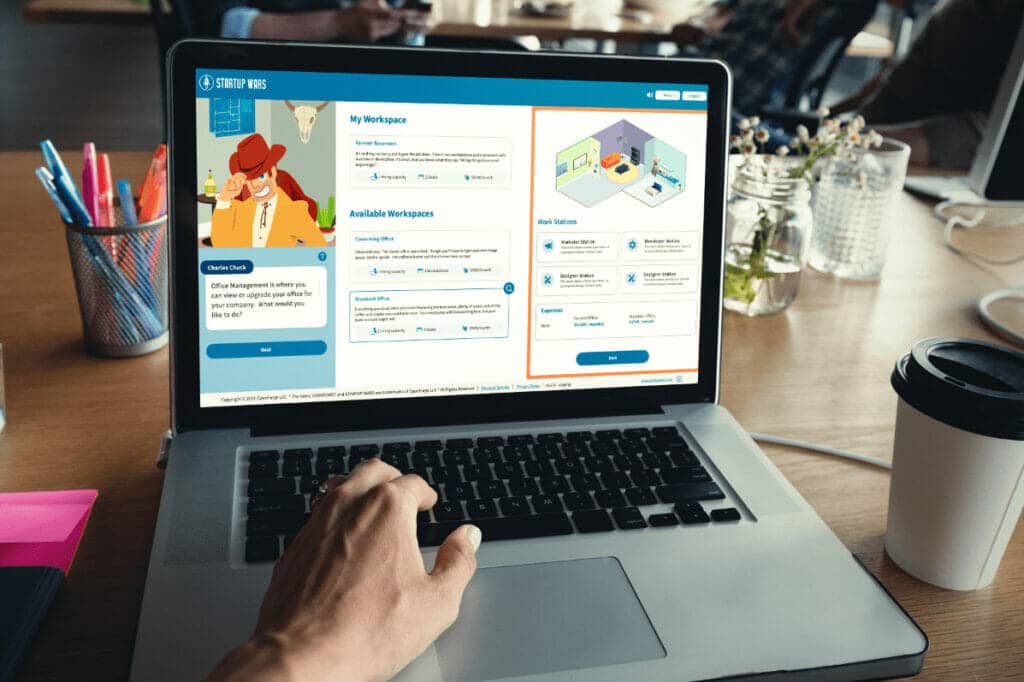
The experience
Students step into the role of a CEO: they make decisions on pricing, hiring, product, and growth; compete in a realistic market; receive real-time feedback; and learn from outcomes without real financial risk.

Built for your goals
Replace passive content with decisions, results, and reflection.
Learners see how choices connect to performance and adjust their strategy.
Try ambitious ideas and learn from mistakes before the stakes are real.
See the effects of each decision in real time and use the result to improve the next move.
By Startup Wars, the developer of the entrepreneurship simulations in our catalog. This teaching example uses illustrative numbers; it is not a screenshot or result generated by the platform.
Imagine a food truck selling meals at a campus event. Each meal sells for $10 and costs $4 to prepare. The event fee is $100.
Students choose whether to prepare 40 or 60 meals before they know demand. Unsold meals have no resale value.
| Meals sold | Profit with 40 prepared | Profit with 60 prepared |
|---|---|---|
| 30 | $40 | −$40 |
| 60 requested | $140, with 20 sales missed | $260 |
Calculate profit as revenue minus the cost of every meal prepared and the event fee. Preparing more stock helps if demand is high, but increases the loss from waste when demand is low. Ask students to state their demand assumption before seeing the result. Then ask what evidence would change their next order.
The printable decision worksheet and answer key let you try this discussion without an account. The Food Truck simulation series provides the related product context. Confirm the specific scenario and feedback in an educator demo.
| Approach | What the learner does | When to consider it |
|---|---|---|
| Educational business simulator | Makes choices in a modeled company and examines results | Practicing connected business decisions |
| Entrepreneurship simulation | Evaluates choices within a startup or growing venture | Teaching resource constraints and entrepreneurial reasoning |
| Case discussion | Analyzes a described situation and defends a recommendation | Comparing arguments without operating a simulated company |
| Business-process model | Studies a system such as a production flow or queue | Testing operational assumptions; this is a different software use case |
The categories overlap, and individual products differ. Select a teaching method by the work you want students to produce, rather than by the number of features in a demo.
Start with one learning objective. For example: “Explain how demand uncertainty affects an inventory decision.” Choose a scenario that makes that decision visible. Then plan what learners will submit: their initial assumption, calculation, choice, result, and revised recommendation.
A simple assessment can give equal attention to four areas: use of evidence, accuracy of calculations, explanation of tradeoffs, and reflection. A profitable result alone does not show whether a student understood the decision. Debrief both successful and unsuccessful choices.
Use the virtual-demo rubric to preview the learner task and instructor workflow. Review the education software buyer guide for access, assessment, and purchasing questions. Our simulation catalog helps you compare venture contexts once the learning goal is clear.
Here is a sample response to the Food Truck choice: “I prepared 60 meals because the event organizer expected a busy lunch period. Only 30 sold, so revenue was $300. Preparation cost $240 and the event fee was $100. The result was a $40 loss. Next time I would check attendance estimates and competing food options before choosing stock.”
That response shows more than a final profit number. It states an assumption, accounts for unsold inventory, and identifies evidence for the next decision. A learner who prepares 40 meals earns $40 at the same demand level. That result is better, but the learner still needs to explain why the smaller order made sense before demand was known.
You can assess each part as missing, partly explained, or supported by evidence. Keep the rubric tied to your course objective. If the lesson is about interpreting financial results, a clear calculation matters more than an elaborate presentation. If it is about persuasive reasoning, ask students to defend their recommendation to a classmate.
Tell students what they will hand in before they make a choice. Allow them to record an individual prediction even when they work in teams. During the debrief, compare two reasonable approaches. Ask which assumptions differed and whether either team changed its reasoning after seeing the outcome.
A useful closing question is: “Would you make the same decision with the information you had at the start?” This separates a defensible choice from a lucky result. A second question, “What new information matters next time?”, connects reflection to another attempt.
A simulated business simplifies the real world. Its rules determine which costs, customers, constraints, and feedback are represented. Ask what the model leaves out before treating a result as a prediction about a real company. The educational value comes from examining decisions within those rules and discussing where real situations could differ.
Startup Wars publishes educational-use sources and recognition so readers can check the context behind our product claims. Those sources do not prove that every class will achieve a specific gain. To evaluate your own lesson, collect the same kind of student explanation before and after the activity, and define how you will judge it.
For a first classroom trial, keep the objective narrow, the task understandable, and the reflection visible. Use the educator resource hub to find materials and plan the next step.
No. A business simulation gives students a situation to work through. Preparation, feedback, discussion, and reflection help connect that experience to course concepts. Learning gains depend on the teaching design and the evidence collected; participation alone does not establish improvement.
The same business context can support different assignments. High-school learners may need vocabulary and a guided calculation. College learners may compare assumptions and defend a decision memo. Review high-school classroom fit or college course integration before choosing the level of challenge.
Bring your course objective, student experience level, class size, devices, and teaching schedule. Ask to see the actual learner task, feedback, instructor view, and access process. Confirm timing and product requirements for the scenario you plan to use.
Bring it to life