
From Roadmaps to Results: A 15-Minute Demo Rubric for Virtual Business Simulation
Most business simulation demos look impressive. However, very few prove anything. Educators often see dashboards, scenarios, and features in quick succession. As a result, demos feel busy but unclear. At the same time, decision-makers leave without confidence. They still wonder how the tool supports learning outcomes.
This is where the gap appears. A virtual business simulation should not be judged by visuals alone. Instead, it should be evaluated by what students actually learn. Unfortunately, most demos focus on roadmaps rather than results.
Because of this, instructors struggle to connect simulations with real teaching goals. Deans struggle to justify adoption. Curriculum teams struggle to compare options fairly. Meanwhile, time remains limited. No one wants a one-hour walkthrough. What educators need is a fast, reliable way to judge value. That is why this guide focuses on a 15-minute demo rubric.
Rather than watching features passively, educators can ask targeted questions. They can observe how learning happens. They can evaluate whether a simulation supports hands on learning, not just interaction. This article shows how to move from promise to proof. More importantly, it helps you assess whether a simulation delivers results you can defend.
Stop Evaluating Simulations by Features Alone
Most demos fail because they start in the wrong place. They start with features instead of learning.
Why Feature-Led Demos Create Confusion
Simulation platforms often showcase everything at once. Charts appear. Scenarios load. Tools multiply. However, clarity disappears. When demos focus on surface features, educators struggle to judge impact. They see what the tool does, but not what students learn. As a result, adoption decisions feel risky.
This problem grows in business simulation training environments. Faculty need more than engagement. They need evidence that simulations support judgment, strategy, and reflection.
Learning Should Drive the Demo, Not the Other Way Around
Effective evaluation flips the process. Instead of asking, “What can this platform do?”, educators should ask, “What will students practise?” This shift changes everything.
Strong simulations support hands on learning through decisions, trade-offs, and consequences. Students do not just click. They think, adapt and reflect. Therefore, a good demo should reveal learning moments early. Within minutes, you should see how students:
-
make decisions
-
experience outcomes
-
revisit assumptions
If a demo cannot show this quickly, the tool may not support real learning.
Process Matters More Than Presentation
Many simulations look polished. However, polish does not equal depth. In a meaningful virtual business simulation, the learning process matters most. Students should move through structured challenges. They should face constraints. They should connect actions to results.
This process aligns closely with simulation learning, where experience drives understanding. It also supports clearer assessment later, because reasoning becomes visible. When demos reveal process clearly, educators gain confidence. They can see how simulations fit their curriculum. They can also see how outcomes align with program goals.
Why a Rubric Changes the Conversation
A rubric brings structure to evaluation. Instead of relying on impressions, educators assess specific criteria. They observe learning signals. They compare tools fairly.
Most importantly, a rubric keeps demos focused. It prevents feature overload. It also ensures that every minute supports a clear judgment. In the next section, we’ll break down the first elements of a 15-minute demo rubric. You’ll see exactly what to watch for and why it matters.
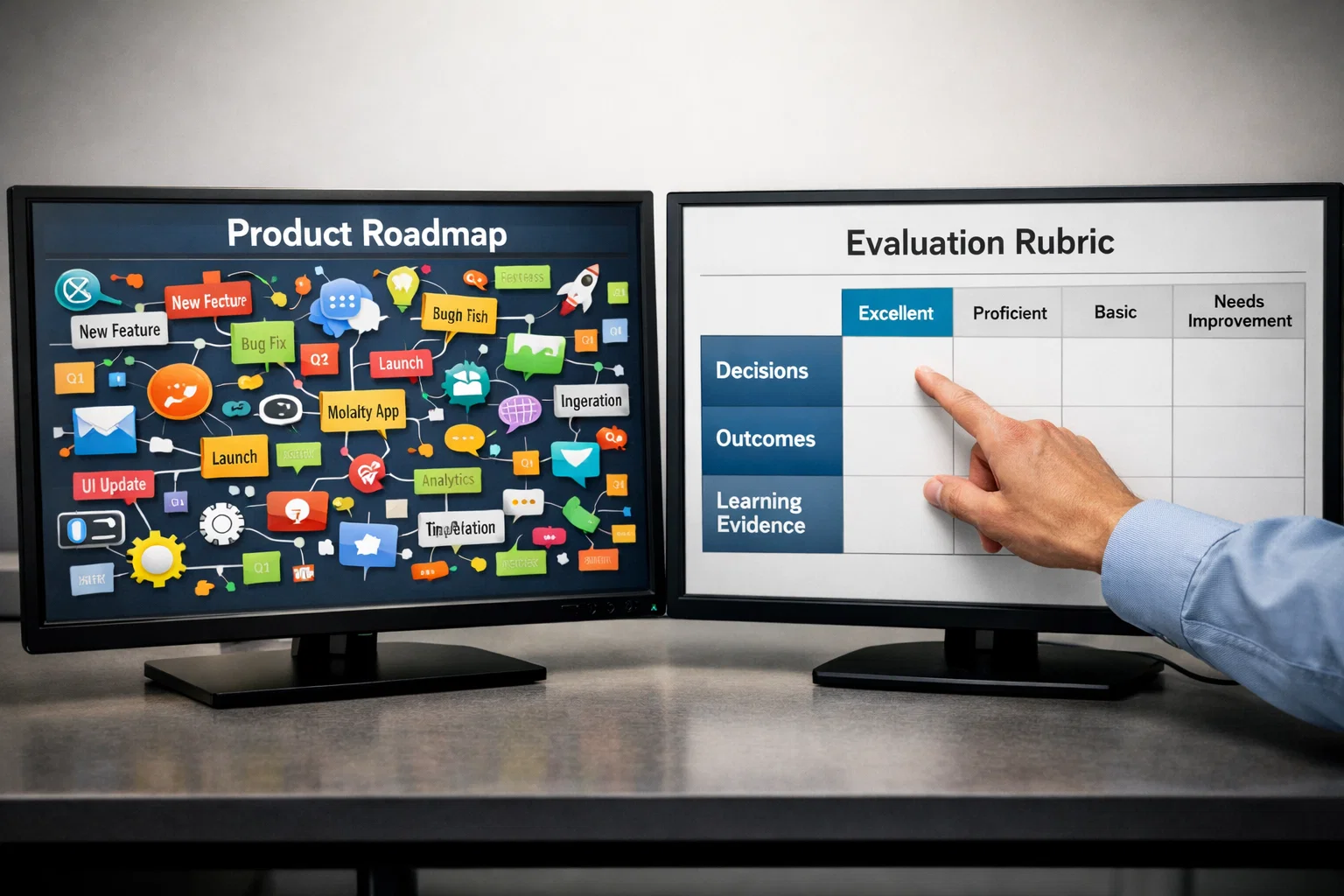
The First Rubric Criteria — Learning Signals and Decisions
A strong demo reveals learning quickly. However, many demos hide it. That is why the first rubric criterion focuses on learning signals. Within the first few minutes, you should see evidence that students are thinking, not just clicking.

Look for Decisions, Not Navigation
Navigation does not equal learning. Decision-making does. In an effective virtual business simulation, students must choose between options that carry trade-offs. Because of this, their thinking becomes visible early.
For example, students might select a pricing strategy, allocate limited resources, or respond to market pressure. Each choice should change outcomes. If decisions feel cosmetic, learning depth is limited.
During a demo, ask: “What decision does the student make in the first five minutes?” Ask the presenter to show the information available to the learner and explain a meaningful tradeoff. For further teaching ideas, see Harvard Business Publishing Education’s classroom simulation guide. A product demonstration alone cannot establish gains in strategic thinking or retention.
Check Whether Consequences Appear Immediately
Decisions matter only when outcomes follow. In strong simulations, feedback appears quickly. Students see results. They adjust. They reflect. As a result, learning accelerates. This is especially important in business simulation training, where instructors need tools that fit real class time. Long delays between action and outcome weaken engagement.
The 2025 OECD working paper on digital technologies and student learning emphasizes that educational gains depend on teaching design, not technology access alone. For this suggested demo rubric, request a complete decision-feedback loop and discuss how you would debrief it. The 15-minute agenda is our evaluation suggestion, not a research-established threshold.
Observe Whether the Simulation Encourages Strategy
Not all choices are strategic. Some are mechanical. A meaningful simulation pushes students to think about business strategies, not isolated tasks. They must balance short-term gains against long-term outcomes. They must justify why one option makes more sense than another.
This is where well-designed entrepreneurship simulations stand out. They frame decisions inside realistic startup and business contexts, rather than abstract exercises. You can see this approach reflected in platforms built around entrepreneurship simulations. When strategy appears naturally, engagement follows.
Confirm That Learning Is Observable
Finally, ask whether learning can be observed, not assumed. Can an instructor see why a student succeeded or failed? Can reasoning be discussed after the activity? If the answer is yes, assessment becomes easier later. This visibility supports hands on learning and prepares instructors to assess outcomes without guesswork. It also helps teams compare tools fairly during evaluation.
Platforms that emphasise decision paths and reflection, such as those used in entrepreneurship simulations, make this process clearer during demos. If learning signals appear early, the simulation passes the first rubric test. In the next section, we’ll examine how to assess outcomes and scalability within the remaining minutes of a demo.
Assess Outcomes and Learning Evidence Fast
A demo should show what evidence the product makes available. After observing decisions and consequences, ask how that evidence could support your assessment. Measuring learning requires a defined assignment and assessment method beyond the demonstration.
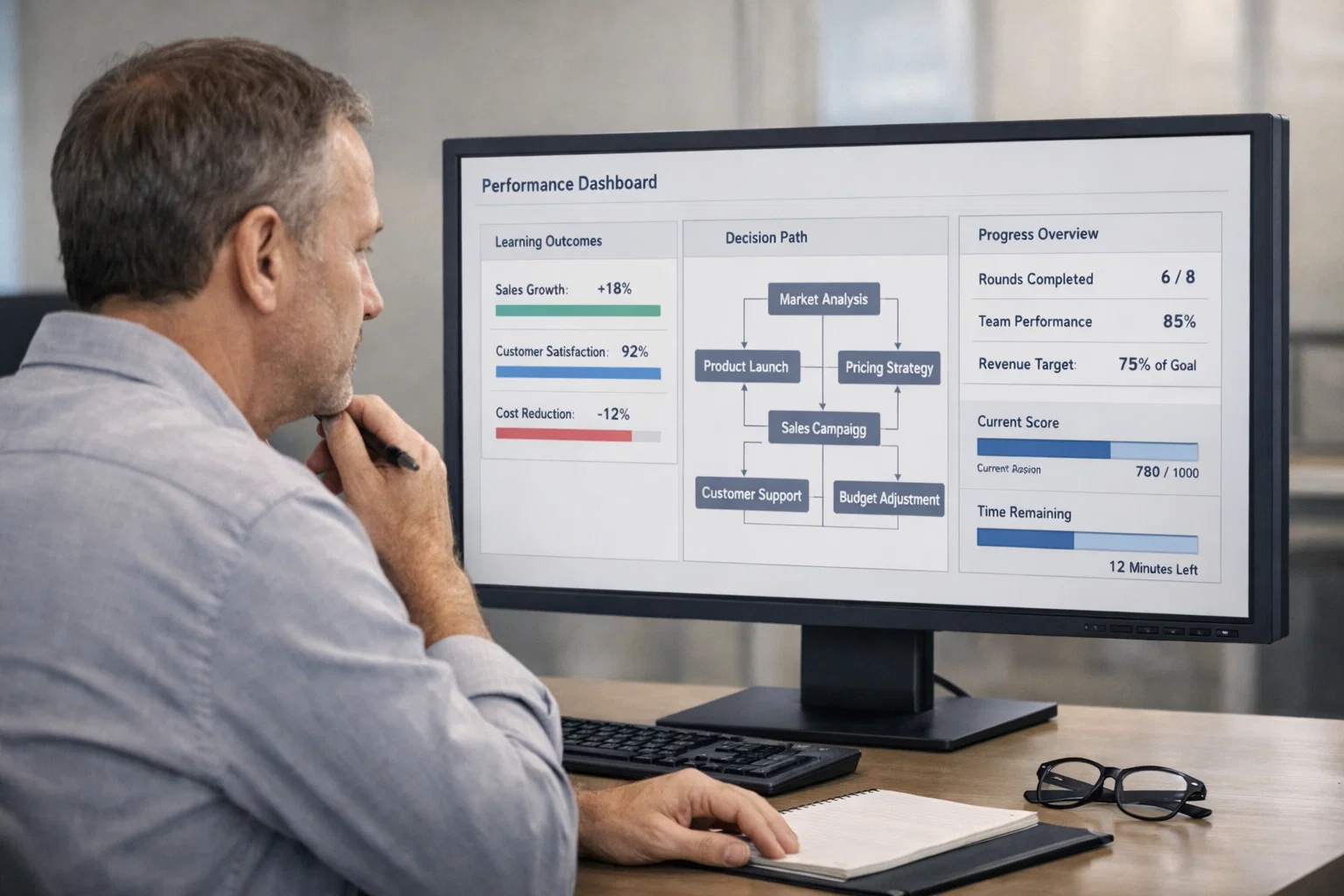
Look for Evidence, Not Assumptions
Many demos rely on implied value. However, implication is not proof. A strong virtual business simulation makes learning evidence visible. You should see performance indicators, progress markers, or outcome summaries that reflect student decisions. As a result, learning stops being abstract.
During a demo, ask this question: “What evidence would I use to assess students after this activity?” If the answer is unclear, the simulation fails this criterion.
Check Whether Outcomes Connect to Teaching Goals
Outcomes must align with real teaching objectives. Otherwise, results feel disconnected. Effective simulations link actions to outcomes that matter in class. These may include strategic thinking, prioritisation, or understanding trade-offs. Because of this alignment, instructors can justify using the tool inside existing courses.
This alignment is especially important when evaluating business simulation software for education, where institutions expect learning outcomes to support curriculum and accreditation needs. Platforms designed for education, such as business simulation software for education, make this connection clearer during demos.
Confirm That Assessment Feels Practical
Assessment should feel manageable. If it feels complex, adoption slows. In a strong demo, you should see how instructors can assess students without extra systems. Rubrics should map directly to decisions and outcomes.
Record the work an instructor would need to do before, during, and after the activity. A clear assessment workflow may help organize grading, but a demo does not establish time savings. Confirm the tools and manual steps required for your course.
Evaluate Whether Results Scale Beyond One Class
Finally, consider scale. A simulation should produce consistent evidence across groups and sessions. If outcomes vary wildly without explanation, assessment becomes unreliable.
During a demo, look for signs of repeatability. Can instructors compare results across teams? Can learning trends be reviewed over time? If yes, the simulation supports program-level use. When outcomes are clear, aligned, and scalable, the demo moves from interesting to convincing.
Scalability, Control, and Adoption Signals
A strong demo should scale beyond one classroom. Therefore, the final rubric step focuses on adoption.
Check Whether the Simulation Scales Across Courses
Some tools work well in isolation. However, many fail when scaled. A reliable virtual business simulation should support multiple sections, cohorts, and instructors. As a result, learning remains consistent across a program.
During a demo, look for signs of repeatability. Can scenarios be reused? Can instructors compare results across groups? If the answer is yes, the simulation supports broader adoption. This matters in business simulation training, where programs often run the same activities across semesters.
Look for Instructor Control, Not Complexity
Control matters more than features. At the same time, complexity slows adoption. Effective simulations give instructors clear control over pacing, difficulty, and outcomes. They do not require constant configuration. Instead, they support teaching goals without technical friction.
When control feels intuitive, faculty confidence increases. Consequently, adoption becomes easier. This balance is essential for hands on learning, where instructors need flexibility without overload.
Evaluate Time-to-Value
Adoption depends on speed. If instructors need weeks to understand a tool, momentum disappears. However, when value appears quickly, commitment follows.
A good demo shows how students engage within minutes. It also shows how instructors assess learning without extra setup. As a result, the simulation earns trust early. During evaluation, ask one question: “How soon would this deliver value in my course?” If the answer is unclear, adoption risk remains high.
Confirm Long-Term Fit
Finally, consider longevity. A simulation should support evolving teaching needs. It should adapt to different learning goals. It should also remain relevant as curricula change. When scalability, control, and time-to-value align, the simulation passes the final rubric test. At this point, the demo no longer feels like a pitch. It feels like a solution.

Conclusion: Turning a 15-Minute Demo Into Confident Decisions
Most simulation demos show potential. Very few prove results. This rubric changes that dynamic. By focusing on learning signals, outcomes, scalability, and control, educators can evaluate virtual business simulation tools with confidence. Instead of guessing, they observe. Instead of reacting, they decide.
Importantly, this approach respects time. A 15-minute demo can help instructors identify a promising workflow and the questions a classroom pilot should test. This matters because adoption carries responsibility. When tools enter a curriculum, they shape how students think, decide, and learn. Strong demos make that responsibility easier to manage.
Startup Wars aligns with this evaluation mindset by centering simulations around decisions, consequences, and measurable outcomes. As a result, educators can move from roadmaps to results without unnecessary complexity.
If you want to see how a structured demo reveals real learning fast, the next step is simple. Schedule a Free Demo and apply this rubric in real time to see whether the simulation delivers the results your program needs.
📅 Schedule a Free Demo and see how Startup Wars can help you lead beyond the classroom today.
Frequently Asked Questions
What is a virtual business simulation in education?
A virtual business simulation is a learning environment where students make decisions in realistic business scenarios. As a result, they practise strategy, judgment, and problem-solving instead of memorising concepts.
Why should educators evaluate simulations during short demos?
Short demos save time and reduce decision fatigue. Therefore, a clear rubric helps educators focus on learning signals, outcomes, and usability within minutes rather than relying on impressions.
What should a 15-minute simulation demo prove?
A demo should show a decision, its consequence, and the evidence available for assessment. It should also make setup and any additional tools or manual work clear.
How does a rubric improve simulation evaluation?
A rubric adds structure and clarity. Instead of comparing features, educators evaluate learning impact. Consequently, adoption decisions feel more confident and defensible.
Can virtual business simulations support hands on learning?
Yes. When designed well, simulations require students to act, reflect, and adapt. Because of this, hands on learning becomes central to the experience rather than optional.
Are virtual business simulations suitable for large programs?
They can be. However, scalability depends on design. Strong simulations support multiple cohorts, consistent outcomes, and instructor control across courses.
How do simulations support assessing student learning outcomes?
Simulations make reasoning visible through decisions and results. As a result, instructors can assess learning outcomes based on process and performance, not just final answers.
What makes a simulation demo worth continuing after evaluation?
A demo is worth continuing when it shows clear learning value, fits class time, and supports assessment. Ultimately, confidence comes from evidence, not presentation.
A usable scorecard for your business simulation demo
This business simulation evaluation scorecard from Startup Wars turns the guide into a record you can take to a curriculum meeting. It is a suggested evaluation aid, not a validated research instrument. Fifteen minutes is a demo agenda, not a claim about student completion time or proof of improved learning.
| Suggested time | Evidence to request | Record before deciding |
|---|---|---|
| Minutes 0–4 | One learner decision, its constraints, and the available information | Decision observed; course objective it could support |
| Minutes 4–8 | The result, feedback, and opportunity to revise | What changed; what a student would need to explain |
| Minutes 8–12 | The actual instructor view and a sample assessment workflow | Evidence available in the product; any manual work required |
| Minutes 12–15 | Access, support, accessibility, and purchasing answers | Unanswered question; owner; next verification step |
Mark each criterion observed, follow-up needed, or not suitable for this course. An unresolved essential requirement should trigger follow-up before a pilot. Avoid adding the labels into a numerical learning-effectiveness score.
For a concrete prompt, ask to preview inventory and demand decisions in the Food Truck series. The catalog's illustrative decision worksheet can help frame your questions, but it is separate from the software. Record the actual product feedback you see; do not substitute the worksheet for a product demonstration.
What can a short demo establish?
A demo can show a workflow and reveal questions to test. It cannot establish retention gains, saved grading time, or outcomes across a whole program. Review published Startup Wars evidence and its limits, then define a pilot assignment and assessment method for your learners.
What should happen after the demo?
Keep the scorecard with your notes. Resolve essential gaps, confirm the proposed license, and plan a small evaluation appropriate to your institution. Use the high-school implementation guide or college course guide to connect the evaluation to a teaching plan.
About the author
Andrea Martinez
Startup Wars marketing and content contributor
Andrea writes about entrepreneurship education, experiential learning, and the programs and product ideas shaping Startup Wars.